Belaire, San Angelo
Updated · 3,135 residents
Belaire is a quiet, residential community in San Angelo defined by its suburban layout and proximity to Goodfellow Air Force Base. While the area offers a peaceful acoustic environment, it is primarily car-dependent with limited local amenities within walking distance.
Key Highlights
About Belaire
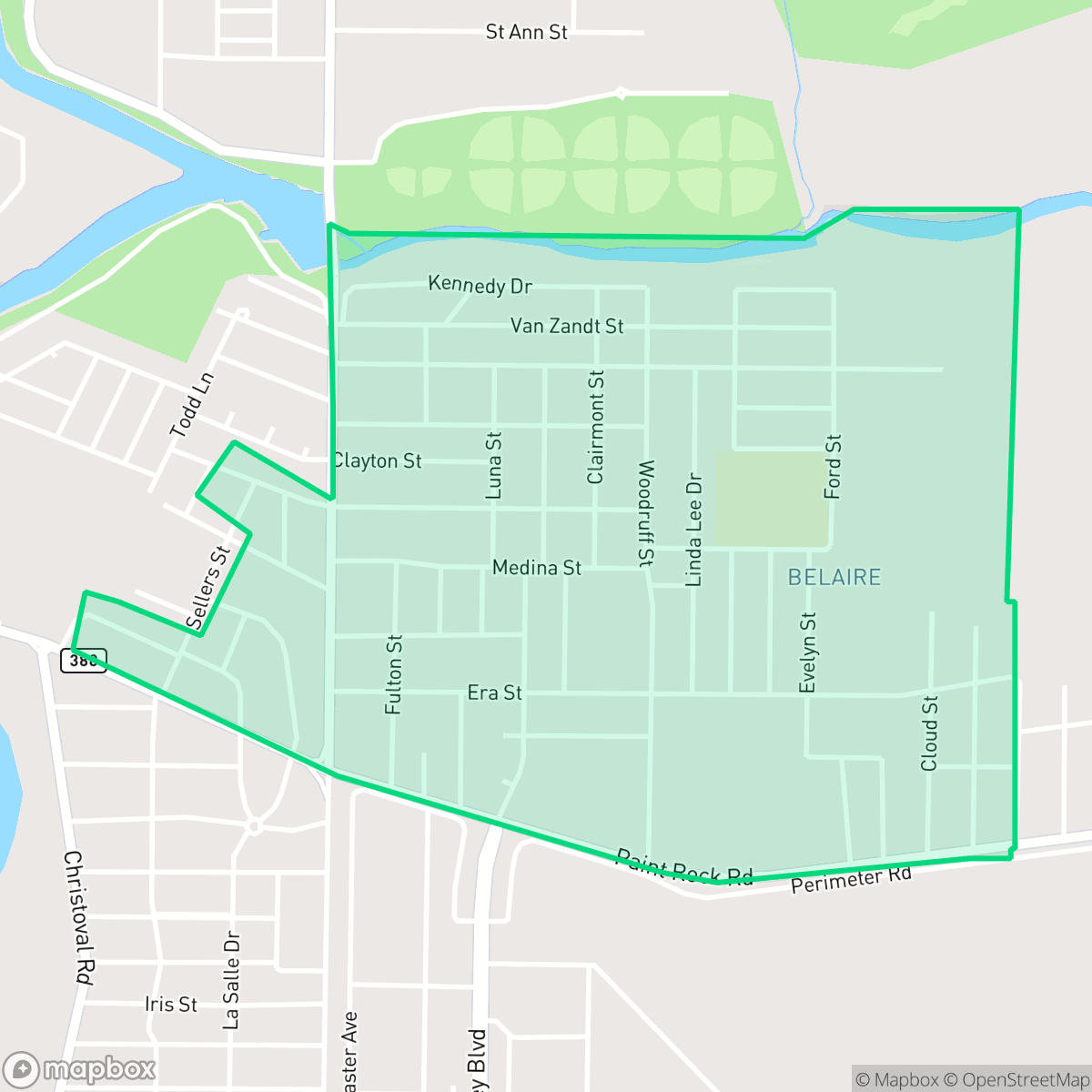
Bounded by Paint Rock Road, Loop 306, the Concho River, and Bell Street, the Belaire neighborhood in San Angelo, Texas, is a quiet, family-oriented residential community with a unique educational legacy. The neighborhood’s defining historical landmark is Belaire Elementary School, constructed in 1955. Designed by Donald R. Goss and the renowned architecture firm Caudill Rowlett Scott, the school featured an innovative decagonal, circular structure. It earned national acclaim as the first completely air-conditioned public elementary school in the United States, a design choice necessitated by West Texas's warm, dusty climate and its proximity to the noise of nearby Goodfellow Air Force Base. Today, the neighborhood maintains its tight-knit character and close partnership with the air force base.
The neighborhood serves as a steady, suburban enclave characterized by its residential streets and proximity to local landmarks like St. Margaret's Church and Belmore Baptist Church. According to iHuus data, the area maintains a relatively quiet acoustic environment, which appeals to residents seeking a reprieve from urban noise. The layout is largely defined by its car-oriented infrastructure, as few commercial businesses or social hubs are accessible by foot. The community provides a consistent rhythm of life for those who value a low-key, residential atmosphere over high-density urban activity.
Prospective residents should note that the area faces specific challenges regarding flood safety and air quality, which are important considerations for long-term planning. While the local elementary school provides a central community point, those prioritizing high-performing educational options or extensive walkability may find the neighborhood's limitations significant. The area is best suited for individuals or families who prioritize a stable, suburban atmosphere and maintain consistent access to personal transportation.
Neighborhood Scores Across 15 Qualities
Residential spacing offers a balanced level of seclusion with some buffer between neighbors. This density is consistent with the average found throughout San Angelo, according to iHuus data.
Low traffic and calm streets provide a pleasant environment for walking, even though the lack of sidewalks makes the area slightly less walkable than the San Angelo average.
Standard tract housing with modest yards and uniform rooflines defines the area. This visual character is slightly below the San Angelo average according to iHuus data.
Access to public parks and wide green verges makes this area slightly more accommodating for dog owners than the San Angelo average, according to iHuus data.
Open land and agricultural areas are common here, providing a landscape that is slightly less dense than the San Angelo average. Low-density residential layouts often sit near undeveloped riverfront and woodland according to iHuus data.
Low-density streets and light industrial areas create a tranquil atmosphere, but the lack of concentrated social hubs makes most activities reliant on a vehicle. According to iHuus data, this neighborhood offers less activity and fewer walkable amenities than the San Angelo average.
Steady noise from nearby busy streets is present, though levels remain more tranquil than the typical experience found across San Angelo. According to iHuus data, residents may encounter a consistent hum of local traffic during peak hours.
Residential life remains largely uninterrupted by heavy industry, though a wastewater treatment plant and electrical substation are located within the area. This level of industrial proximity is very similar to the average found throughout San Angelo.
Health insurance access is slightly below the San Angelo average. According to iHuus data, fewer residents in this area possess active health coverage compared to the rest of the city.
Conservative values represent the majority of the community, though a modest opposing presence exists. This political leaning is notably more conservative than the San Angelo average, according to iHuus data.
Residents live alongside a diverse mix of young adults, families, and seniors. This demographic spread is slightly lower than the San Angelo average, according to iHuus data.
Flood risk is significant in this area due to its location within a designated floodplain. According to iHuus data, this level of vulnerability is higher than the San Angelo city average and may necessitate flood insurance.
Address-Level Insights for Belaire


iHuus Neighborhood Intelligence Insights
Get address-level neighborhood insights for Belaire
- Street-level scores — see how individual blocks compare, not just neighborhood averages
- Micro-zone boundaries — identify quiet pockets, flood boundaries, and walkable clusters before you visit
- 15 dimensions in full — walkability, noise, air quality, school quality, insurance coverage, population age profile, urban/rural index, and more
- Boundary risk alerts — know if your address sits near a block boundary where scores drop, the kind of detail no listing will ever mention
- School insights — individual school ratings and insights, not just district-level data
- Compare before you commit — side-by-side data across neighborhoods, down to block precision
No credit card required
Compare with Any Neighborhood
| Dimension | Belaire | Angelo Heights |
|---|---|---|
| 🚶 Walkabilityavg 5.86 | ||
| 🔊 Acoustic Comfortavg 4.52 | ||
| 🤫 Privacy Indexavg 6.06 | ||
| 🎨 Visual Appealavg 5.61 | ||
| 🐕 Dog Friendlinessavg 5.82 | ||
| 🗺️ Urban-Rural Indexavg 7.3 | ||
| ✨ Neighborhood Vibeavg 4.15 | ||
| 🏥 Health Insurance Coverageavg 6.22 | ||
| 🌿 Air Quality | ||
| 🏭 Industrial Proximityavg 8.42 | ||
| 🌊 Flood Safetyavg 3.02 | ||
| 🗳️ Ideological Leanavg 1.23 | ||
| 👥 Population Age Profileavg 4.73 | ||
| 🔥 Fire Safety | ||
| 🏫 School Quality |
Belaire Rankings
School Districts Serving Belaire
School Insights for Belaire
Below average outcomes; significant attendance and academic challenges.
School Insights
See what's really behind every school rating near Belaire
- Individual school ratings — each school's own score with outcome context, not just a district average
- Enrollment & class size data — student-to-teacher ratio and how it compares to the state average
- Full demographics breakdown — ethnicity and gender composition for every school in the enrollment zone
- Every school in the district — all schools within the enrollment boundary ranked by rating, not just the closest one
- Grade levels & benchmarks — elementary through high school, with below/above state-average flags
No credit card required