ASU-College Hills, San Angelo
Updated · 7,297 residents
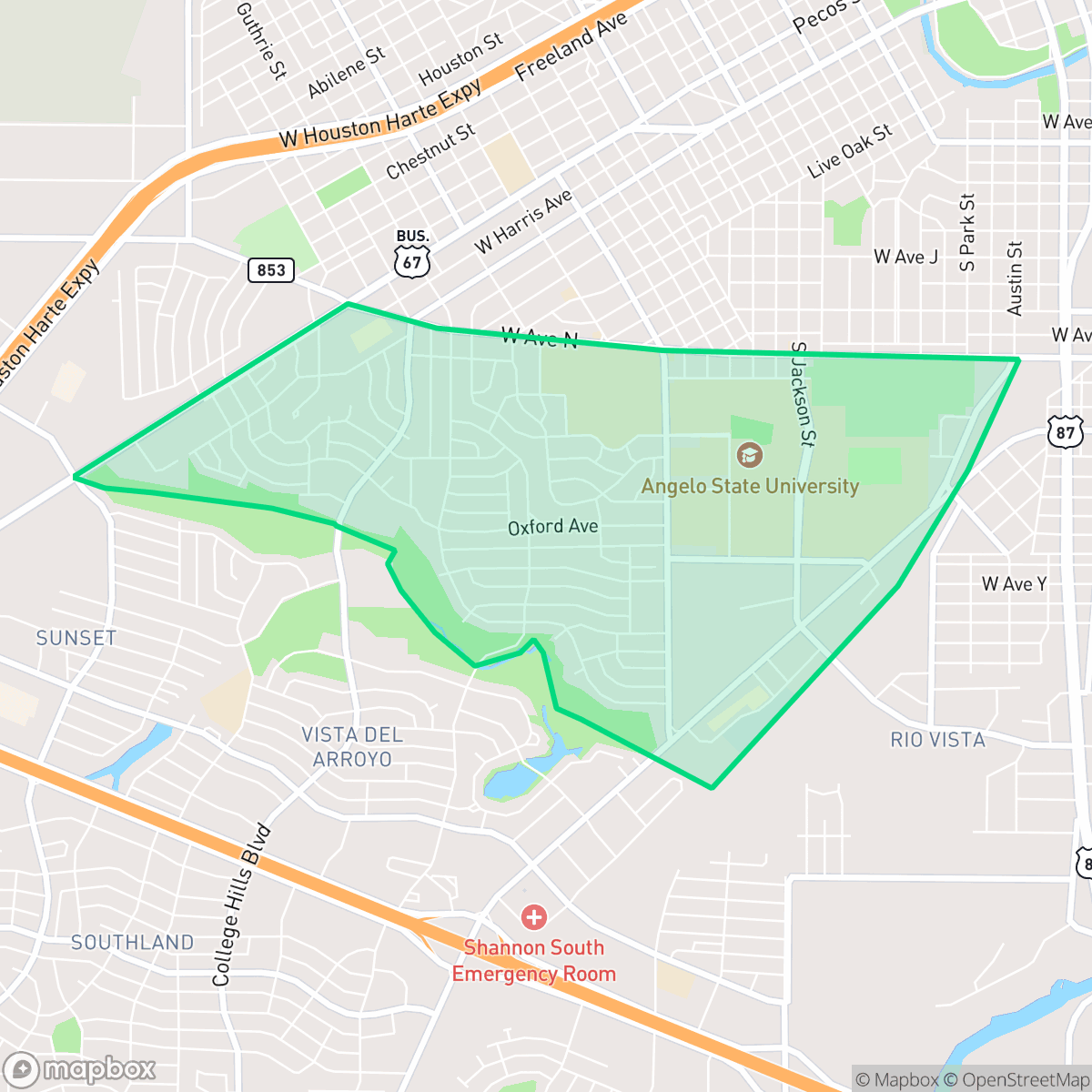
Centered around Angelo State University, this neighborhood features a classic collection of mid-century ranch homes and abundant green spaces. While it offers a quiet suburban atmosphere with various local dining options, residents primarily rely on vehicles for daily errands and commuting.
Key Highlights
About ASU-College Hills
Anchored by Angelo State University (ASU), the ASU-College Hills neighborhood in San Angelo, Texas, developed in tandem with the university's post-World War II expansion. Originally founded downtown in 1928 as San Angelo College, the institution relocated to its current West Avenue N campus in 1947 after local citizens raised $300,000 to fund the transition. This move catalyzed the surrounding residential development of College Hills, which grew rapidly between 1940 and 1969. The neighborhood is characterized by its classic mid-century ranch-style homes, central public parks, and a distinct college-town identity. Today, it remains a vibrant hub heavily shaped by its student population and military families connected to nearby Goodfellow Air Force Base.
The area serves as a primary residential hub for students, faculty, and military families associated with the nearby Goodfellow Air Force Base. Residents benefit from a blend of quiet, low-density streets and local amenities, including popular spots like The Penny Tap House and Ichiban Japanese Steak House. The landscape is defined by its mix of residential blocks and accessible green spaces, providing a stable environment that balances proximity to the university with a traditional suburban feel. According to iHuus data, the neighborhood maintains a moderate level of acoustic comfort, though road traffic remains the primary source of ambient noise.
Prospective residents should note that the neighborhood is car-dependent, as most daily needs and services are not within comfortable walking distance. Families with school-aged children should consider that the local San Angelo Independent School District is currently navigating structural budget challenges and consolidation efforts, which may impact future campus operations. Despite these factors, the area remains a popular choice for those seeking a established, quiet community with strong ties to local educational and military institutions.
Neighborhood Scores Across 15 Qualities
Residential spacing is varied, offering some buffer between neighbors. According to iHuus data, this level of privacy is roughly in line with the San Angelo average.
Pedestrian access is supported by sidewalks on one side of the street and safe crossings. According to iHuus data, walkability in this area is slightly above the San Angelo average.
Standard tract housing characterizes the area, featuring tidy but small yards and uniform rooflines. This level of visual interest is slightly above the San Angelo average according to iHuus data.
Accessible green spaces and wide paths offer good opportunities for pet owners. According to iHuus data, this area is more favorable for dog walking than the San Angelo average.
Frequent open land and scattered homes provide a more rural atmosphere than the San Angelo average. According to iHuus data, the area features a mix of low-density sprawl including commercial strips and light industrial sectors.
A moderate level of activity exists throughout the area, featuring a mix of quiet residential streets and scattered dining options. While the neighborhood offers slightly more social variety than the San Angelo average, most essential services and restaurants require a car to access.
Steady sounds from nearby busy streets create a consistent ambient hum. According to iHuus data, acoustic levels here are slightly higher than the San Angelo average.
Residential life here is largely undisturbed by heavy industry, offering a cleaner environment than the San Angelo average. According to iHuus data, the area consists primarily of quiet streets and light commercial zones with no significant industrial hazards.
Health insurance access is more prevalent here than in the rest of San Angelo, according to iHuus data. Residents benefit from a higher rate of coverage compared to the city average.
Conservative voting patterns and census indicators are very strong here, appearing slightly more pronounced than the San Angelo city average according to iHuus data.
Residents experience a balanced demographic spread of young adults, families, and older individuals. This age distribution is consistent with the average found across San Angelo.
Flood risk in this area is higher than the San Angelo average; however, official FEMA studies for this specific neighborhood are currently incomplete. According to iHuus data, the lack of detailed mapping means residents should remain cautious regarding potential inundation during extreme weather events.
Address-Level Insights for ASU-College Hills


iHuus Neighborhood Intelligence Insights
Get address-level neighborhood insights for ASU-College Hills
- Street-level scores — see how individual blocks compare, not just neighborhood averages
- Micro-zone boundaries — identify quiet pockets, flood boundaries, and walkable clusters before you visit
- 15 dimensions in full — walkability, noise, air quality, school quality, insurance coverage, population age profile, urban/rural index, and more
- Boundary risk alerts — know if your address sits near a block boundary where scores drop, the kind of detail no listing will ever mention
- School insights — individual school ratings and insights, not just district-level data
- Compare before you commit — side-by-side data across neighborhoods, down to block precision
No credit card required
Compare with Any Neighborhood
| Dimension | ASU-College Hills | Angelo Heights |
|---|---|---|
| 🚶 Walkabilityavg 5.86 | ||
| 🔊 Acoustic Comfortavg 4.52 | ||
| 🤫 Privacy Indexavg 6.06 | ||
| 🎨 Visual Appealavg 5.61 | ||
| 🐕 Dog Friendlinessavg 5.82 | ||
| 🗺️ Urban-Rural Indexavg 7.3 | ||
| ✨ Neighborhood Vibeavg 4.15 | ||
| 🏥 Health Insurance Coverageavg 6.22 | ||
| 🌿 Air Quality | ||
| 🏭 Industrial Proximityavg 8.42 | ||
| 🌊 Flood Safetyavg 3.02 | ||
| 🗳️ Ideological Leanavg 1.23 | ||
| 👥 Population Age Profileavg 4.73 | ||
| 🔥 Fire Safety | ||
| 🏫 School Quality |
ASU-College Hills Rankings
School Districts Serving ASU-College Hills
School Insights for ASU-College Hills
Below average outcomes; significant attendance and academic challenges.
School Insights
See what's really behind every school rating near ASU-College Hills
- Individual school ratings — each school's own score with outcome context, not just a district average
- Enrollment & class size data — student-to-teacher ratio and how it compares to the state average
- Full demographics breakdown — ethnicity and gender composition for every school in the enrollment zone
- Every school in the district — all schools within the enrollment boundary ranked by rating, not just the closest one
- Grade levels & benchmarks — elementary through high school, with below/above state-average flags
No credit card required