Tech Terrace, Lubbock
Updated · 5,270 residents
Tech Terrace is a highly walkable community adjacent to Texas Tech University that features a mix of local cafes and quiet residential streets. While the area offers excellent health insurance coverage and proximity to academic amenities, residents should note the elevated road traffic noise and low flood safety ratings.
Key Highlights
About Tech Terrace
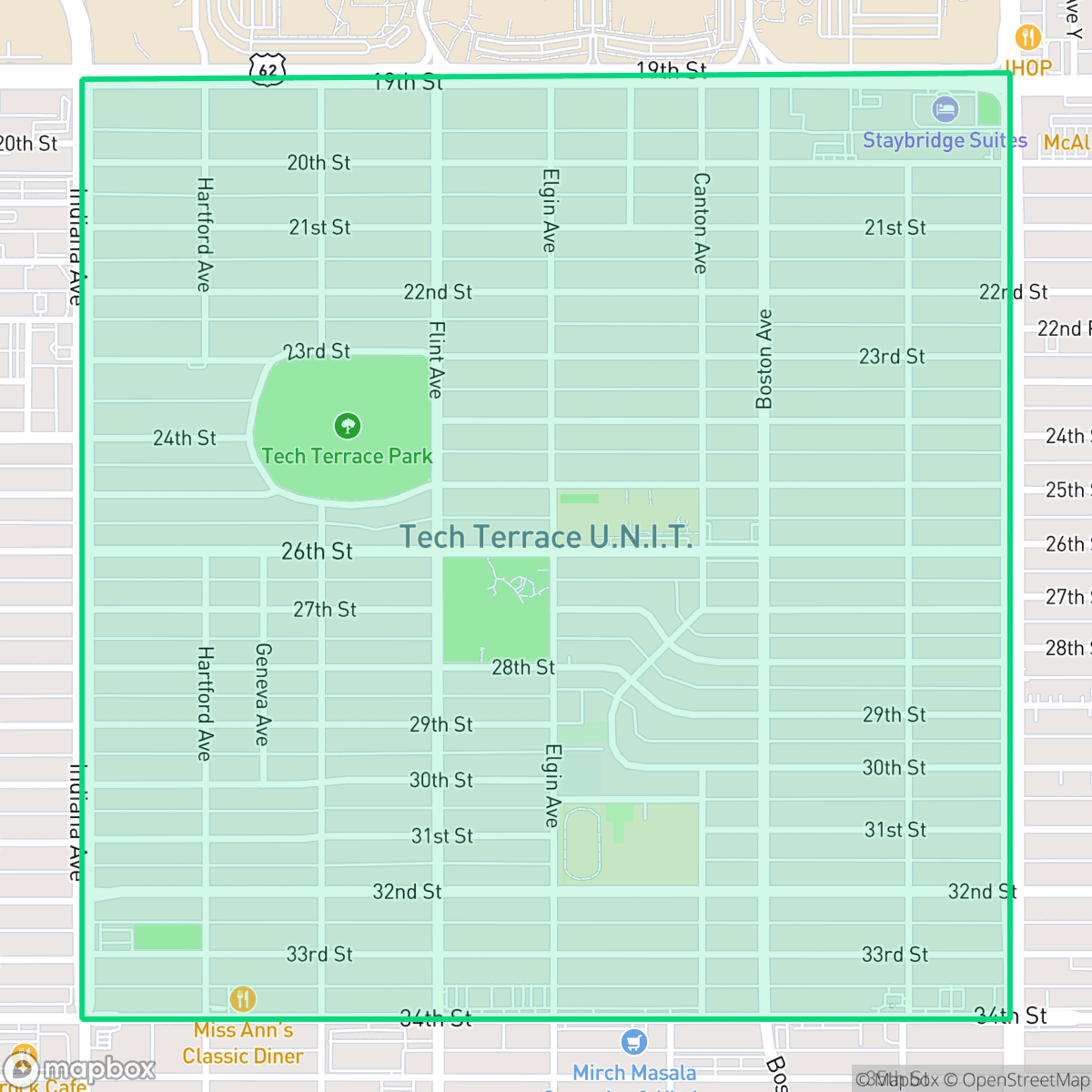
Established in 1925 as Lubbock’s first planned suburb, Tech Terrace (also known as Tech Terrace U.N.I.T.) was developed just south of Texas Tech University to house professors and university staff. The neighborhood features tree-lined streets, charming historic bungalows dating back to the 1930s, and local landmarks like Tech Terrace Park and Wagner Park. Its acronym, U.N.I.T., represents its bounding streets: University, Nineteenth, Indiana, and Thirty-fourth. In 1974, residents formed Lubbock’s first voluntary neighborhood association to successfully block multi-family rezoning and preserve the area's single-family character. Historically home to notable figures like music legend Buddy Holly, Tech Terrace remains a highly walkable, academic-centric community defined by its unique local character and the historic Tech Terrace Shopping Center.
The neighborhood functions as a central hub for those seeking a pedestrian-friendly lifestyle in Lubbock. Residents benefit from a variety of local dining options and coffee shops integrated into the suburban landscape, creating a distinct sense of community that avoids industrial activity entirely. The area is characterized by its academic-centric atmosphere, providing high levels of health insurance coverage for its inhabitants and maintaining a consistent, quiet residential feel across its blocks. It remains a preferred location for those who prioritize proximity to university resources and local green spaces like Wagner Park over modern commercial developments.
Prospective residents should weigh the benefits of high walkability against specific environmental and infrastructure considerations. The area records an average noise level of 60 decibels due to road traffic, which may impact acoustic comfort in certain zones. Additionally, the neighborhood faces challenges regarding flood safety and is served by the Lubbock Independent School District, which is currently navigating a period of operational transition and fiscal restructuring. Despite these factors, the area remains a stable choice for those looking for an established, walkable community with strong educational access through nearby schools like Hutchinson Middle and Wilson Elementary.
Neighborhood Scores Across 15 Qualities
Building density varies between dense dormitories and single-family homes with standard yard setbacks. According to iHuus data, this level of separation between neighbors is slightly higher than the Lubbock average.
Pedestrian paths and sidewalks are extensive throughout the residential streets and campus areas, offering much better connectivity than the Lubbock average. Low traffic volumes and safe crossing points make navigating the neighborhood on foot reliable and easy.
Standard tract housing and university-style architecture define the area, offering a clean but simple landscape that is slightly more visually varied than the Lubbock average. Most lots feature tidy yards and boxy rooflines without significant luxury or estate features.
Access to large central parks and expansive university greens provides more space for pet exercise than the typical Lubbock neighborhood. While some residential streets feature narrower parkways, the presence of connected trails and wide grassy verges makes the area highly suitable for dog owners.
A mix of residential grids and institutional footprints creates a setting that is slightly less open than the Lubbock average. Residents will find a blend of medium-density housing and larger campus structures interspersed with urban blocks.
Diverse dining options and local social spots create a more active atmosphere than the Lubbock average. While some areas feature walkable access to amenities, other parts of the neighborhood remain quieter with more residential-focused surroundings.
Audible disturbances from nearby railroad tracks and major roadways are common in this area. According to iHuus data, acoustic levels are slightly higher than the Lubbock average.
Industrial activity and warehouses are nonexistent here, making the area notably more residential and free of heavy industrial hazards than the Lubbock average.
Health insurance coverage among residents is slightly above the Lubbock average, according to iHuus data.
Political leanings in this area lean conservative, though there is a modest presence of opposing views. According to iHuus data, the neighborhood's ideological tilt is more conservative than the Lubbock average.
A high concentration of young adults characterizes this area, making it notably younger than the Lubbock average. According to iHuus data, the resident population lacks a significant presence of older adults or large families.
Flood vulnerability is significantly higher in this area than the Lubbock average, according to iHuus data. Residents should be aware of increased drainage challenges during heavy rain events.
Address-Level Insights for Tech Terrace


iHuus Neighborhood Intelligence Insights
Get address-level neighborhood insights for Tech Terrace
- Street-level scores — see how individual blocks compare, not just neighborhood averages
- Micro-zone boundaries — identify quiet pockets, flood boundaries, and walkable clusters before you visit
- 15 dimensions in full — walkability, noise, air quality, school quality, insurance coverage, population age profile, urban/rural index, and more
- Boundary risk alerts — know if your address sits near a block boundary where scores drop, the kind of detail no listing will ever mention
- School insights — individual school ratings and insights, not just district-level data
- Compare before you commit — side-by-side data across neighborhoods, down to block precision
No credit card required
Compare with Any Neighborhood
| Dimension | Tech Terrace | Arnett Benson |
|---|---|---|
| 🚶 Walkabilityavg 6.67 | ||
| 🔊 Acoustic Comfortavg 3.09 | ||
| 🤫 Privacy Indexavg 5.75 | ||
| 🎨 Visual Appealavg 5.7 | ||
| 🐕 Dog Friendlinessavg 5.29 | ||
| 🗺️ Urban-Rural Indexavg 6.86 | ||
| ✨ Neighborhood Vibeavg 4.81 | ||
| 🏥 Health Insurance Coverageavg 6.7 | ||
| 🌿 Air Quality | ||
| 🏭 Industrial Proximityavg 8.52 | ||
| 🌊 Flood Safetyavg 1.79 | ||
| 🗳️ Ideological Leanavg 2.17 | ||
| 👥 Population Age Profileavg 4.52 | ||
| 🔥 Fire Safety | ||
| 🏫 School Quality |
Tech Terrace Rankings
School Districts Serving Tech Terrace
School Insights for Tech Terrace
Below average outcomes; significant attendance and academic challenges.
School Insights
See what's really behind every school rating near Tech Terrace
- Individual school ratings — each school's own score with outcome context, not just a district average
- Enrollment & class size data — student-to-teacher ratio and how it compares to the state average
- Full demographics breakdown — ethnicity and gender composition for every school in the enrollment zone
- Every school in the district — all schools within the enrollment boundary ranked by rating, not just the closest one
- Grade levels & benchmarks — elementary through high school, with below/above state-average flags
No credit card required