South Overton, Lubbock
Updated · 2,586 residents
South Overton is an exceptionally walkable neighborhood that offers a vibrant atmosphere near Texas Tech University. Residents enjoy convenient access to local coffee shops and eateries, though the area experiences moderate noise levels due to road traffic.
Key Highlights
About South Overton
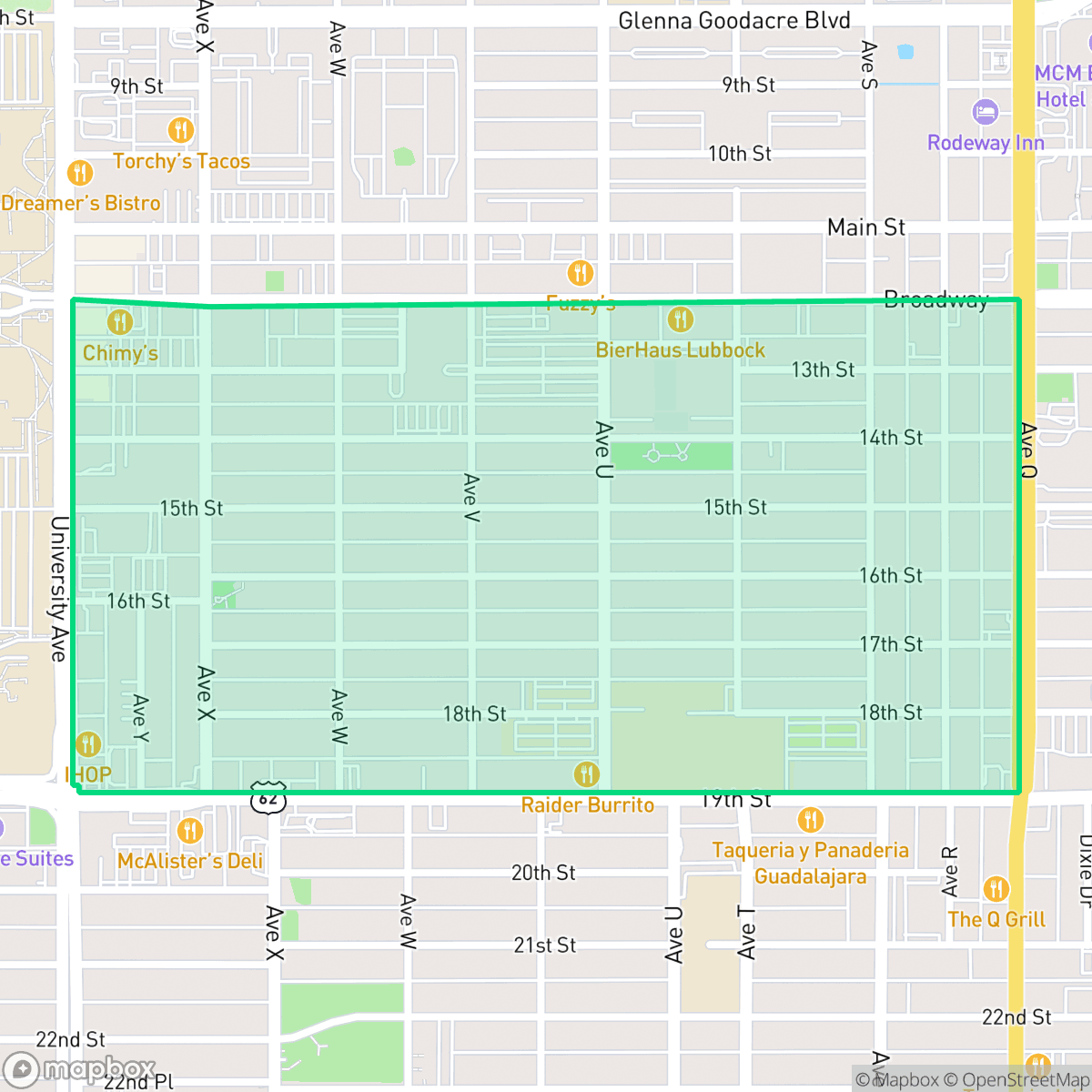
Established in 1907, South Overton is Lubbock’s oldest residential neighborhood. Originally part of the broader Overton addition, the area evolved by the late 1930s into a middle-class enclave for local business owners and Texas Tech University professors. In the 1960s, South Overton officially separated from North Overton. While its northern counterpart underwent dramatic urban renewal, South Overton preserved its historic single-family housing stock. Bounded by Broadway, Avenue Q, 19th Street, and University Avenue, the neighborhood is characterized by its historic brick streets and diverse architectural styles, including Craftsman Bungalow, Tudor Revival, and Colonial Revival. Listed on the National Register of Historic Places in 1996, the South Overton Residential Historic District features local landmarks like M.C. Overton Park and remains a preserved historic pocket adjacent to the university.
The neighborhood serves as a highly accessible hub for those connected to the university, characterized by its grid layout and high pedestrian connectivity. It maintains a lively environment with a variety of local dining and social venues, including popular coffee spots and casual restaurants along its borders. The area functions as a dense urban-suburban hybrid, providing a unique blend of quiet residential streets and active commercial corridors that benefit from consistent infrastructure and well-maintained public spaces.
Prospective residents should note that the area experiences moderate noise levels from road traffic, which is a trade-off for its central location. While the neighborhood offers excellent walkability and freedom from industrial hazards, housing density provides standard levels of privacy. It is well-suited for students and faculty members who prioritize proximity to campus and a walkable lifestyle over absolute quiet or expansive private outdoor spaces.
Neighborhood Scores Across 15 Qualities
Residential spacing varies from densely packed structures to detached single-family homes with moderate separation. This level of density is roughly comparable to the Lubbock average, according to iHuus data.
Extensive sidewalk networks and clearly marked crosswalks make navigating the area on foot very easy. According to iHuus data, the pedestrian infrastructure in South Overton is significantly more developed than the average for Lubbock.
Modest housing and uniform rooflines characterize the area, presenting a visual profile that is roughly in line with the Lubbock average. Streetscapes consist mainly of dense residential blocks and university housing with limited luxury landscape features.
Abundant green spaces, connected sidewalks, and a large central park with tennis courts offer superior walking opportunities for pets compared to the Lubbock average. Large university grounds and wide grassy verges provide additional safe areas for exercise.
A blend of multi-family housing and commercial structures defines this area, providing a slightly more urban feel than the typical Lubbock landscape. According to iHuus data, the neighborhood features a mix of dense residential blocks and institutional footprints that is slightly less open than the city average.
Local dining and social spots are concentrated throughout the area, making this neighborhood significantly more active than the Lubbock average. According to iHuus data, the presence of diverse eateries and coffee shops creates a consistent level of energy across many residential blocks.
Frequent noise from nearby transit corridors and rail lines characterizes the area. This level of acoustic disturbance is slightly higher than the Lubbock average, according to iHuus data.
Residential life here is free from warehouses, heavy industrial facilities, or visible environmental hazards. According to iHuus data, this neighborhood maintains a much cleaner profile regarding industrial proximity than the Lubbock average.
Health insurance accessibility is slightly below the Lubbock city average, according to iHuus data. Residents may find fewer options for employer-sponsored or private coverage compared to other parts of the city.
Political leanings in this area are more balanced than the city average, featuring a mix of conservative and liberal perspectives. According to iHuus data, no single political ideology dominates the neighborhood.
Young adults make up the majority of the population here, resulting in a demographic profile that is notably younger than the Lubbock city average.
Property within a designated 100-year floodplain carries a notable risk of inundation; according to iHuus data, this level of flood vulnerability is higher than the Lubbock city average.
Address-Level Insights for South Overton


iHuus Neighborhood Intelligence Insights
Get address-level neighborhood insights for South Overton
- Street-level scores — see how individual blocks compare, not just neighborhood averages
- Micro-zone boundaries — identify quiet pockets, flood boundaries, and walkable clusters before you visit
- 15 dimensions in full — walkability, noise, air quality, school quality, insurance coverage, population age profile, urban/rural index, and more
- Boundary risk alerts — know if your address sits near a block boundary where scores drop, the kind of detail no listing will ever mention
- School insights — individual school ratings and insights, not just district-level data
- Compare before you commit — side-by-side data across neighborhoods, down to block precision
No credit card required
Compare with Any Neighborhood
| Dimension | South Overton | Arnett Benson |
|---|---|---|
| 🚶 Walkabilityavg 6.67 | ||
| 🔊 Acoustic Comfortavg 3.09 | ||
| 🤫 Privacy Indexavg 5.75 | ||
| 🎨 Visual Appealavg 5.7 | ||
| 🐕 Dog Friendlinessavg 5.29 | ||
| 🗺️ Urban-Rural Indexavg 6.86 | ||
| ✨ Neighborhood Vibeavg 4.81 | ||
| 🏥 Health Insurance Coverageavg 6.7 | ||
| 🌿 Air Quality | ||
| 🏭 Industrial Proximityavg 8.52 | ||
| 🌊 Flood Safetyavg 1.79 | ||
| 🗳️ Ideological Leanavg 2.17 | ||
| 👥 Population Age Profileavg 4.52 | ||
| 🔥 Fire Safety | ||
| 🏫 School Quality |
South Overton Rankings
School Districts Serving South Overton
School Insights for South Overton
Below average outcomes; significant attendance and academic challenges.
School Insights
See what's really behind every school rating near South Overton
- Individual school ratings — each school's own score with outcome context, not just a district average
- Enrollment & class size data — student-to-teacher ratio and how it compares to the state average
- Full demographics breakdown — ethnicity and gender composition for every school in the enrollment zone
- Every school in the district — all schools within the enrollment boundary ranked by rating, not just the closest one
- Grade levels & benchmarks — elementary through high school, with below/above state-average flags
No credit card required