Maedgen Area, Lubbock
Updated · 5,044 residents
The Maedgen Area offers a quiet, mid-century suburban environment characterized by tree-lined streets and established single-family homes. While the neighborhood provides a peaceful residential atmosphere, residents should anticipate moderate road traffic noise and a car-dependent lifestyle for most daily errands.
Key Highlights
About Maedgen Area
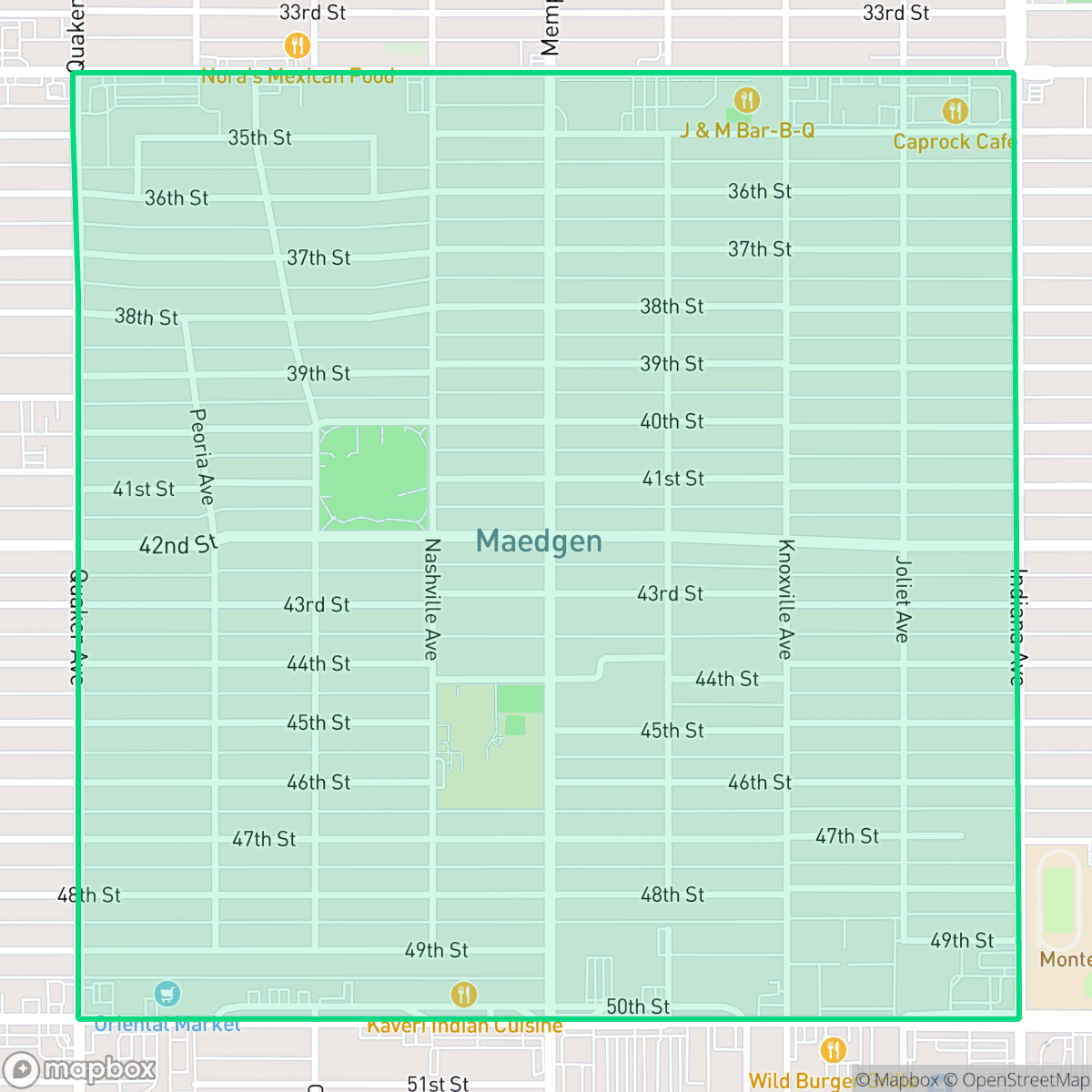
Named after Charles E. Maedgen, a prominent West Texas banker and civic leader, the Maedgen Area is a well-established, mid-century residential neighborhood in southwest Lubbock. Developed primarily between 1940 and 1969, its housing stock is dominated by classic ranch-style single-family homes situated along tree-lined streets. The community's local identity is anchored by Maedgen Elementary School, which opened in 1955, and A.B. Davis Park, which offers local green space. Positioned between major corridors like 34th Street and 50th Street, the neighborhood's proximity to Texas Tech University and the Medical District has historically made it a popular, convenient area for commuters, students, and families alike.
This community serves as a stable residential hub in southwest Lubbock, benefiting from its strategic position near the Medical District and Texas Tech University. Local amenities include a mix of dining options like Beijing House and Royal Indian Cuisine, though most daily services require a short drive. The area maintains a consistent visual appeal with its classic architecture and open green spaces, fostering a suburban environment that prioritizes privacy and quiet over high-density walkability.
Prospective residents often choose the area for its proximity to educational resources, specifically the highly-regarded Maedgen Elementary School. While the broader Lubbock Independent School District is currently navigating a period of operational transition, the neighborhood remains a practical choice for families and commuters. Those considering a move should note that while the neighborhood is largely free from industrial disruption, the average acoustic comfort is influenced by surrounding road traffic, making it a better fit for those who prefer a traditional, car-reliant suburban pace.
Neighborhood Scores Across 15 Qualities
Residential spacing is relatively average for the city, though certain areas featuring detached homes have neighbors positioned closely with minimal side-yard buffers.
Low traffic levels on residential streets make for pleasant walks, though the lack of sidewalks in certain areas makes this neighborhood slightly less walkable than the Lubbock average.
Standard tract housing features simple rooflines and small, tidy yards. This level of visual variety is consistent with the average for Lubbock.
Fenced backyards and narrow parkways are common here, though a lack of large public parks makes it slightly less dog friendly than the Lubbock average. According to iHuus data, residents may find fewer opportunities for off-leash exercise within this specific grid section.
Residential blocks feature a standard suburban layout of single-family homes and small commercial lots, providing a slightly more developed feel than the more rural parts of Lubbock. According to iHuus data, the area sits just below the city average for open land and scattered acreage.
Suburban streets and green spaces provide a serene setting, though nearby dining and services are generally not within walking distance. This area offers a slightly lower level of activity compared to the Lubbock average, according to iHuus data.
Frequent noise from nearby transit corridors and heavy traffic patterns is a notable feature of this area. According to iHuus data, acoustic comfort in this neighborhood is slightly lower than the Lubbock average.
Industrial presence is nonexistent in this area, providing a cleaner environment than the Lubbock average. According to iHuus data, the neighborhood consists entirely of residential streets and light commercial zones with no detected warehouses or heavy manufacturing facilities.
Health insurance coverage among residents is slightly above the Lubbock average, according to iHuus data. This indicates a relatively high level of access to healthcare coverage for the local population.
Conservative voters represent the vast majority of the population here, reflecting a political leaning that is more pronounced than the Lubbock city average.
Residents live alongside a balanced spread of young adults, families, and older individuals. This demographic distribution is consistent with the average found across Lubbock.
Flood risk in this area is significantly higher than the Lubbock average. Residents should prepare for elevated or potentially prohibitive flood insurance costs according to iHuus data.
Address-Level Insights for Maedgen Area


iHuus Neighborhood Intelligence Insights
Get address-level neighborhood insights for Maedgen Area
- Street-level scores — see how individual blocks compare, not just neighborhood averages
- Micro-zone boundaries — identify quiet pockets, flood boundaries, and walkable clusters before you visit
- 15 dimensions in full — walkability, noise, air quality, school quality, insurance coverage, population age profile, urban/rural index, and more
- Boundary risk alerts — know if your address sits near a block boundary where scores drop, the kind of detail no listing will ever mention
- School insights — individual school ratings and insights, not just district-level data
- Compare before you commit — side-by-side data across neighborhoods, down to block precision
No credit card required
Compare with Any Neighborhood
| Dimension | Maedgen Area | Arnett Benson |
|---|---|---|
| 🚶 Walkabilityavg 6.67 | ||
| 🔊 Acoustic Comfortavg 3.09 | ||
| 🤫 Privacy Indexavg 5.75 | ||
| 🎨 Visual Appealavg 5.7 | ||
| 🐕 Dog Friendlinessavg 5.29 | ||
| 🗺️ Urban-Rural Indexavg 6.86 | ||
| ✨ Neighborhood Vibeavg 4.81 | ||
| 🏥 Health Insurance Coverageavg 6.7 | ||
| 🌿 Air Quality | ||
| 🏭 Industrial Proximityavg 8.52 | ||
| 🌊 Flood Safetyavg 1.79 | ||
| 🗳️ Ideological Leanavg 2.17 | ||
| 👥 Population Age Profileavg 4.52 | ||
| 🔥 Fire Safety | ||
| 🏫 School Quality |
Maedgen Area Rankings
School Districts Serving Maedgen Area
School Insights for Maedgen Area
Below average outcomes; significant attendance and academic challenges.
School Insights
See what's really behind every school rating near Maedgen Area
- Individual school ratings — each school's own score with outcome context, not just a district average
- Enrollment & class size data — student-to-teacher ratio and how it compares to the state average
- Full demographics breakdown — ethnicity and gender composition for every school in the enrollment zone
- Every school in the district — all schools within the enrollment boundary ranked by rating, not just the closest one
- Grade levels & benchmarks — elementary through high school, with below/above state-average flags
No credit card required