Jackson-Mahon, Lubbock
Updated · 3,190 residents
Jackson-Mahon is a quiet, car-dependent residential area in North Lubbock characterized by mid-century single-family homes and proximity to light industrial zones. While the neighborhood offers a suburban atmosphere with local dining favorites, residents primarily rely on vehicles for daily commuting and access to services.
Key Highlights
About Jackson-Mahon
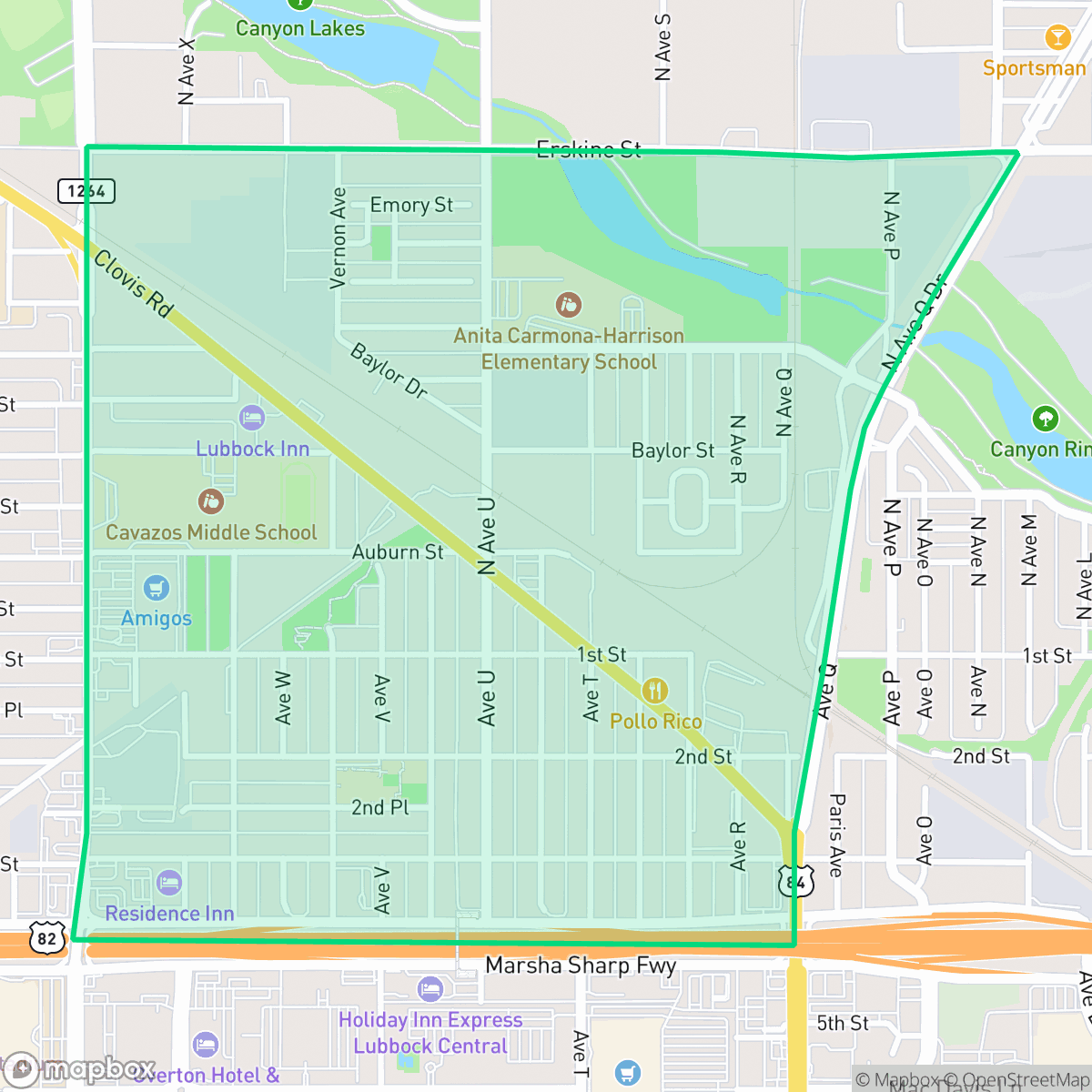
Located in North Lubbock, Texas, the majority-Hispanic Jackson-Mahon neighborhood is a historically working-class community comprised of two subareas: Jackson and Mahon. Most of the neighborhood's single-family homes were built between 1940 and 1969. Situated just north of the Marsha Sharp Freeway and Texas Tech University, Jackson-Mahon has historically faced challenges associated with industrial zoning, environmental disparities, and municipal disinvestment. To address these issues, local groups like the Mahon Neighborhood Association and the North Lubbock Neighborhood Alliance mobilized for community improvements. Recognizing its unique needs, the Lubbock City Council selected Jackson-Mahon in 2022 as one of the first two areas to receive an official municipal Neighborhood Plan under the Lubbock Neighborhood Planning Program, which was formally adopted in April 2024.
The area maintains a modest suburban feel, defined by its mix of residential blocks and light industrial presence. Residents have access to local staples like Jim Dandy Drive In and Tastee Burgers, which serve as community touchstones. The layout is largely shaped by its proximity to major transit routes, including the Marsha Sharp Freeway, which facilitates regional travel but contributes to elevated ambient noise levels from road traffic. According to iHuus data, the neighborhood features a distinct ideological profile and a residential density that prioritizes privacy over high-traffic walkability.
Prospective residents should note that the area is car-dependent, with limited pedestrian infrastructure compared to nearby districts like North Overton. While the community benefits from access to well-regarded schools such as Cavazos Middle, the neighborhood faces challenges regarding health insurance coverage and flood safety. It is best suited for individuals or families seeking an established, quiet environment who prioritize proximity to Texas Tech and local industrial employment hubs over central city walkability.
Neighborhood Scores Across 15 Qualities
Residential spacing varies between closely packed multi-family units and houses with small buffers between neighbors; this level of density is slightly higher than the Lubbock average according to iHuus data.
Pedestrian infrastructure is roughly comparable to the Lubbock average, featuring a grid system with sidewalks present on some blocks but absent on others. While campus areas offer dense paths, the nearby highway acts as a significant barrier to continuous walking.
Uniform housing lots and standard student complexes create a functional but plain landscape. This area features less greenery and fewer luxury amenities than the Lubbock average, according to iHuus data.
Private fenced yards are common, but the lack of wide grass verges and street-side greenery makes public walking slightly less convenient than the Lubbock average. Access to campus green spaces and sidewalks provides some options for pet exercise.
Street layouts and green spaces are distributed relatively evenly throughout the area. This neighborhood feels less urbanized than the Lubbock average, as it features a mix of low-rise grids and light industrial zones.
Local dining options and social hubs provide a notable level of activity that is higher than the Lubbock average. While certain pockets feature high-energy commercial clusters, much of the area remains characterized by a quieter, more suburban atmosphere.
Frequent noise from nearby railroad tracks and heavy freeway traffic is a notable characteristic of this area. According to iHuus data, acoustic comfort in this neighborhood is lower than the Lubbock city average.
Most of the area consists of residential and institutional spaces, though some heavy equipment storage and salvage yards are visible on the eastern edge. This level of industrial activity is slightly higher than the Lubbock average, according to iHuus data.
Health insurance coverage among residents is below the Lubbock average. According to iHuus data, a minority of the population possesses active coverage.
Political leanings in this area are varied and represent a more even split between conservative and liberal viewpoints than the Lubbock average. Residents will find a diverse range of political perspectives according to iHuus data.
A significant majority of the population consists of young adults, creating a demographic profile that is notably younger than the Lubbock city average. According to iHuus data, the area contains a modest presence of families and older residents but lacks a balanced age distribution.
Flood risk is significant here as the area sits within a designated floodplain; according to iHuus data, this level of risk is consistent with the city average.
Address-Level Insights for Jackson-Mahon


iHuus Neighborhood Intelligence Insights
Get address-level neighborhood insights for Jackson-Mahon
- Street-level scores — see how individual blocks compare, not just neighborhood averages
- Micro-zone boundaries — identify quiet pockets, flood boundaries, and walkable clusters before you visit
- 15 dimensions in full — walkability, noise, air quality, school quality, insurance coverage, population age profile, urban/rural index, and more
- Boundary risk alerts — know if your address sits near a block boundary where scores drop, the kind of detail no listing will ever mention
- School insights — individual school ratings and insights, not just district-level data
- Compare before you commit — side-by-side data across neighborhoods, down to block precision
No credit card required
Compare with Any Neighborhood
| Dimension | Jackson-Mahon | Arnett Benson |
|---|---|---|
| 🚶 Walkabilityavg 6.67 | ||
| 🔊 Acoustic Comfortavg 3.09 | ||
| 🤫 Privacy Indexavg 5.75 | ||
| 🎨 Visual Appealavg 5.7 | ||
| 🐕 Dog Friendlinessavg 5.29 | ||
| 🗺️ Urban-Rural Indexavg 6.86 | ||
| ✨ Neighborhood Vibeavg 4.81 | ||
| 🏥 Health Insurance Coverageavg 6.7 | ||
| 🌿 Air Quality | ||
| 🏭 Industrial Proximityavg 8.52 | ||
| 🌊 Flood Safetyavg 1.79 | ||
| 🗳️ Ideological Leanavg 2.17 | ||
| 👥 Population Age Profileavg 4.52 | ||
| 🔥 Fire Safety | ||
| 🏫 School Quality |
Jackson-Mahon Rankings
School Districts Serving Jackson-Mahon
School Insights for Jackson-Mahon
Below average outcomes; significant attendance and academic challenges.
School Insights
See what's really behind every school rating near Jackson-Mahon
- Individual school ratings — each school's own score with outcome context, not just a district average
- Enrollment & class size data — student-to-teacher ratio and how it compares to the state average
- Full demographics breakdown — ethnicity and gender composition for every school in the enrollment zone
- Every school in the district — all schools within the enrollment boundary ranked by rating, not just the closest one
- Grade levels & benchmarks — elementary through high school, with below/above state-average flags
No credit card required