Clapp Park, Lubbock
Updated · 4,567 residents
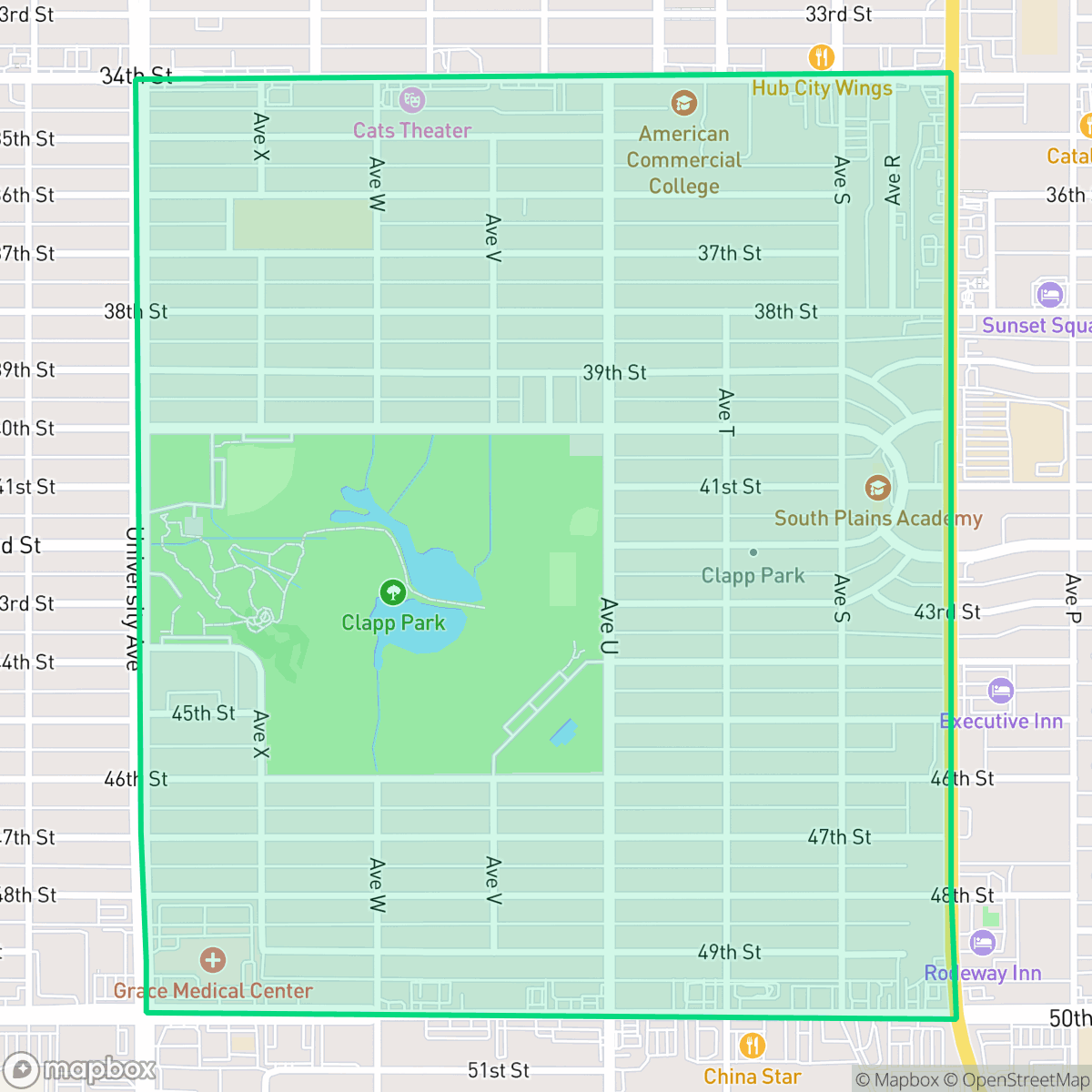
Clapp Park is a highly walkable and dog-friendly neighborhood in central Lubbock, defined by its mid-century residential character and proximity to major transit routes. While the area offers exceptional access to local amenities and green spaces, residents should be aware of significant road traffic noise and limited flood safety protections.
Key Highlights
About Clapp Park
The Clapp Park neighborhood in central Lubbock is historically anchored by its namesake park, established in 1930 on land donated by local philanthropist William Walter Clapp. Residential development in the surrounding neighborhood flourished primarily between 1940 and 1969, leaving a legacy of well-established, mid-century single-family homes. The area serves as a key cultural and recreational hub for the city, housing the Lubbock Memorial Arboretum—established in 1961 to showcase regional flora—and the Lubbock Garden & Arts Center. Another defining local landmark is Safety City, a 2.5-acre miniature town founded in 1991 by the Junior League of Lubbock to provide hands-on traffic and pedestrian safety education for area children.
The neighborhood functions as a central hub for Lubbock residents, offering a high degree of walkability that is rare for the region. The streets are lined with mid-century homes and benefit from a strong connection to local social hubs and diverse dining options. The presence of significant green spaces and dedicated community areas makes the area particularly appealing for pet owners and those who value an active, outdoor-oriented lifestyle.
Prospective residents should consider the acoustic environment, as the area experiences elevated noise levels primarily due to consistent road traffic. While the neighborhood maintains a residential feel, its location near major transit corridors creates a trade-off between accessibility and quiet. Additionally, the area faces challenges regarding flood safety and health insurance coverage, factors that potential buyers or renters should evaluate alongside the benefits of living in such a central, well-connected part of the city.
Neighborhood Scores Across 15 Qualities
Residential structures feature standard suburban setbacks with small side yards and back alleys separating neighbors. This level of spacing is slightly higher than the Lubbock average, providing a modest buffer between adjacent homes.
Pedestrian access is a strength here, as the area features a complete grid with frequent crosswalks and sidewalks that surpass the Lubbock average. Low traffic volumes on residential streets further contribute to a safe environment for walking.
Simple mid-century tract housing and uniform lots define the landscape. This area offers a slightly more orderly visual character than the Lubbock average, according to iHuus data.
Accessible green spaces and connected pathways provide more opportunities for walking dogs than the Lubbock average. Large public parks and continuous grass verges offer safe areas away from traffic for pet owners.
Residential blocks feature a dense grid of single-family homes and some peripheral commercial structures. This level of development is roughly in line with the city average for Lubbock.
Local dining and social hubs are more frequent here than in most of Lubbock. While certain blocks offer lively pockets of activity near major roads, other residential areas remain quiet and suburban in character.
Ongoing sounds from a nearby freeway and railroad tracks contribute to a level of acoustic disturbance that is slightly higher than the Lubbock average, according to iHuus data.
Residential life here is free from warehouses or heavy industrial hazards, providing a cleaner environment than the Lubbock average. According to iHuus data, the area consists exclusively of residential and light commercial uses with no detected industrial facilities.
Health insurance accessibility in this area is below the Lubbock average, according to iHuus data. Residents may face more challenges accessing comprehensive coverage compared to other parts of the city.
Conservative viewpoints hold a majority in this area, representing a more conservative leaning than the Lubbock average according to iHuus data.
A diverse range of age groups resides here, including young adults, families, and seniors. This demographic distribution is largely consistent with the city average, according to iHuus data.
Flood risk in this area is significantly higher than the Lubbock average. Residents should anticipate elevated or potentially prohibitive flood insurance costs according to iHuus data.
Address-Level Insights for Clapp Park


iHuus Neighborhood Intelligence Insights
Get address-level neighborhood insights for Clapp Park
- Street-level scores — see how individual blocks compare, not just neighborhood averages
- Micro-zone boundaries — identify quiet pockets, flood boundaries, and walkable clusters before you visit
- 15 dimensions in full — walkability, noise, air quality, school quality, insurance coverage, population age profile, urban/rural index, and more
- Boundary risk alerts — know if your address sits near a block boundary where scores drop, the kind of detail no listing will ever mention
- School insights — individual school ratings and insights, not just district-level data
- Compare before you commit — side-by-side data across neighborhoods, down to block precision
No credit card required
Compare with Any Neighborhood
| Dimension | Clapp Park | Arnett Benson |
|---|---|---|
| 🚶 Walkabilityavg 6.67 | ||
| 🔊 Acoustic Comfortavg 3.09 | ||
| 🤫 Privacy Indexavg 5.75 | ||
| 🎨 Visual Appealavg 5.7 | ||
| 🐕 Dog Friendlinessavg 5.29 | ||
| 🗺️ Urban-Rural Indexavg 6.86 | ||
| ✨ Neighborhood Vibeavg 4.81 | ||
| 🏥 Health Insurance Coverageavg 6.7 | ||
| 🌿 Air Quality | ||
| 🏭 Industrial Proximityavg 8.52 | ||
| 🌊 Flood Safetyavg 1.79 | ||
| 🗳️ Ideological Leanavg 2.17 | ||
| 👥 Population Age Profileavg 4.52 | ||
| 🔥 Fire Safety | ||
| 🏫 School Quality |
Clapp Park Rankings
School Districts Serving Clapp Park
School Insights for Clapp Park
Below average outcomes; significant attendance and academic challenges.
School Insights
See what's really behind every school rating near Clapp Park
- Individual school ratings — each school's own score with outcome context, not just a district average
- Enrollment & class size data — student-to-teacher ratio and how it compares to the state average
- Full demographics breakdown — ethnicity and gender composition for every school in the enrollment zone
- Every school in the district — all schools within the enrollment boundary ranked by rating, not just the closest one
- Grade levels & benchmarks — elementary through high school, with below/above state-average flags
No credit card required