Arnett Benson, Lubbock
Updated · 8,082 residents
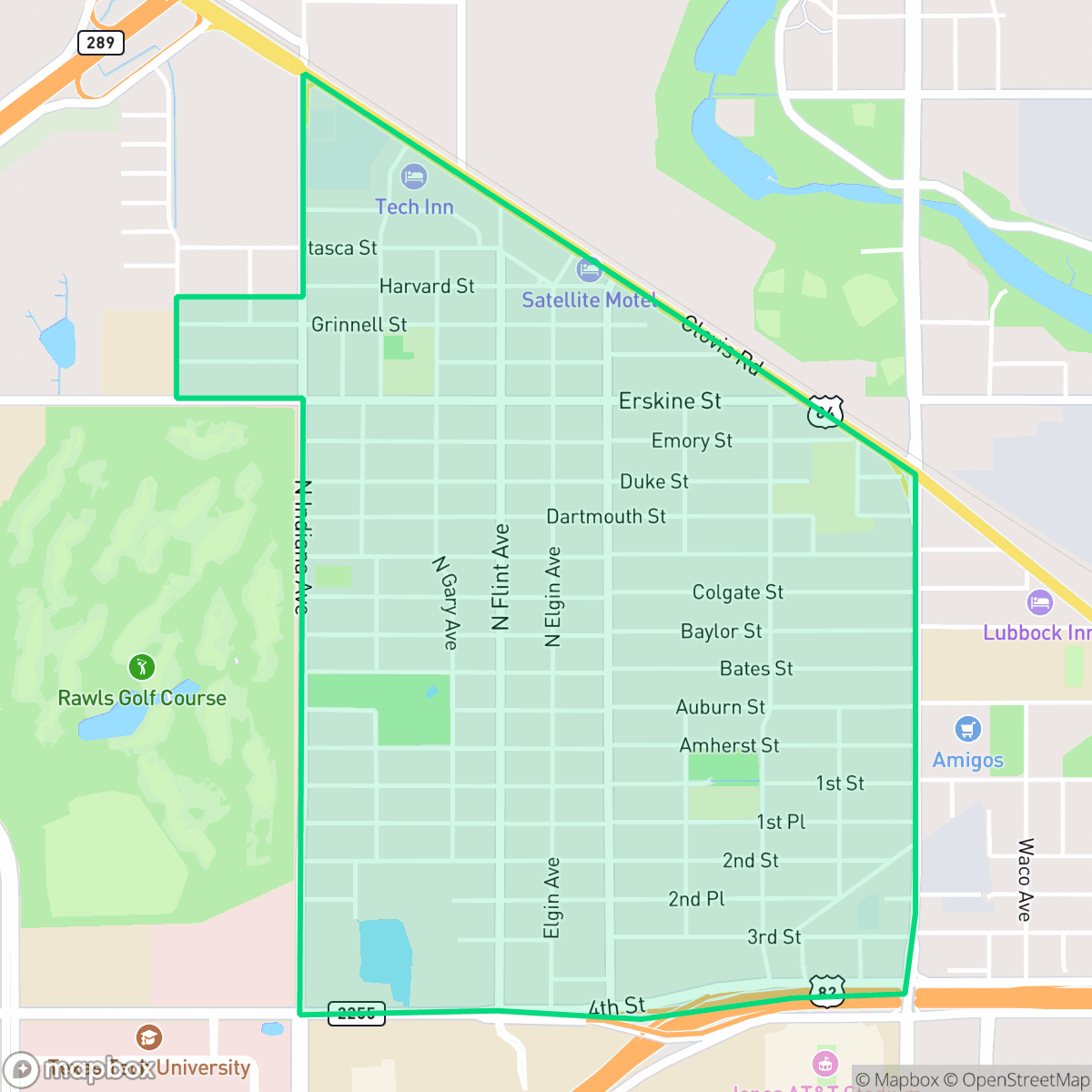
Arnett Benson is a historic, close-knit community located just north of Texas Tech University, characterized by its grid-based street layout and established single-family homes. While the neighborhood offers a quiet, suburban atmosphere, residents experience moderate traffic noise and a high degree of residential density. It is a car-dependent area where daily errands often require a vehicle, though it remains a central and accessible part of the Lubbock landscape.
Key Highlights
About Arnett Benson
Located directly north of Texas Tech University, the Arnett Benson neighborhood in Lubbock, Texas, is a historic community with a rich, multicultural heritage. Originally settled by immigrants who arrived to work on the Santa Fe Railroad, it evolved into a vibrant, predominantly Hispanic enclave where Mexican cultural traditions and the Spanish language remain central to its identity. The neighborhood’s residential landscape features well-established single-family homes built primarily between 1940 and 1969. A prominent local landmark was the historic Arnett Benson Theatre on University Avenue, opened in 1950 by Preston Smith and his wife. Today, the neighborhood maintains its close-knit character, anchored by local institutions like the Arnett Benson Medical and Dental Clinic and recreational spaces like Hodges Park.
The neighborhood is defined by a dense, low-rise urban grid that transitions into light industrial and commercial zones near the highway. According to iHuus data, the area features a mix of well-established single-family residences and mid-sized apartment complexes, creating a consistent but compact suburban feel. While the layout provides straightforward, grid-based navigation, the proximity to major thoroughfares contributes to a notable acoustic environment influenced by consistent road traffic. Residents benefit from access to local services and recreational spaces like Hodges Park, though the area is largely car-dependent due to limited walkable business corridors.
Families may consider the local educational landscape, which includes McWhorter Elementary, a school that performs well within the broader Lubbock Independent School District. The area is best suited for those seeking a central location with an established, quiet residential character, provided they are comfortable with a higher-density living environment and the typical noise levels associated with proximity to major transit routes. As noted by iHuus, the neighborhood maintains a stable, if compact, residential footprint that balances its historic roots with the practical realities of modern urban living.
Neighborhood Scores Across 15 Qualities
Residential spacing varies between closely packed multi-family units and homes with small gaps between structures. This level of density is slightly lower than the Lubbock average, providing some buffer between neighbors in certain areas.
Sidewalk availability is slightly above the Lubbock average, though large industrial zones and high-traffic corridors can create barriers to pedestrian movement. While residential grid streets feature sidewalks, connectivity is inconsistent across some blocks.
Standard tract housing and dense apartment complexes define the landscape, characterized by uniform rooftops and modest yards. This visual profile is slightly below the Lubbock average due to a lack of premium landscaping or luxury architectural features.
Access to public green space and walking areas for pets is slightly above the Lubbock average. While some residential areas feature narrow verges and private fenced yards, the neighborhood benefits from nearby golf course grounds and localized park access.
Residential streets and green spaces exist in equal measure, offering a suburban feel that is slightly less dense than the Lubbock average. According to iHuus data, the area transitions between single-family grids and light industrial zones.
Mixed-use pockets offer a lively atmosphere with several dining options, though much of the area remains quiet and suburban. According to iHuus data, the local energy levels are slightly higher than the Lubbock average.
Frequent noise from nearby transit corridors, such as highways and rail lines, is a common characteristic here. This level of acoustic disturbance is slightly higher than the average found throughout Lubbock.
Industrial presence is minimal in this area, consisting primarily of residential streets and light commercial zones. While some warehouses and storage yards are located near the northeast edge, the neighborhood lacks the heavy industrial hazards found more frequently elsewhere in Lubbock.
Health insurance access remains consistent with the city average. Most residents in this area have access to medical coverage, according to iHuus data.
Political perspectives are relatively balanced between conservative and liberal viewpoints, representing a more even split than the city average according to iHuus data.
Young adults make up the majority of the population here, representing a younger demographic than the Lubbock average. This creates a residential profile with fewer families and older residents compared to most other parts of the city.
Flood vulnerability is significantly higher here than the Lubbock average, which may lead to elevated or prohibitive insurance costs for residents. According to iHuus data, this area is subject to much greater flood hazards than most of the city.
Address-Level Insights for Arnett Benson


iHuus Neighborhood Intelligence Insights
Get address-level neighborhood insights for Arnett Benson
- Street-level scores — see how individual blocks compare, not just neighborhood averages
- Micro-zone boundaries — identify quiet pockets, flood boundaries, and walkable clusters before you visit
- 15 dimensions in full — walkability, noise, air quality, school quality, insurance coverage, population age profile, urban/rural index, and more
- Boundary risk alerts — know if your address sits near a block boundary where scores drop, the kind of detail no listing will ever mention
- School insights — individual school ratings and insights, not just district-level data
- Compare before you commit — side-by-side data across neighborhoods, down to block precision
No credit card required
Compare with Any Neighborhood
| Dimension | Arnett Benson | Ballenger |
|---|---|---|
| 🚶 Walkabilityavg 6.67 | ||
| 🔊 Acoustic Comfortavg 3.09 | ||
| 🤫 Privacy Indexavg 5.75 | ||
| 🎨 Visual Appealavg 5.7 | ||
| 🐕 Dog Friendlinessavg 5.29 | ||
| 🗺️ Urban-Rural Indexavg 6.86 | ||
| ✨ Neighborhood Vibeavg 4.81 | ||
| 🏥 Health Insurance Coverageavg 6.7 | ||
| 🌿 Air Quality | ||
| 🏭 Industrial Proximityavg 8.52 | ||
| 🌊 Flood Safetyavg 1.79 | ||
| 🗳️ Ideological Leanavg 2.17 | ||
| 👥 Population Age Profileavg 4.52 | ||
| 🔥 Fire Safety | ||
| 🏫 School Quality |
Arnett Benson Rankings
School Districts Serving Arnett Benson
School Insights for Arnett Benson
Below average outcomes; significant attendance and academic challenges.
School Insights
See what's really behind every school rating near Arnett Benson
- Individual school ratings — each school's own score with outcome context, not just a district average
- Enrollment & class size data — student-to-teacher ratio and how it compares to the state average
- Full demographics breakdown — ethnicity and gender composition for every school in the enrollment zone
- Every school in the district — all schools within the enrollment boundary ranked by rating, not just the closest one
- Grade levels & benchmarks — elementary through high school, with below/above state-average flags
No credit card required