Shady Grove, Irving
Updated · 7,628 residents
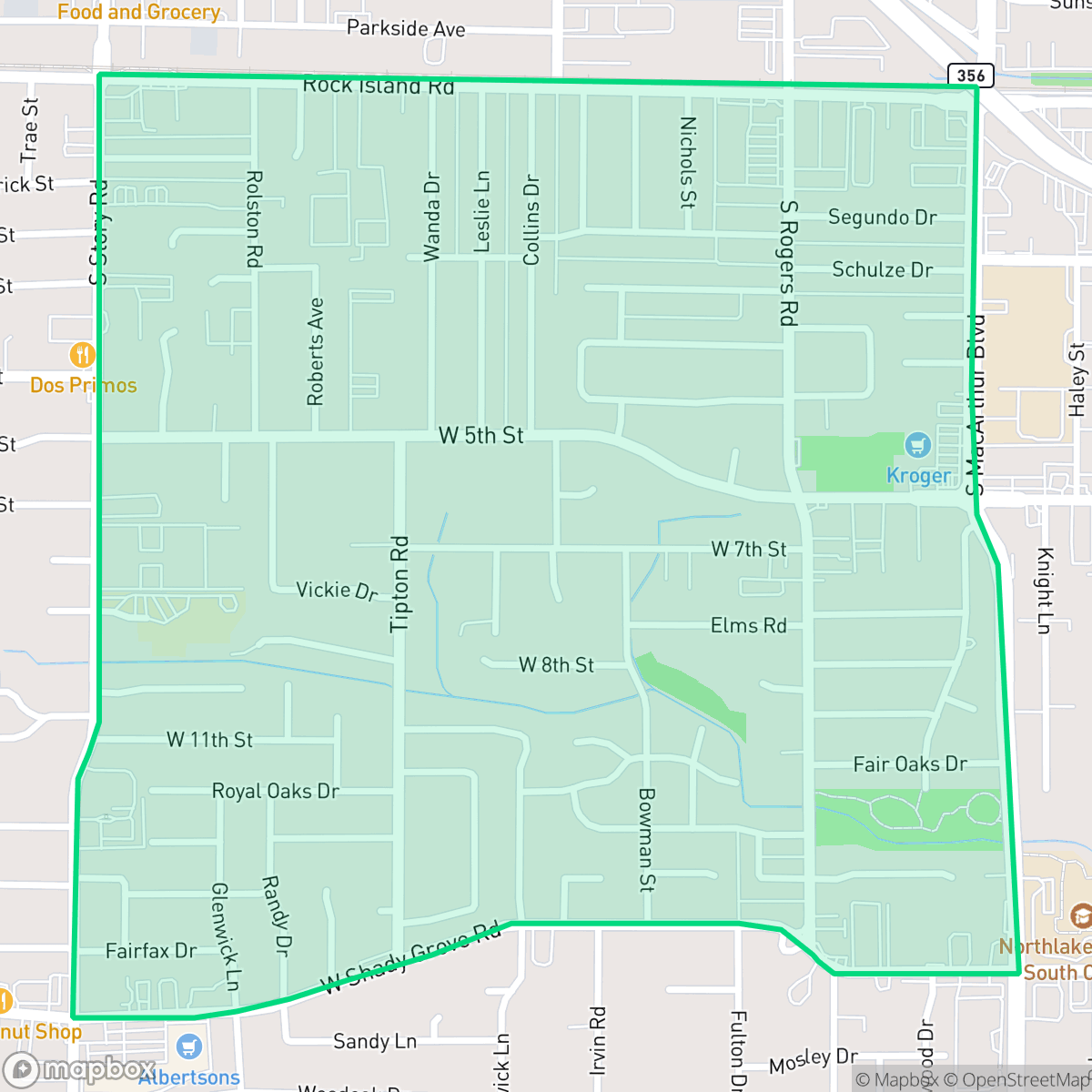
Shady Grove is a quiet, car-dependent suburban neighborhood in Irving defined by a mix of standard tract housing and apartment complexes. While it offers moderate walkability and access to local green spaces, residents primarily rely on vehicles to navigate the area and reach nearby commercial services.
Key Highlights
About Shady Grove
Established in the mid-to-late 19th century, the historic community of Shady Grove began along the Shady Grove Trail (originally the Eagle Ford Trail), used by pioneers traveling between Dallas and Fort Worth. In 1877, settler Louis H. Caster deeded land for a community graveyard, church, and schoolhouse. By the mid-20th century, Shady Grove sat directly on the shifting border of Irving and Grand Prairie. Its local school became the last common school in Dallas County by 1964. Following decades of jurisdictional confusion and annexation disputes between the two cities, Irving and Grand Prairie formed a joint committee in 1985 to manage the area’s zoning and services. Today, the neighborhood’s pioneer heritage is commemorated at Shady Grove Trail Park, which features a dedicated History Plaza.
The area maintains a steady, residential rhythm characterized by a mix of single-family homes and multi-story apartment blocks. It is a quiet environment where the suburban landscape is punctuated by light industrial zones and essential services like local churches and dining establishments. According to iHuus data, the neighborhood provides a functional, if low-activity, setting that prioritizes residential space over high-density commercial development.
Residents should anticipate a car-oriented lifestyle, as the layout is designed for suburban convenience rather than high-frequency pedestrian connectivity. While the area features consistent sidewalk networks, the proximity to major roads contributes to a moderate noise level. The community is well-suited for those seeking a predictable, standard suburban environment with access to Irving Independent School District facilities, though prospective residents should note the limited public amenities and the necessity of commuting for broader entertainment or shopping needs.
Neighborhood Scores Across 15 Qualities
Residential structures feature moderate spacing with some distance between neighbors, providing more privacy than the Irving average. While some houses are closely set with shared fence lines, most detached homes maintain small side yards and typical suburban buffers.
Sidewalk networks are present along main roads and low-traffic residential streets, though some segments are interrupted by large commercial parking lots. Pedestrian connectivity is slightly below the Irving average due to wider intersections and intermittent paths.
Uniform tract housing and modest yards define the area, which offers slightly less visual variety than the Irving average. Residential views consist primarily of middle-class homes, apartment blocks, and some commercial warehouses.
Walking routes for pets are primarily restricted to narrow sidewalk verges and private fenced backyards. According to iHuus data, the availability of public parks and accessible greenery is below the Irving average.
Predominantly suburban in character, this area features a mix of single-family homes, apartment complexes, and light commercial zones. The landscape is slightly more developed than the typical surroundings in Irving.
Residential life here follows a steady, subdued pace with a mix of light industrial units and scattered dining options. Activity levels are slightly below the Irving average, as the area primarily functions as a calm, car-oriented landscape.
Steady traffic sounds from nearby busy streets are present, though acoustic comfort levels remain slightly higher than the average for Irving.
Air quality levels fluctuate between acceptable and unhealthy, presenting occasional concerns for sensitive groups. This pattern is largely consistent with the broader Irving area according to iHuus data.
Primarily residential and light commercial, this area stays mostly clear of heavy industrial hazards. However, some noise and truck activity are noticeable near the northern edge due to nearby warehouses and transit infrastructure, which is slightly more prevalent here than in the rest of Irving.
Health insurance coverage among residents is notably lower than the Irving city average, according to iHuus data. This indicates a higher prevalence of uninsured individuals within the Shady Grove area.
Political views in this area are split nearly evenly between conservative and liberal leanings. This represents a more moderate ideological landscape than the more pronounced lean seen across the rest of Irving.
Residents live alongside a balanced mix of young adults, families, and older individuals. This demographic distribution is consistent with the average seen across Irving.
Flood risk is notably higher here than the Irving average, as parts of the area sit within a designated hundred year floodplain. Residents should be aware that flood insurance is typically required for properties in this zone according to iHuus data.
Address-Level Insights for Shady Grove


iHuus Neighborhood Intelligence Insights
Get address-level neighborhood insights for Shady Grove
- Street-level scores — see how individual blocks compare, not just neighborhood averages
- Micro-zone boundaries — identify quiet pockets, flood boundaries, and walkable clusters before you visit
- 15 dimensions in full — walkability, noise, air quality, school quality, insurance coverage, population age profile, urban/rural index, and more
- Boundary risk alerts — know if your address sits near a block boundary where scores drop, the kind of detail no listing will ever mention
- School insights — individual school ratings and insights, not just district-level data
- Compare before you commit — side-by-side data across neighborhoods, down to block precision
No credit card required
Compare with Any Neighborhood
| Dimension | Shady Grove | Bear Creek |
|---|---|---|
| 🚶 Walkabilityavg 7.64 | ||
| 🔊 Acoustic Comfortavg 4.08 | ||
| 🤫 Privacy Indexavg 5.22 | ||
| 🎨 Visual Appealavg 6.37 | ||
| 🐕 Dog Friendlinessavg 6.65 | ||
| 🗺️ Urban-Rural Indexavg 6.69 | ||
| ✨ Neighborhood Vibeavg 4.62 | ||
| 🏥 Health Insurance Coverageavg 5.16 | ||
| 🌿 Air Qualityavg 4.08 | ||
| 🏭 Industrial Proximityavg 7.88 | ||
| 🌊 Flood Safetyavg 3.48 | ||
| 🗳️ Ideological Leanavg 6.48 | ||
| 👥 Population Age Profileavg 4.39 | ||
| 🔥 Fire Safety | ||
| 🏫 School Quality |
Shady Grove Rankings
School Districts Serving Shady Grove
School Insights for Shady Grove
Below average outcomes; significant attendance and academic challenges.
School Insights
See what's really behind every school rating near Shady Grove
- Individual school ratings — each school's own score with outcome context, not just a district average
- Enrollment & class size data — student-to-teacher ratio and how it compares to the state average
- Full demographics breakdown — ethnicity and gender composition for every school in the enrollment zone
- Every school in the district — all schools within the enrollment boundary ranked by rating, not just the closest one
- Grade levels & benchmarks — elementary through high school, with below/above state-average flags
No credit card required