Senter, Irving
Updated · 8,462 residents
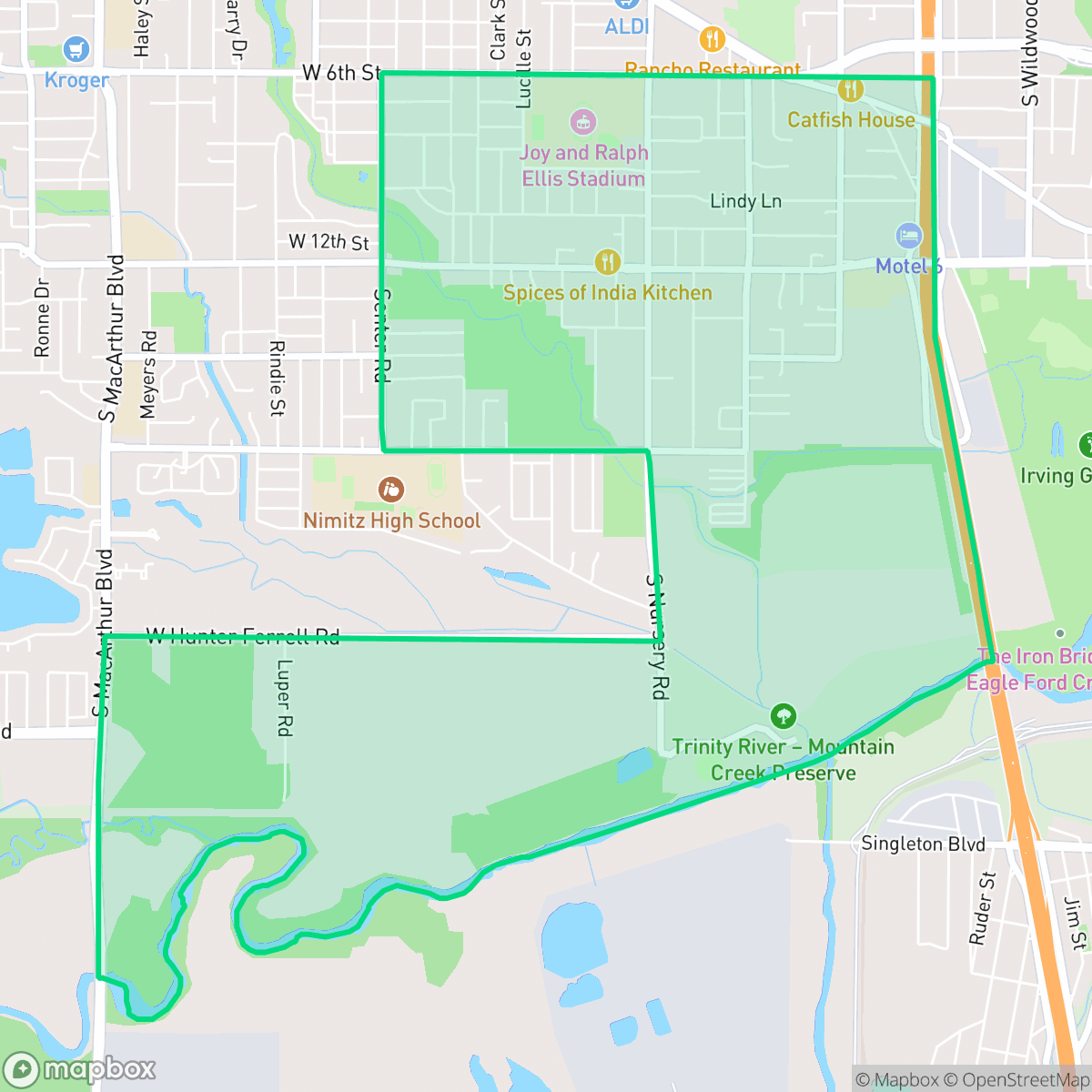
Senter is a quiet, established residential neighborhood in Irving defined by its mid-century housing and proximity to the city's inaugural municipal park. The area offers a blend of suburban living and industrial access, though residents should note the high proximity to logistics hubs and significant flood risk.
Key Highlights
About Senter
The Senter neighborhood in Irving, Texas, is anchored by Senter Park, which holds historical significance as the city’s very first municipal park. In 1931, during the Great Depression, the town purchased the land for the park from the local Senter family under the administration of Mayor Dr. John Haley. Located just south of Irving's historic Heritage District, the residential area surrounding the park developed primarily during the mid-20th century, with traditional single-family brick and frame homes dating from the 1950s through the 1970s. Senter Park itself serves as a vital community hub, featuring the Senter Park Recreation Center and Senter East Building. The area is currently undergoing a major modern transformation with a multi-million dollar redevelopment to convert its historic outdoor pool into a state-of-the-art, year-round indoor aquatic center and natatorium.
The neighborhood features a traditional grid of single-family brick and frame homes constructed between the 1950s and 1970s. It maintains a calm, suburban atmosphere, characterized by a mix of residential streets and nearby commercial services. While the area provides convenient access to local dining and community facilities, the landscape is heavily influenced by its proximity to major logistics hubs and industrial freight corridors. According to iHuus data, the environment is marked by a moderate level of road traffic noise, and the existing infrastructure reflects a standard suburban density with consistent sidewalk coverage. Prospective residents should weigh the benefits of a central location against specific livability trade-offs. The area faces notable challenges, including a high risk of flooding and limited private outdoor space for pet owners due to narrow sidewalk verges. While the local Irving Independent School District provides specialized career and technical education programs, overall academic outcomes vary across neighborhood campuses. The neighborhood is best suited for those who prioritize proximity to major transit routes and established community amenities over luxury aesthetics or high-end walkability.
Neighborhood Scores Across 15 Qualities
Residential lots provide a standard amount of separation between neighbors, offering slightly more privacy than the typical Irving average. According to iHuus data, the neighborhood features a consistent suburban grid with moderate density and established side yards.
Established sidewalks and a dense grid of low-traffic residential streets facilitate safe walking, though some major roads lack pedestrian buffers. This level of connectivity is slightly below the Irving city average according to iHuus data.
Uniform tract housing and mid-range apartments define the visual landscape, which is slightly below the Irving average for visual variety. Properties typically feature consistent rooflines and modest yard spaces according to iHuus data.
Access to large parks and athletic trails provides good opportunities for exercise, though the immediate street grid lacks significant public green space. According to iHuus data, overall pet-friendly amenities in this area are slightly below the Irving city average.
Frequent open land and scattered residential clusters create a landscape that is slightly more rural than the Irving average. Residents will find a mix of wooded areas and open fields interspersed with low-density housing according to iHuus data.
Suburban streets and industrial corridors create a tranquil atmosphere with limited commercial density. According to iHuus data, the level of activity and social vibrancy here is slightly below the Irving city average.
Steady sounds from nearby busy streets characterize the area, though acoustic levels remain slightly more tranquil than the Irving average according to iHuus data.
Air quality levels fluctuate between acceptable and unhealthy, presenting occasional concerns for sensitive groups. This pattern is largely consistent with the broader Irving area, according to iHuus data.
Industrial presence is minimal throughout most of the area, though some residents may notice localized noise or dust from nearby wastewater treatment and quarrying operations. According to iHuus data, this level of industrial proximity is slightly lower than the Irving average.
Health insurance coverage is notably lower in Senter than in the rest of Irving. According to iHuus data, a small portion of the resident population is covered by health insurance plans.
Political leanings in this area are evenly split, representing a slightly more moderate landscape than the Irving city average according to iHuus data.
Residents live alongside a balanced mix of young adults, families, and seniors. According to iHuus data, this age distribution is slightly more varied than the average found across Irving.
Significant flood risk exists here due to being located within a designated floodplain. According to iHuus data, this level of risk is considerably higher than the average for Irving.
Address-Level Insights for Senter


iHuus Neighborhood Intelligence Insights
Get address-level neighborhood insights for Senter
- Street-level scores — see how individual blocks compare, not just neighborhood averages
- Micro-zone boundaries — identify quiet pockets, flood boundaries, and walkable clusters before you visit
- 15 dimensions in full — walkability, noise, air quality, school quality, insurance coverage, population age profile, urban/rural index, and more
- Boundary risk alerts — know if your address sits near a block boundary where scores drop, the kind of detail no listing will ever mention
- School insights — individual school ratings and insights, not just district-level data
- Compare before you commit — side-by-side data across neighborhoods, down to block precision
No credit card required
Compare with Any Neighborhood
| Dimension | Senter | Bear Creek |
|---|---|---|
| 🚶 Walkabilityavg 7.64 | ||
| 🔊 Acoustic Comfortavg 4.08 | ||
| 🤫 Privacy Indexavg 5.22 | ||
| 🎨 Visual Appealavg 6.37 | ||
| 🐕 Dog Friendlinessavg 6.65 | ||
| 🗺️ Urban-Rural Indexavg 6.69 | ||
| ✨ Neighborhood Vibeavg 4.62 | ||
| 🏥 Health Insurance Coverageavg 5.16 | ||
| 🌿 Air Qualityavg 4.08 | ||
| 🏭 Industrial Proximityavg 7.88 | ||
| 🌊 Flood Safetyavg 3.48 | ||
| 🗳️ Ideological Leanavg 6.48 | ||
| 👥 Population Age Profileavg 4.39 | ||
| 🔥 Fire Safety | ||
| 🏫 School Quality |
Senter Rankings
School Districts Serving Senter
School Insights for Senter
Below average outcomes; significant attendance and academic challenges.
School Insights
See what's really behind every school rating near Senter
- Individual school ratings — each school's own score with outcome context, not just a district average
- Enrollment & class size data — student-to-teacher ratio and how it compares to the state average
- Full demographics breakdown — ethnicity and gender composition for every school in the enrollment zone
- Every school in the district — all schools within the enrollment boundary ranked by rating, not just the closest one
- Grade levels & benchmarks — elementary through high school, with below/above state-average flags
No credit card required