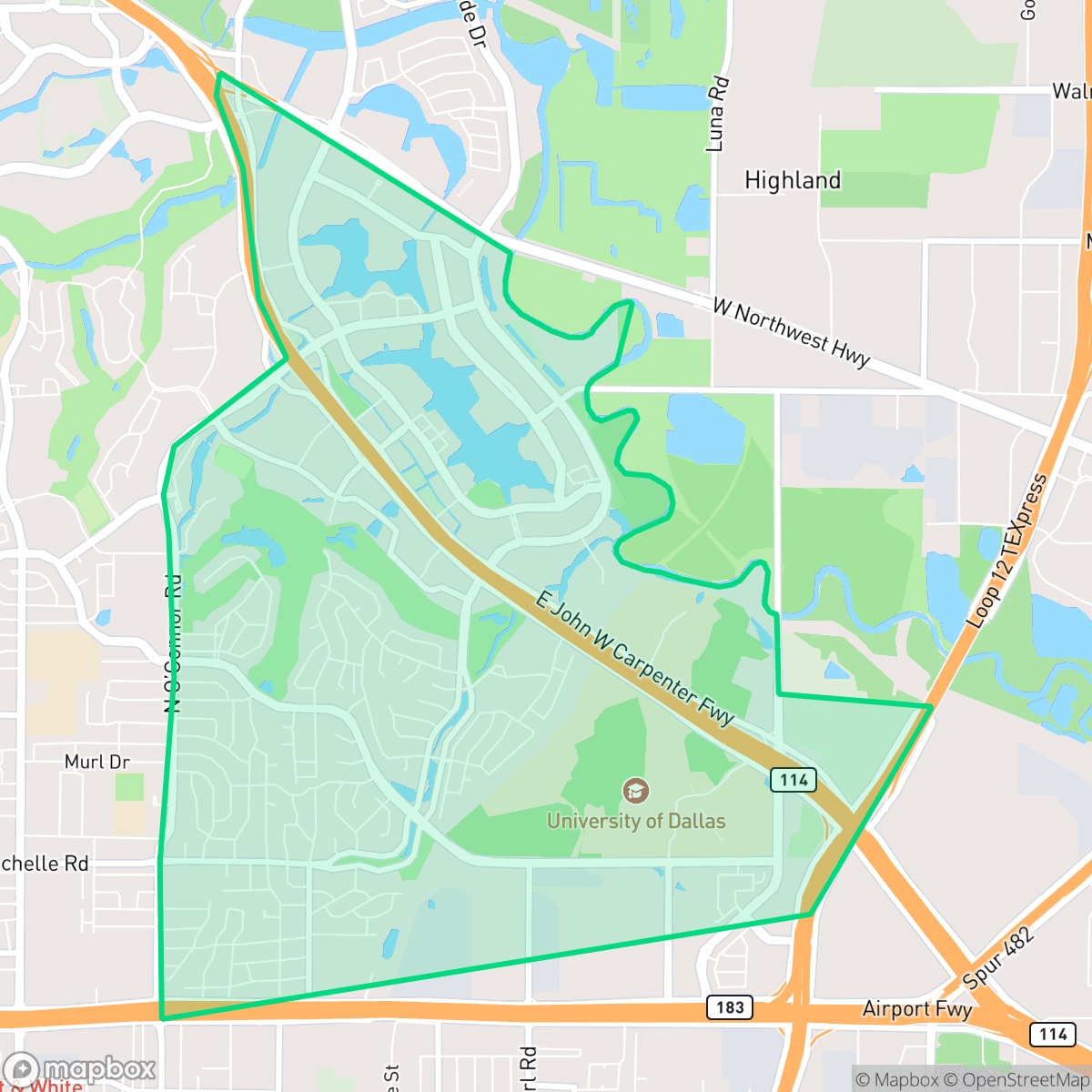
Las Colinas Urban Center, Irving
Updated · 12,148 residents
Las Colinas Urban Center is a dense suburban hub in Irving characterized by its unique canal-side architecture and proximity to major logistics and office corridors. While the area offers a mix of residential options and diverse dining, it remains a car-dependent environment with significant noise levels from nearby highways and industrial traffic.
Key Highlights
About Las Colinas Urban Center
The Las Colinas Urban Center in Irving, Texas, originated in 1973 when developer Ben H. Carpenter began transforming his family’s Hackberry Creek Ranch into a pioneering master-planned community. To reclaim 960 acres of the Elm Fork of the Trinity River floodplain for high-density development, Carpenter bypassed conventional levees to construct Lake Carolyn and the Venice-inspired Mandalay Canals. Designed as a futuristic, transit-oriented hub, the Urban Center features the Las Colinas Area Personal Transit (APT) System, an early automated people mover. The neighborhood’s architectural and cultural anchor is Williams Square, a massive office plaza featuring *The Mustangs of Las Colinas*—the world's largest equestrian bronze sculpture, which depicts nine wild mustangs crossing a granite stream.
The neighborhood serves as a primary business and residential district, blending high-density apartment living with office parks and retail centers. It features a distinct landscape where modern residential blocks sit alongside large-scale logistics warehouses and heavy highway infrastructure. According to iHuus data, the area maintains a moderate level of walkability on local streets, though the prevalence of industrial activity and highway traffic contributes to a more suburban, vehicle-reliant atmosphere. Residents benefit from a central location that provides access to a variety of dining establishments and commercial services, though the overall environment is characterized by its proximity to transit corridors rather than quiet, rural seclusion.
For prospective residents, the area offers strong health insurance coverage and reliable flood safety, though it lacks extensive public park space for pet owners. The neighborhood is best suited for professionals and commuters who prioritize proximity to major employment hubs and diverse local eateries over a tranquil setting. While educational outcomes vary across the surrounding districts, the area provides a stable environment for those working within the Irving sector who are comfortable navigating a busy, mixed-use landscape.
Neighborhood Scores Across 15 Qualities
Residential spacing is varied, featuring both shared walls in apartment complexes and closely packed homes with small gaps between neighbors. This level of density is slightly higher than the average for Irving, according to iHuus data.
Sidewalks are available on many streets and residential blocks remain low traffic; however, large commercial lots and a major highway create disconnected paths that make walking slightly less seamless than the Irving average.
Frequent upscale amenities and large homes contribute to a visual environment that is more polished than the Irving average. According to iHuus data, the area features a mix of premium landscapes alongside some dense, uniform apartment complexes.
Green spaces for pets are mostly restricted to private apartment courtyards or a single small park in the southwest corner. According to iHuus data, the availability of public dog-friendly areas is below the Irving city average.
Large-scale logistics warehouses, office parks, and apartment complexes create a built-up environment that is comparable to the city average. According to iHuus data, the area features significant grey space and industrial infrastructure alongside patches of preserved woodland.
A mix of tranquil suburban blocks and industrial zones creates a subdued atmosphere with limited walking access to amenities. While some pockets near major highways offer diverse dining, much of the area relies on vehicle travel due to the low density of local businesses.
Frequent noise from nearby highways and rail lines makes this area significantly louder than the Irving average. Residents may experience consistent auditory disturbances from heavy transit activity according to iHuus data.
Air quality levels fluctuate between acceptable and unhealthy, presenting occasional concerns for sensitive groups. According to iHuus data, these conditions are slightly worse than the average seen across Irving.
Industrial activity remains minimal within this area, though residents may encounter some light commercial traffic. This level of industrial proximity is notably lower than the Irving city average.
Health insurance accessibility is slightly above the Irving average according to iHuus data. Residents may find a mix of insured and uninsured individuals within the community.
Political perspectives in this area are split fairly evenly between conservative and liberal leanings. This landscape is notably more moderate than the broader Irving average, according to iHuus data.
A diverse range of age groups resides here, including young professionals, families, and seniors. This demographic distribution is consistent with the broader Irving area according to iHuus data.
Flood risk in this area is higher than the Irving average, as the location lacks a detailed federal flood study. Residents should remain aware of the undetermined risk levels identified in iHuus data.
Address-Level Insights for Las Colinas Urban Center


iHuus Neighborhood Intelligence Insights
Get address-level neighborhood insights for Las Colinas Urban Center
- Street-level scores — see how individual blocks compare, not just neighborhood averages
- Micro-zone boundaries — identify quiet pockets, flood boundaries, and walkable clusters before you visit
- 15 dimensions in full — walkability, noise, air quality, school quality, insurance coverage, population age profile, urban/rural index, and more
- Boundary risk alerts — know if your address sits near a block boundary where scores drop, the kind of detail no listing will ever mention
- School insights — individual school ratings and insights, not just district-level data
- Compare before you commit — side-by-side data across neighborhoods, down to block precision
No credit card required
Compare with Any Neighborhood
| Dimension | Las Colinas Urban Center | Bear Creek |
|---|---|---|
| 🚶 Walkabilityavg 7.64 | ||
| 🔊 Acoustic Comfortavg 4.08 | ||
| 🤫 Privacy Indexavg 5.22 | ||
| 🎨 Visual Appealavg 6.37 | ||
| 🐕 Dog Friendlinessavg 6.65 | ||
| 🗺️ Urban-Rural Indexavg 6.69 | ||
| ✨ Neighborhood Vibeavg 4.62 | ||
| 🏥 Health Insurance Coverageavg 5.16 | ||
| 🌿 Air Qualityavg 4.08 | ||
| 🏭 Industrial Proximityavg 7.88 | ||
| 🌊 Flood Safetyavg 3.48 | ||
| 🗳️ Ideological Leanavg 6.48 | ||
| 👥 Population Age Profileavg 4.39 | ||
| 🔥 Fire Safety | ||
| 🏫 School Quality |
Las Colinas Urban Center Rankings
School Districts Serving Las Colinas Urban Center
School Insights for Las Colinas Urban Center
Below average outcomes; significant attendance and academic challenges.
School Insights
See what's really behind every school rating near Las Colinas Urban Center
- Individual school ratings — each school's own score with outcome context, not just a district average
- Enrollment & class size data — student-to-teacher ratio and how it compares to the state average
- Full demographics breakdown — ethnicity and gender composition for every school in the enrollment zone
- Every school in the district — all schools within the enrollment boundary ranked by rating, not just the closest one
- Grade levels & benchmarks — elementary through high school, with below/above state-average flags
No credit card required