Downtown, Irving
Updated · 4,121 residents
Downtown Irving, known as the Heritage District, serves as a historic hub that blends early 20th-century character with a steady, moderate local rhythm. While the area offers decent access to parks and local dining, residents should be aware of persistent traffic noise and a higher risk of flooding compared to other parts of the city.
Key Highlights
About Downtown
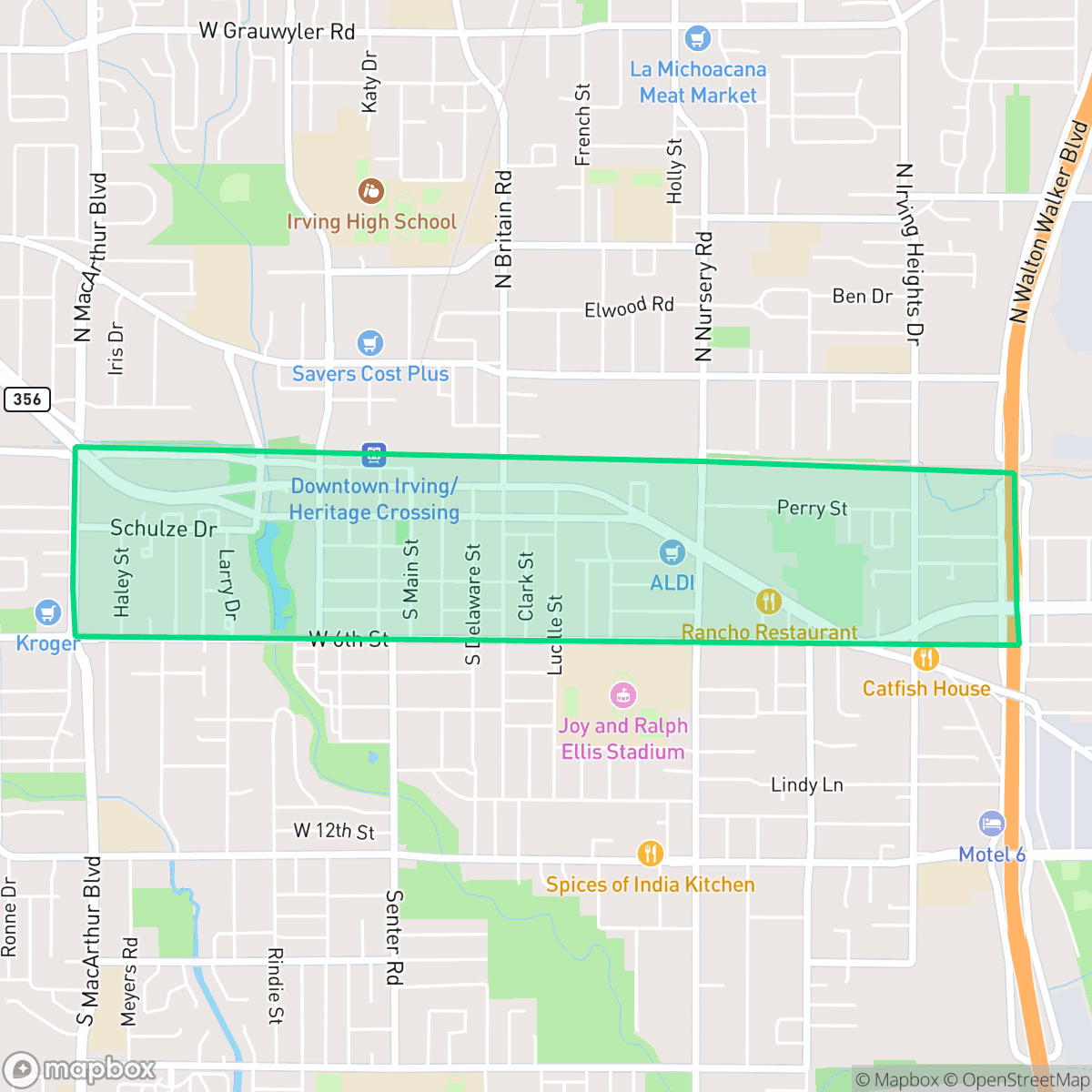
Downtown Irving, often referred to as the Heritage District, serves as the city's historic core where founders J.O. Schulze and Otis Brown first established the town in 1903 along the Chicago, Rock Island and Gulf Railway. The area retains its early 20th-century roots through landmarks like the Heritage House, built in 1912 by C.P. Shulze, and Heritage Park, which preserves remnants of the city's pioneer era, including a replica 1903 train depot and the 1887 Caster Cabin. Once a center for cotton and truck farming, the district has transitioned into a revitalized cultural hub featuring the Main Stage Irving-Las Colinas community theater and public spaces like Centennial Park. Today, the area balances its historical identity with modern pedestrian-friendly development, maintaining the original street grid that defined the town's early growth.
Downtown Irving functions as a diverse residential environment where a mix of young adults, families, and seniors reside in a landscape of functional tract housing and multi-family units. The area maintains a moderate level of activity, supported by local services and green spaces that encourage a consistent, if modest, pace of daily life. Residents benefit from a low industrial presence, which helps preserve the residential feel of the district according to iHuus data. Prospective residents should consider specific environmental and infrastructure factors, including a notable risk of flooding that may require specialized insurance. The area experiences moderate levels of road traffic noise, and while sidewalks connect many residential zones to public amenities, pedestrian buffers on major roads are sometimes limited. The Irving Independent School District serves the area, providing access to specialized academies and career training programs, though academic outcomes remain varied across different school campuses.
Neighborhood Scores Across 15 Qualities
Residential spacing varies from closely packed apartment blocks to detached homes with small side yards. This level of density is slightly higher than the Irving average, providing a mix of shared walls and some buffer between neighbors.
Sidewalks are available on most streets and connect various residential zones to parks, though some major roads lack sufficient pedestrian buffers. According to iHuus data, the level of walkability in this area is slightly below the Irving city average.
Standard tract housing and multi-family units define the area, providing functional residential spaces with modest yards. This visual landscape is slightly less varied than the average across Irving.
Walking paths along the central waterway and various green corridors provide decent areas for pets. According to iHuus data, these amenities are slightly below the Irving city average.
A blend of industrial zones, commercial strips, and residential complexes creates a landscape that is slightly less open than the Irving average. This transition zone features a mix of low-rise buildings and single-family homes according to iHuus data.
A balanced mix of residential streets, green spaces, and local dining establishments provides a level of activity that is slightly above the city average. While some industrial and railway areas are more car-dependent, many blocks offer a steady, moderate presence of neighborhood services.
Steady traffic sounds from nearby busy streets create a persistent hum. This level of acoustic activity is slightly higher than the average for Irving.
Air quality fluctuates between acceptable and unhealthy levels, with occasional concerns for sensitive groups. This area experiences air quality levels similar to the overall Irving average, according to iHuus data.
Industrial activity is notably lower here than the city average, as the area remains primarily residential with only occasional light commercial use. While some warehouse facilities and rail corridors exist in certain quadrants, the neighborhood lacks the heavy manufacturing or large-scale logistics hubs found elsewhere in Irving.
Health insurance accessibility is notably lower in this area than the Irving average, according to iHuus data.
Political leanings in this area align closely with the city average, reflecting a liberal majority with a modest opposing presence according to iHuus data.
Residents live alongside a balanced demographic of young adults, families, and seniors. This age distribution is consistent with the broader Irving area according to iHuus data.
Significant flood risk exists due to the neighborhood's location within a designated floodplain; according to iHuus data, this risk is notably higher than the Irving average and may necessitate specialized insurance coverage.
Address-Level Insights for Downtown


iHuus Neighborhood Intelligence Insights
Get address-level neighborhood insights for Downtown
- Street-level scores — see how individual blocks compare, not just neighborhood averages
- Micro-zone boundaries — identify quiet pockets, flood boundaries, and walkable clusters before you visit
- 15 dimensions in full — walkability, noise, air quality, school quality, insurance coverage, population age profile, urban/rural index, and more
- Boundary risk alerts — know if your address sits near a block boundary where scores drop, the kind of detail no listing will ever mention
- School insights — individual school ratings and insights, not just district-level data
- Compare before you commit — side-by-side data across neighborhoods, down to block precision
No credit card required
Compare with Any Neighborhood
| Dimension | Downtown | Bear Creek |
|---|---|---|
| 🚶 Walkabilityavg 7.64 | ||
| 🔊 Acoustic Comfortavg 4.08 | ||
| 🤫 Privacy Indexavg 5.22 | ||
| 🎨 Visual Appealavg 6.37 | ||
| 🐕 Dog Friendlinessavg 6.65 | ||
| 🗺️ Urban-Rural Indexavg 6.69 | ||
| ✨ Neighborhood Vibeavg 4.62 | ||
| 🏥 Health Insurance Coverageavg 5.16 | ||
| 🌿 Air Qualityavg 4.08 | ||
| 🏭 Industrial Proximityavg 7.88 | ||
| 🌊 Flood Safetyavg 3.48 | ||
| 🗳️ Ideological Leanavg 6.48 | ||
| 👥 Population Age Profileavg 4.39 | ||
| 🔥 Fire Safety | ||
| 🏫 School Quality |
Downtown Rankings
School Districts Serving Downtown
School Insights for Downtown
Below average outcomes; significant attendance and academic challenges.
School Insights
See what's really behind every school rating near Downtown
- Individual school ratings — each school's own score with outcome context, not just a district average
- Enrollment & class size data — student-to-teacher ratio and how it compares to the state average
- Full demographics breakdown — ethnicity and gender composition for every school in the enrollment zone
- Every school in the district — all schools within the enrollment boundary ranked by rating, not just the closest one
- Grade levels & benchmarks — elementary through high school, with below/above state-average flags
No credit card required