Windsor Road, Austin
Updated · 9,325 residents
Windsor Road is a historic West Austin enclave defined by its distinct architectural character and abundant green space. While the area offers a quiet, residential atmosphere with high visual appeal, residents should expect notable noise levels from nearby highway traffic.
Key Highlights
About Windsor Road
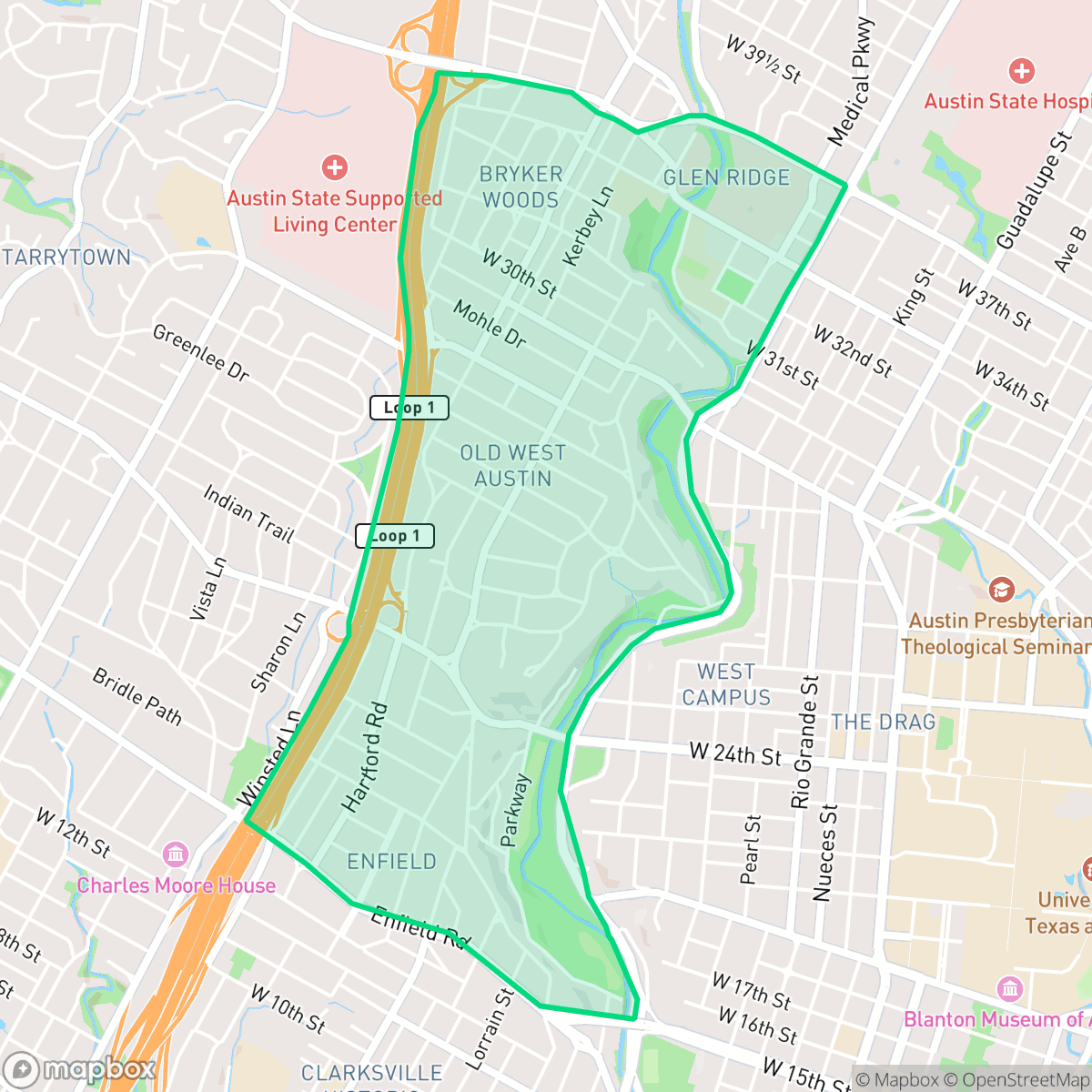
The Windsor Road neighborhood planning area in West Austin, bounded by West 35th Street, North Lamar Boulevard, Enfield Road, and the MoPac Expressway, encompasses the historic suburbs of Bryker Woods and Pemberton Heights. Developed in the 1920s and 1930s as one of Austin’s first automobile-oriented suburbs, its namesake street was named after Windsor, Connecticut, the birthplace of Mrs. L.C. Pease, wife of Texas Governor Elisha M. Pease. A key local landmark is the historic Windsor Road Bridge, built in 1928 to span Shoal Creek. Notable architectural gems include the 1927 English Tudor estate at 2208 Windsor Road designed by Edwin F. Kreïsle and the 1930 Spanish Colonial Revival home at 2402 Windsor Road, built for Goldie Horton-Porter, the first woman to earn a Ph.D. from the University of Texas.
The neighborhood is characterized by its low-density, suburban layout that prioritizes open space and aesthetic beauty. Its streets are lined with a mix of historic homes and mature trees, creating a visually appealing environment that stands out within the Austin landscape. According to iHuus data, the area maintains a high level of flood safety and excellent health insurance coverage, making it a stable choice for long-term residents. The proximity to Shoal Creek and various green spaces provides a natural buffer, though the overall vibe remains quiet and relatively subdued compared to more central, high-energy districts.
Prospective residents should consider the trade-offs between the neighborhood's suburban charm and its acoustic environment. While the area is reasonably walkable, the proximity to major thoroughfares results in elevated traffic noise levels. Families are served by the Austin Independent School District, with local options like Bryker Woods Elementary providing strong educational support. The area is best suited for those who prioritize a quiet, visually scenic, and safe residential setting over proximity to high-density commercial or entertainment hubs.
Neighborhood Scores Across 15 Qualities
Residential spacing varies from dense apartment clusters to single-family homes with significant tree buffers, resulting in a privacy level slightly above the Austin average according to iHuus data.
Pedestrian connectivity is better than the Austin average due to a dense street grid and safe crossings between residential and commercial zones. While interior streets are low traffic, some high speed arterial roads and a nearby highway can act as barriers to walking.
Large custom homes, private pools, and well-maintained grounds characterize this area. According to iHuus data, the visual landscape is notably more polished and expansive than the Austin average.
Proximity to large wooded greenbelts and central walking paths provides excellent exercise areas for dogs. While some residential streets feature narrow sidewalks, the area remains slightly more dog friendly than the Austin average according to iHuus data.
Significant tree canopy and pockets of open land provide a more tranquil, semi-rural feel than much of the Austin area. According to iHuus data, the landscape features a mix of established residential clusters and scattered woodland.
Local dining and social destinations provide a noticeable energy that is higher than the Austin average. Residents can find a steady rhythm of activity through various coffee shops, parks, and eateries situated near local greenery and water features.
Frequent noise from nearby major freeways and transit corridors makes this a louder area than most of Austin. According to iHuus data, residents can expect more consistent acoustic disturbance than the city average.
Air quality in this area fluctuates between acceptable and unhealthy levels, though it remains better than the Austin city average. Sensitive groups may experience occasional concern during certain weather conditions, according to iHuus data.
No warehouses, heavy industrial facilities, or hazardous sites are present within the neighborhood. This area maintains a higher level of separation from industrial activity than the Austin average, consisting primarily of residential, medical, and light commercial zones.
Health insurance access is more prevalent in this area than in the rest of Austin. According to iHuus data, a majority of residents are covered by a health plan.
Voting patterns and census indicators show a predominantly liberal leaning that is slightly more pronounced than the Austin city average, according to iHuus data.
Residents live alongside a varied demographic of young professionals, families, and seniors. According to iHuus data, this area features a slightly less concentrated youthful population than the Austin average.
Flood risk levels in this area are higher than the Austin average; however, official FEMA studies for this specific location remain incomplete. According to iHuus data, the area lacks a detailed flood study, which results in an undetermined risk level for residents.
Address-Level Insights for Windsor Road


iHuus Neighborhood Intelligence Insights
Get address-level neighborhood insights for Windsor Road
- Street-level scores — see how individual blocks compare, not just neighborhood averages
- Micro-zone boundaries — identify quiet pockets, flood boundaries, and walkable clusters before you visit
- 15 dimensions in full — walkability, noise, air quality, school quality, insurance coverage, population age profile, urban/rural index, and more
- Boundary risk alerts — know if your address sits near a block boundary where scores drop, the kind of detail no listing will ever mention
- School insights — individual school ratings and insights, not just district-level data
- Compare before you commit — side-by-side data across neighborhoods, down to block precision
No credit card required
Compare with Any Neighborhood
| Dimension | Windsor Road | Allandale |
|---|---|---|
| 🚶 Walkabilityavg 6.73 | ||
| 🔊 Acoustic Comfortavg 3.73 | ||
| 🤫 Privacy Indexavg 5.87 | ||
| 🎨 Visual Appealavg 6.95 | ||
| 🐕 Dog Friendlinessavg 6.92 | ||
| 🗺️ Urban-Rural Indexavg 7.09 | ||
| ✨ Neighborhood Vibeavg 4.91 | ||
| 🏥 Health Insurance Coverageavg 7.56 | ||
| 🌿 Air Qualityavg 5.17 | ||
| 🏭 Industrial Proximityavg 8.86 | ||
| 🌊 Flood Safetyavg 4.83 | ||
| 🗳️ Ideological Leanavg 9.13 | ||
| 👥 Population Age Profileavg 4.52 | ||
| 🔥 Fire Safety | ||
| 🏫 School Quality |
Windsor Road Rankings
School Districts Serving Windsor Road
School Insights for Windsor Road
Below average outcomes; significant attendance and academic challenges.
School Insights
See what's really behind every school rating near Windsor Road
- Individual school ratings — each school's own score with outcome context, not just a district average
- Enrollment & class size data — student-to-teacher ratio and how it compares to the state average
- Full demographics breakdown — ethnicity and gender composition for every school in the enrollment zone
- Every school in the district — all schools within the enrollment boundary ranked by rating, not just the closest one
- Grade levels & benchmarks — elementary through high school, with below/above state-average flags
No credit card required