Windsor Park, Austin
Updated · 17,128 residents
Windsor Park is a mid-century residential community in North Austin known for its vintage ranch-style architecture and proximity to major transit corridors. While the area offers a suburban feel with mature tree cover, residents should note that road noise and inconsistent sidewalk connectivity present challenges for those seeking a quiet, pedestrian-focused lifestyle.
Key Highlights
About Windsor Park
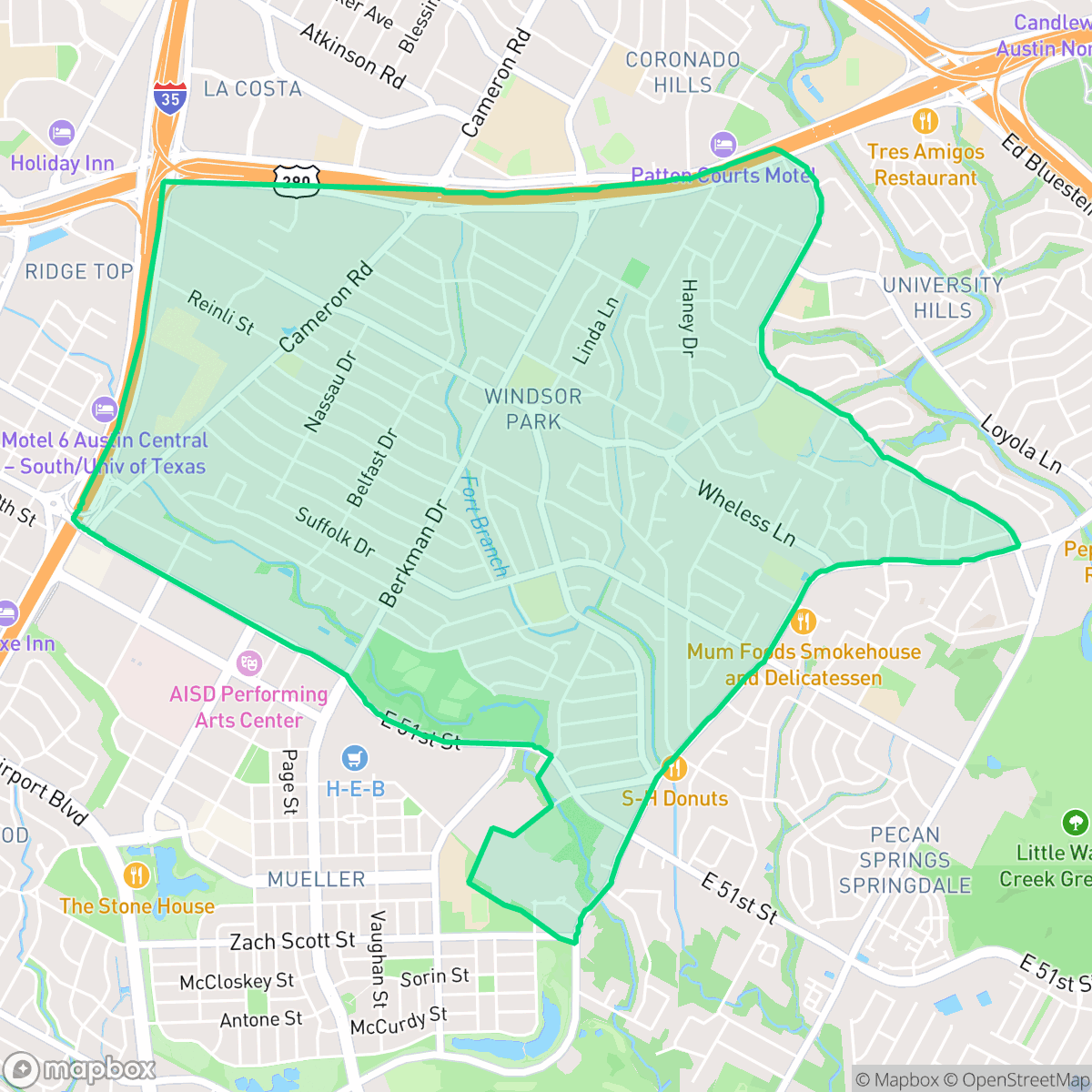
Established in 1954, Austin’s Windsor Park neighborhood serves as a well-preserved example of post-WWII suburbanization. Developed by local building giant Nash Phillips/Copus (NPC), the master-planned community began with 300 homes on 60 acres east of Cameron Road. Characterized by its classic mid-century modern ranch-style homes on spacious, tree-lined lots, the neighborhood captured the postwar American dream so perfectly that it was chosen as the first stop for a visiting delegation of Russian builders in October 1955 to showcase American middle-class life. Early commercial hubs like the Cameron Village shopping center (1958) and Capital Plaza (1960) quickly followed. Today, the neighborhood maintains its vintage aesthetic, anchored by local green spaces like Bartholomew District Park.
The neighborhood is situated near major highway interchanges, which provides residents with convenient access to the broader Austin metropolitan area. The landscape consists of a dense suburban mix of single-family homes and apartment complexes, interspersed with light commercial development. According to iHuus data, the area maintains a moderate level of urban density, balancing residential life with active commercial traffic along main roads like Cameron Road.
Potential residents should be aware of the acoustic environment, as proximity to major roads results in elevated noise levels. While the area features green spaces like Bartholomew District Park, overall walkability is limited by fragmented infrastructure and busy intersections. This neighborhood is well-suited for those who prioritize a central location and established community character over a high-scoring pedestrian environment or complete acoustic isolation.
Neighborhood Scores Across 15 Qualities
Neighboring structures vary from closely packed multi-family units to single-family homes with modest buffers between properties. This level of density is slightly higher than the Austin average, resulting in limited separation between adjacent lots.
A consistent sidewalk network and a grid-like street layout provide reliable pedestrian connectivity, though the southern highway remains a significant barrier to movement. Most residential streets are easy to navigate on foot, matching the typical walkability found across Austin.
Typical tract housing and apartment complexes define the area, featuring modest yards and shared amenities. The visual landscape is less varied than the Austin average due to uniform rooflines and dense residential spacing.
Residential yards and accessible school athletic fields provide decent space for pets, though the area lacks the abundance of dedicated public parks found in many other Austin neighborhoods. According to iHuus data, sidewalk greenery is present but does not match the city average for wide, grassy walking verges.
Dense suburban layouts featuring a blend of single-family homes and apartment complexes define the area. This landscape is slightly less developed than the Austin average, offering a mix of residential pockets and commercial retail structures according to iHuus data.
Diverse dining options and social hubs provide a more active atmosphere than the city average, though much of the area remains characterized by quiet, car-dependent suburban blocks. While some pockets offer lively street life near major thoroughfares, other sections are much more serene and focused on green space near local waterways.
Frequent noise from nearby major transit routes and rail lines is common in this area. According to iHuus data, the acoustic environment is consistent with the typical noise levels found across Austin.
Air quality levels in Windsor Park are consistent with the city average, characterized by a mix of acceptable and unhealthy days. Residents with respiratory sensitivities may experience occasional concern during certain periods, according to iHuus data.
Residential and light commercial uses dominate the area, with very few heavy industrial hazards or large warehouses visible. While some proximity to highway-adjacent retail may introduce minor activity, the neighborhood remains slightly more industrial-free than the Austin average according to iHuus data.
Health insurance access among residents is slightly above the Austin average, according to iHuus data.
Voting patterns and census indicators show a very high concentration of liberal-leaning residents, which is even more pronounced here than in the rest of Austin.
Residents live alongside a varied mix of young adults, families, and older individuals. This demographic distribution is largely consistent with the broader Austin area, according to iHuus data.
Significant flood risk exists here because portions of the neighborhood fall within a designated floodplain; according to iHuus data, this risk level is considerably higher than the Austin average.
Address-Level Insights for Windsor Park


iHuus Neighborhood Intelligence Insights
Get address-level neighborhood insights for Windsor Park
- Street-level scores — see how individual blocks compare, not just neighborhood averages
- Micro-zone boundaries — identify quiet pockets, flood boundaries, and walkable clusters before you visit
- 15 dimensions in full — walkability, noise, air quality, school quality, insurance coverage, population age profile, urban/rural index, and more
- Boundary risk alerts — know if your address sits near a block boundary where scores drop, the kind of detail no listing will ever mention
- School insights — individual school ratings and insights, not just district-level data
- Compare before you commit — side-by-side data across neighborhoods, down to block precision
No credit card required
Compare with Any Neighborhood
| Dimension | Windsor Park | Allandale |
|---|---|---|
| 🚶 Walkabilityavg 6.73 | ||
| 🔊 Acoustic Comfortavg 3.73 | ||
| 🤫 Privacy Indexavg 5.87 | ||
| 🎨 Visual Appealavg 6.95 | ||
| 🐕 Dog Friendlinessavg 6.92 | ||
| 🗺️ Urban-Rural Indexavg 7.09 | ||
| ✨ Neighborhood Vibeavg 4.91 | ||
| 🏥 Health Insurance Coverageavg 7.56 | ||
| 🌿 Air Qualityavg 5.17 | ||
| 🏭 Industrial Proximityavg 8.86 | ||
| 🌊 Flood Safetyavg 4.83 | ||
| 🗳️ Ideological Leanavg 9.13 | ||
| 👥 Population Age Profileavg 4.52 | ||
| 🔥 Fire Safety | ||
| 🏫 School Quality |
Windsor Park Rankings
School Districts Serving Windsor Park
School Insights for Windsor Park
Below average outcomes; significant attendance and academic challenges.
School Insights
See what's really behind every school rating near Windsor Park
- Individual school ratings — each school's own score with outcome context, not just a district average
- Enrollment & class size data — student-to-teacher ratio and how it compares to the state average
- Full demographics breakdown — ethnicity and gender composition for every school in the enrollment zone
- Every school in the district — all schools within the enrollment boundary ranked by rating, not just the closest one
- Grade levels & benchmarks — elementary through high school, with below/above state-average flags
No credit card required