Windsor Hills, Austin
Updated · 8,580 residents
Windsor Hills is an established northeast Austin neighborhood defined by its mid-century ranch homes and mature, tree-lined streets. The area offers a quiet, suburban atmosphere with reliable pedestrian access to local parks and schools while maintaining a practical, mixed-use character near major highway corridors.
Key Highlights
About Windsor Hills
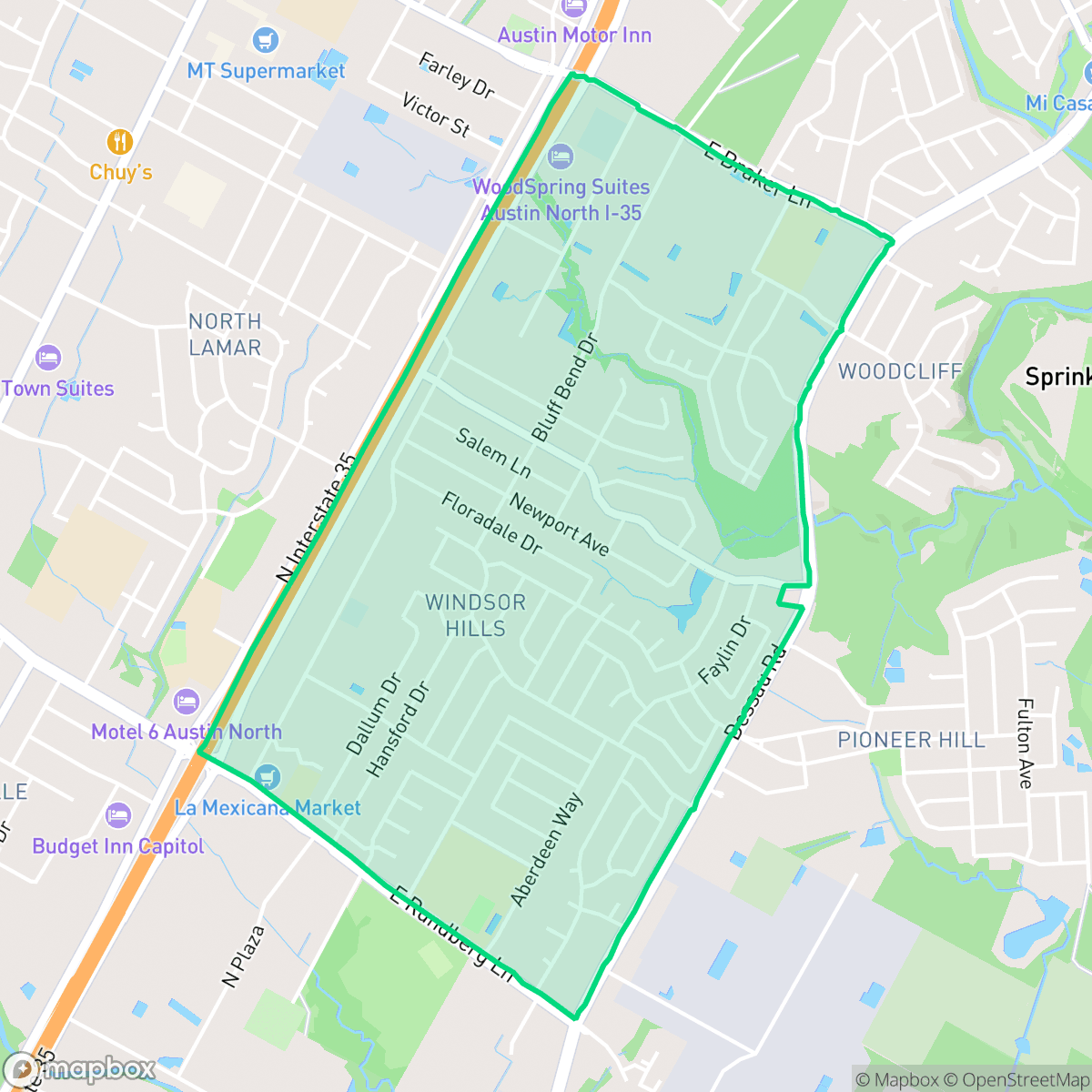
Located in northeast Austin, Windsor Hills was historically part of the rural community of Fiskville, with its land primarily used for farming and raising cattle. Suburban development began in the 1950s and 1960s when homebuilders Phillips and Copus began constructing residential subdivisions in the area. The neighborhood's housing stock predominantly features mid-to-late-century ranch-style homes built between the 1960s and 1980s, set along rolling streets shaded by mature, half-century-old heritage oak, pecan, and cedar elm trees. Formally annexed by the City of Austin in 2008, Windsor Hills sits adjacent to the historic Jourdan-Bachman Pioneer Farms, a living history museum on a preserved 1850s homestead that serves as a major local landmark.
Windsor Hills functions as a quiet residential enclave that balances suburban living with proximity to essential services and light industrial zones. Residents benefit from a grid-like street layout that supports moderate walkability, allowing for relatively easy access to neighborhood schools and green spaces. The presence of mature trees provides a distinct sense of place, while the local dining scene features diverse options that reflect the community's varied demographic.
Prospective residents should note that the neighborhood experiences a blend of residential and commercial activity, particularly near the western highway corridor. While the area offers superior flood safety compared to many parts of the city, acoustic comfort remains moderate due to consistent road traffic. It is well-suited for those seeking an established, budget-conscious community that prioritizes access to parks and functional transit routes over a high-density urban lifestyle.
Neighborhood Scores Across 15 Qualities
Residential spacing varies between multi-family units and single-family homes, resulting in a level of privacy that is slightly lower than the Austin average. Neighbors are occasionally situated close to property lines, particularly near apartment and industrial clusters according to iHuus data.
Quiet residential streets allow for casual walking, but a high-speed highway and disconnected sidewalks create significant barriers for pedestrians. According to iHuus data, walkability in this area is slightly lower than the Austin average.
Uniform rooflines and tidy but modest yards define the landscape here. The visual variety in Windsor Hills is lower than the Austin average, consisting primarily of mid-range tract housing and apartment complexes.
Residential lawns and a large park with trails in the southwest provide decent green space for pets, though overall dog friendliness is slightly below the Austin average. According to iHuus data, while street verges vary, certain areas offer good access to nearby parkland.
Open land and woodland areas are frequently interspersed with scattered homes, making this area slightly less dense than the Austin average. According to iHuus data, the landscape maintains a semi-rural feel despite the presence of some industrial and multi-family residential pockets.
A balanced mix of residential life and essential services creates a sense of activity that is consistent with the Austin average. While various dining and social spots provide local interest, the area's car-dependent nature and presence of light industrial units contribute to a quieter, suburban atmosphere.
Frequent disturbances from nearby freeway traffic and railroad proximity characterize the area. Acoustic comfort is slightly lower than the Austin average, according to iHuus data.
Frequent unhealthy air quality levels pose significant risks to sensitive groups. According to iHuus data, the air quality in this area is notably worse than the Austin average.
A blend of residential streets and commercial warehouses creates a varied landscape. Residents may encounter intermittent noise and heavy vehicle traffic from logistics hubs and nearby shipping corridors, which is more pronounced here than in many other parts of Austin.
Health insurance access is noticeably lower in this area compared to the Austin average, according to iHuus data.
Voting patterns and census indicators show a highly progressive political leaning that is even more pronounced than the Austin average, according to iHuus data.
Residents live alongside a balanced mix of young adults, families, and older populations. This age distribution is slightly more varied than the average seen across Austin.
Flood risk levels are currently difficult to determine because official federal studies for this area are incomplete. According to iHuus data, the level of precaution required is slightly higher than the Austin average due to this lack of detailed mapping.
Address-Level Insights for Windsor Hills


iHuus Neighborhood Intelligence Insights
Get address-level neighborhood insights for Windsor Hills
- Street-level scores — see how individual blocks compare, not just neighborhood averages
- Micro-zone boundaries — identify quiet pockets, flood boundaries, and walkable clusters before you visit
- 15 dimensions in full — walkability, noise, air quality, school quality, insurance coverage, population age profile, urban/rural index, and more
- Boundary risk alerts — know if your address sits near a block boundary where scores drop, the kind of detail no listing will ever mention
- School insights — individual school ratings and insights, not just district-level data
- Compare before you commit — side-by-side data across neighborhoods, down to block precision
No credit card required
Compare with Any Neighborhood
| Dimension | Windsor Hills | Allandale |
|---|---|---|
| 🚶 Walkabilityavg 6.73 | ||
| 🔊 Acoustic Comfortavg 3.73 | ||
| 🤫 Privacy Indexavg 5.87 | ||
| 🎨 Visual Appealavg 6.95 | ||
| 🐕 Dog Friendlinessavg 6.92 | ||
| 🗺️ Urban-Rural Indexavg 7.09 | ||
| ✨ Neighborhood Vibeavg 4.91 | ||
| 🏥 Health Insurance Coverageavg 7.56 | ||
| 🌿 Air Qualityavg 5.17 | ||
| 🏭 Industrial Proximityavg 8.86 | ||
| 🌊 Flood Safetyavg 4.83 | ||
| 🗳️ Ideological Leanavg 9.13 | ||
| 👥 Population Age Profileavg 4.52 | ||
| 🔥 Fire Safety | ||
| 🏫 School Quality |
Windsor Hills Rankings
School Districts Serving Windsor Hills
School Insights for Windsor Hills
Below average outcomes; significant attendance and academic challenges.
School Insights
See what's really behind every school rating near Windsor Hills
- Individual school ratings — each school's own score with outcome context, not just a district average
- Enrollment & class size data — student-to-teacher ratio and how it compares to the state average
- Full demographics breakdown — ethnicity and gender composition for every school in the enrollment zone
- Every school in the district — all schools within the enrollment boundary ranked by rating, not just the closest one
- Grade levels & benchmarks — elementary through high school, with below/above state-average flags
No credit card required