West University, Austin
Updated · 14,115 residents
West University is a dense, highly walkable neighborhood adjacent to the University of Texas, defined by a mix of historic homes and modern high-rise student housing. The area offers a vibrant lifestyle with diverse dining options and proximity to green belts, though residents should expect significant noise from road traffic.
Key Highlights
About West University
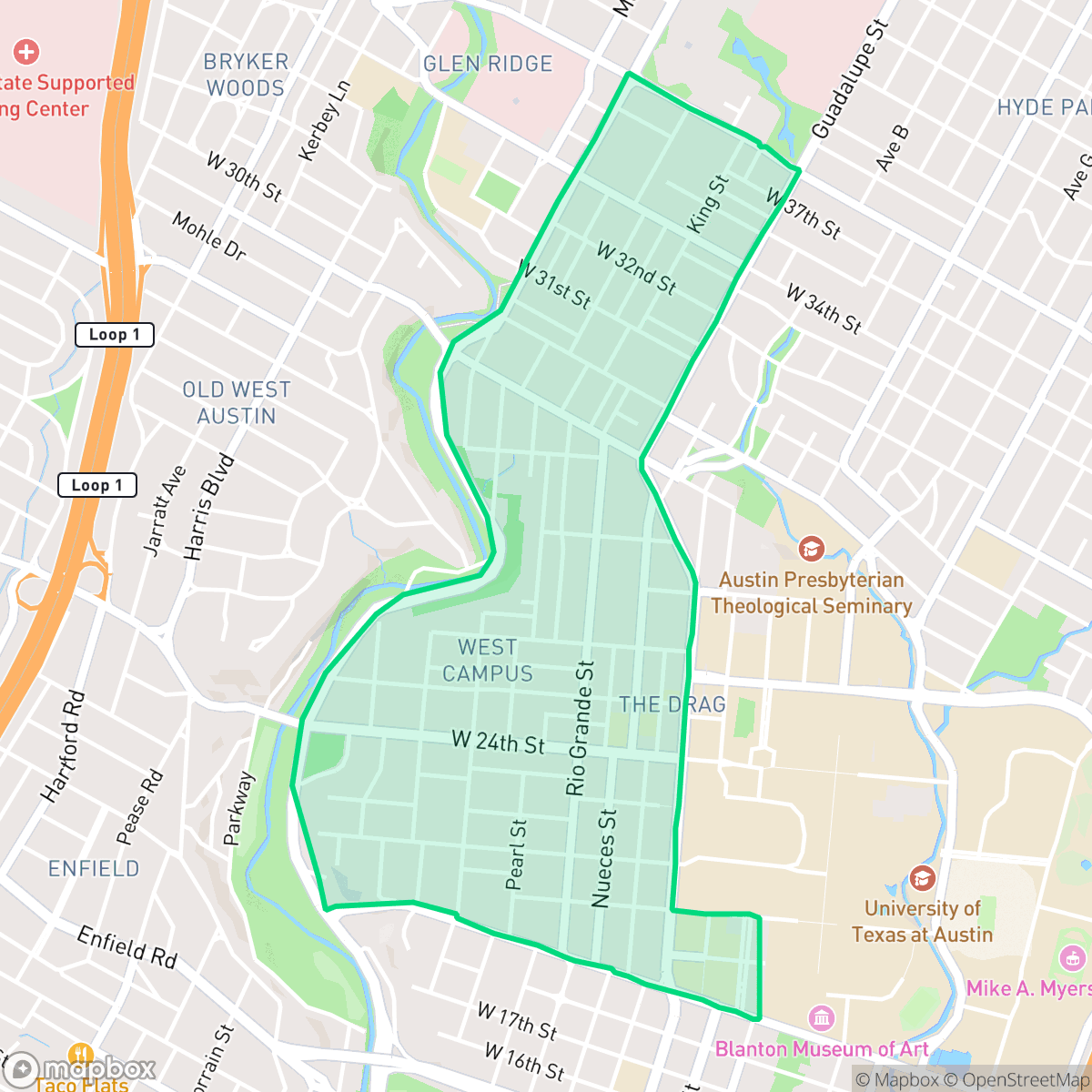
West University, also known as West Campus, is a central Austin neighborhood with a rich, multi-layered history. In 1867, former slave James Wheat founded Wheatville here, Austin’s first post-Civil War Black community. The neighborhood's historic cornerstone, the 1869 Franzetti Store building on San Gabriel Street, originally housed the First (Colored) Baptist Church and the Gold Dollar, one of Texas's first Black-owned newspapers, published by Reverend Jacob Fontaine. Following discriminatory municipal zoning in 1928, Wheatville’s Black population was displaced. By the mid-20th century, fueled by the GI Bill and the Austin Plan of 1958, West University transitioned into a dense student enclave for the adjacent University of Texas. Today, its eastern border along Guadalupe Street, known as "The Drag," serves as a bustling commercial hub, while the 2004 University Neighborhood Overlay (UNO) has reshaped its skyline with high-rise student housing.
Characterized by its dense grid and high walkability, the area serves as a primary residential hub for students and faculty. The landscape is a distinct blend of traditional single-family homes with manicured grounds and modern high-rise developments that have transformed the local skyline. Residents benefit from consistent access to diverse dining and cultural destinations, with the neighborhood maintaining a strong sense of connectivity to both the university campus and the broader city center. According to iHuus data, the area is free from industrial hazards and maintains relatively high health insurance coverage among its population.
While the neighborhood offers excellent pedestrian accessibility and proximity to wooded green belts, prospective residents should consider the trade-offs of living in a high-density environment. The area experiences elevated noise levels primarily due to constant road traffic, and the demographic profile skews heavily toward a younger, student-aged population. Families considering the area should note that while it falls within the Austin Independent School District, the district faces ongoing budgetary and operational transitions. The neighborhood is best suited for those who prioritize proximity to campus, a vibrant urban atmosphere, and the convenience of walking to daily amenities.
Neighborhood Scores Across 15 Qualities
Physical privacy varies significantly across the area, ranging from densely packed apartment complexes to single-family homes with wooded buffers. According to iHuus data, the level of separation between neighbors is slightly lower than the Austin city average.
Pedestrian-oriented street grids and safe campus connections make navigating the area on foot much easier than the Austin average. Most residential and commercial zones feature well-defined sidewalks and marked crosswalks, according to iHuus data.
Manicured grounds, custom architecture, and high-end amenities create a visually pleasing environment that is more aesthetically refined than the Austin average. According to iHuus data, the area is characterized by well-maintained residential properties and modern, high-value multi-family complexes.
Abundant tree canopy, university lawns, and proximity to large western greenbelts provide excellent exercise opportunities. This accessibility to shaded walking paths and wooded areas is notably higher than the Austin average.
Residential streets and green spaces exist in equal measure with low-rise urban density. According to iHuus data, this environment is less densely urbanized than the Austin average.
Diverse dining destinations and social hubs create an atmosphere that is significantly more energetic than the Austin average. While some pockets offer high-density urban activity, other areas remain more suburban and car-dependent according to iHuus data.
Steady sounds from nearby busy streets are present, though acoustic levels remain more moderate than the Austin average according to iHuus data.
Air quality levels are generally acceptable but can reach levels that cause concern for sensitive groups on certain days; this is slightly better than the Austin city average according to iHuus data.
Industrial activity and heavy warehouses are entirely absent from this area. According to iHuus data, the neighborhood consists solely of residential, educational, and commercial zones, offering a cleaner environment than the Austin average.
Health insurance accessibility is higher than the Austin average, according to iHuus data. This indicates a more stable level of medical coverage among the local resident population.
Voting patterns and census indicators show a deeply liberal leaning that is even more pronounced than the Austin city average, according to iHuus data.
A significant majority of residents are young adults, making the demographic much younger than the Austin average. According to iHuus data, there is a minimal presence of older residents or established families in the area.
Flood safety levels in this area are slightly below the Austin average because FEMA has not yet completed a detailed flood study for this specific location. Residents should remain cautious as the risk level is currently categorized as undetermined.
Address-Level Insights for West University


iHuus Neighborhood Intelligence Insights
Get address-level neighborhood insights for West University
- Street-level scores — see how individual blocks compare, not just neighborhood averages
- Micro-zone boundaries — identify quiet pockets, flood boundaries, and walkable clusters before you visit
- 15 dimensions in full — walkability, noise, air quality, school quality, insurance coverage, population age profile, urban/rural index, and more
- Boundary risk alerts — know if your address sits near a block boundary where scores drop, the kind of detail no listing will ever mention
- School insights — individual school ratings and insights, not just district-level data
- Compare before you commit — side-by-side data across neighborhoods, down to block precision
No credit card required
Compare with Any Neighborhood
| Dimension | West University | Allandale |
|---|---|---|
| 🚶 Walkabilityavg 6.73 | ||
| 🔊 Acoustic Comfortavg 3.73 | ||
| 🤫 Privacy Indexavg 5.87 | ||
| 🎨 Visual Appealavg 6.95 | ||
| 🐕 Dog Friendlinessavg 6.92 | ||
| 🗺️ Urban-Rural Indexavg 7.09 | ||
| ✨ Neighborhood Vibeavg 4.91 | ||
| 🏥 Health Insurance Coverageavg 7.56 | ||
| 🌿 Air Qualityavg 5.17 | ||
| 🏭 Industrial Proximityavg 8.86 | ||
| 🌊 Flood Safetyavg 4.83 | ||
| 🗳️ Ideological Leanavg 9.13 | ||
| 👥 Population Age Profileavg 4.52 | ||
| 🔥 Fire Safety | ||
| 🏫 School Quality |
West University Rankings
School Districts Serving West University
School Insights for West University
Below average outcomes; significant attendance and academic challenges.
School Insights
See what's really behind every school rating near West University
- Individual school ratings — each school's own score with outcome context, not just a district average
- Enrollment & class size data — student-to-teacher ratio and how it compares to the state average
- Full demographics breakdown — ethnicity and gender composition for every school in the enrollment zone
- Every school in the district — all schools within the enrollment boundary ranked by rating, not just the closest one
- Grade levels & benchmarks — elementary through high school, with below/above state-average flags
No credit card required