West Oak Hill, Austin
Updated · 17,966 residents
West Oak Hill is a suburban community defined by its rugged Hill Country terrain and a blend of residential cul-de-sacs and natural forest cover. While the area offers high visual appeal and a quiet, low-density environment, residents rely heavily on personal vehicles for daily errands due to limited walkability.
Key Highlights
About West Oak Hill
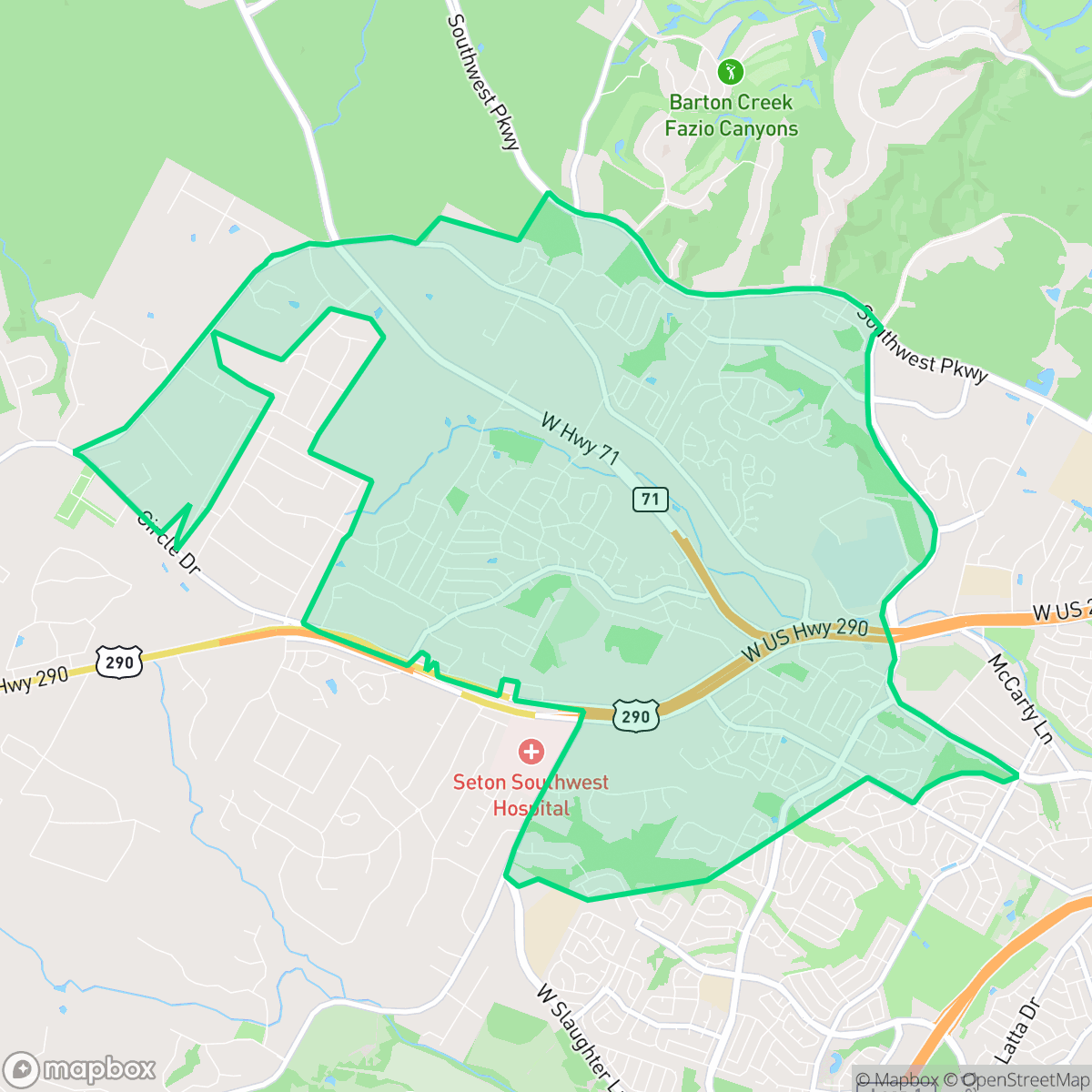
Originally settled in the 1840s on a Mexican land grant awarded to William Cannon, the West Oak Hill area was historically known as Live Oak Springs and Oatmanville before adopting its current name in 1900. The neighborhood’s history is deeply tied to its natural resources; in the 1880s, limestone was quarried here—often using convict labor—to rebuild the Texas State Capitol, a legacy preserved at Convict Hill Quarry Park. A prominent local landmark is the "Old Rock Store" on US Highway 290, a two-story hand-tooled limestone building erected in 1898 by former Texas Ranger James A. Patton. Today, West Oak Hill is defined by its signature "Y" intersection where Highways 290 and 71 split, blending its rugged Hill Country heritage of oak canopies and historic stone structures with modern suburban growth.
The neighborhood functions as a transition zone between dense suburban development and the natural beauty of the Texas Hill Country. With significant preserved natural hilly terrain and abundant tree canopy, the area provides a serene, low-density living experience. According to iHuus data, the area maintains a high degree of privacy and visual appeal, characterized by a mix of residential clusters and scattered commercial footprints. While it lacks the dense, walkable urban core found in other parts of Austin, it offers a stable environment with high rates of health insurance coverage and a quiet atmosphere that balances residential space with accessible essential services.
Living here requires a car, as the layout is largely designed for suburban commuting rather than pedestrian transit. Prospective residents should note that while the neighborhood is largely free from industrial hazards, proximity to major highway corridors like the Y intersection contributes to consistent road traffic noise. The community is well-suited for those who prioritize a quiet, green setting over proximity to nightlife or high-density entertainment hubs, and who are comfortable with the car-dependent nature of the outer suburban landscape.
Neighborhood Scores Across 15 Qualities
Detached homes feature moderate setbacks and significant wooded buffers that provide more separation than the Austin average. According to iHuus data, many properties maintain a comfortable distance from neighbors through natural vegetation and varied spacing.
Low-traffic residential streets and cul-de-sacs provide safe walking paths, though the heavy tree canopy often obscures available sidewalks. Overall walkability is slightly below the Austin average due to these limited pedestrian infrastructure features.
Large homes featuring complex architectural details and private swimming pools characterize the area. According to iHuus data, the visual landscape is notably more polished than the Austin average.
Wooded buffers and continuous green verges provide ample space for pets to roam safely. According to iHuus data, these connected green spaces offer slightly less accessibility to off-leash areas than the Austin average.
Low-density residential layouts and significant tree canopy provide a more open, wooded atmosphere than the typical Austin urban landscape. According to iHuus data, this area features more frequent open land and scattered homes nestled within hilly terrain compared to the city average.
Suburban landscapes and rural pockets dominate the area, offering a tranquil environment with significantly less commercial activity than the Austin average. Most residents will find a peaceful atmosphere characterized by low-density housing and limited access to high-traffic social hubs.
Steady hums from nearby busy streets create a consistent background sound, though acoustic conditions are slightly more tranquil than the Austin average according to iHuus data.
Air quality levels here can fluctuate between acceptable and unhealthy, posing occasional concerns for sensitive groups. According to iHuus data, the air quality in West Oak Hill is lower than the Austin city average.
Industrial activity is virtually non-existent here, as the area lacks warehouses, factories, or hazardous sites. This lack of heavy industry makes the neighborhood significantly cleaner of industrial blight than the Austin average.
Health insurance access is widespread among residents here, appearing more consistent than the average found across Austin according to iHuus data.
Political leanings in this area are predominantly liberal, though the concentration is slightly lower than the Austin city average according to iHuus data.
A balanced mix of young adults, families, and older residents characterizes the local demographic. This age distribution is slightly more varied than the average seen across Austin.
Flood risk in this area is slightly higher than the Austin average, though detailed studies from FEMA are currently unavailable for this specific neighborhood. Residents should remain cautious as the precise level of vulnerability has not been fully documented.
Address-Level Insights for West Oak Hill


iHuus Neighborhood Intelligence Insights
Get address-level neighborhood insights for West Oak Hill
- Street-level scores — see how individual blocks compare, not just neighborhood averages
- Micro-zone boundaries — identify quiet pockets, flood boundaries, and walkable clusters before you visit
- 15 dimensions in full — walkability, noise, air quality, school quality, insurance coverage, population age profile, urban/rural index, and more
- Boundary risk alerts — know if your address sits near a block boundary where scores drop, the kind of detail no listing will ever mention
- School insights — individual school ratings and insights, not just district-level data
- Compare before you commit — side-by-side data across neighborhoods, down to block precision
No credit card required
Compare with Any Neighborhood
| Dimension | West Oak Hill | Allandale |
|---|---|---|
| 🚶 Walkabilityavg 6.73 | ||
| 🔊 Acoustic Comfortavg 3.73 | ||
| 🤫 Privacy Indexavg 5.87 | ||
| 🎨 Visual Appealavg 6.95 | ||
| 🐕 Dog Friendlinessavg 6.92 | ||
| 🗺️ Urban-Rural Indexavg 7.09 | ||
| ✨ Neighborhood Vibeavg 4.91 | ||
| 🏥 Health Insurance Coverageavg 7.56 | ||
| 🌿 Air Qualityavg 5.17 | ||
| 🏭 Industrial Proximityavg 8.86 | ||
| 🌊 Flood Safetyavg 4.83 | ||
| 🗳️ Ideological Leanavg 9.13 | ||
| 👥 Population Age Profileavg 4.52 | ||
| 🔥 Fire Safety | ||
| 🏫 School Quality |
West Oak Hill Rankings
School Districts Serving West Oak Hill
School Insights for West Oak Hill
Below average outcomes; significant attendance and academic challenges.
School Insights
See what's really behind every school rating near West Oak Hill
- Individual school ratings — each school's own score with outcome context, not just a district average
- Enrollment & class size data — student-to-teacher ratio and how it compares to the state average
- Full demographics breakdown — ethnicity and gender composition for every school in the enrollment zone
- Every school in the district — all schools within the enrollment boundary ranked by rating, not just the closest one
- Grade levels & benchmarks — elementary through high school, with below/above state-average flags
No credit card required