West Congress, Austin
Updated · 3,262 residents
West Congress is a South Austin neighborhood defined by its mix of mid-century ranch homes and proximity to the unique Cathedral of Junk. While the area offers a vibrant, community-focused atmosphere, residents rely heavily on vehicles due to limited walkability and experience higher noise levels from nearby major roadways.
Key Highlights
About West Congress
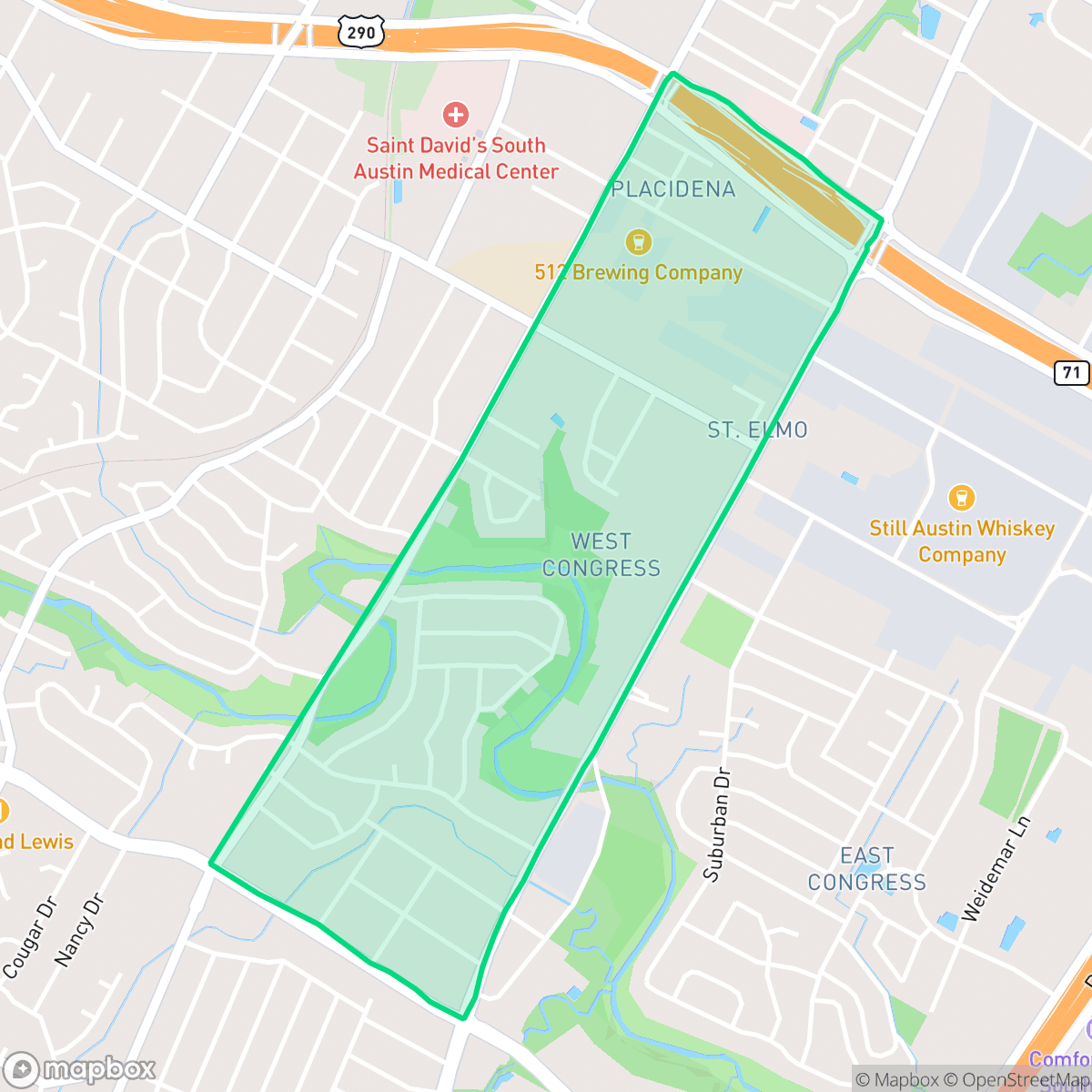
Located in South Austin, the West Congress neighborhood is bounded by Ben White Boulevard to the north, South Congress Avenue to the east, West Stassney Lane to the south, and South 1st Street to the west. Developed primarily in the mid-to-late 20th century, the area features a mix of mid-century ranch-style homes and contemporary residential infill, bisected by the lush canopy of Williamson Creek. West Congress is most famously home to the Cathedral of Junk, a towering, three-story backyard folk art structure created by local artist Vince Hannemann on Lareina Drive. Hannemann began compiling the massive, 60-ton sculpture from discarded bicycles, signs, and household items in 1988, cementing the neighborhood's association with Austin's eccentric cultural identity. The area's formal development guidelines were solidified with the adoption of the West Congress Neighborhood Plan in 2005.
The neighborhood functions as a blend of residential quiet and active commercial corridors. With its location bounded by key transit arteries like Ben White Boulevard, the area provides convenient access to the rest of Austin. According to iHuus data, the community maintains a lively vibe that exceeds the city average, supported by diverse local dining options along the main thoroughfares. The landscape is characterized by a mix of mature trees and a variety of housing styles, ranging from original mid-century builds to newer residential infill.
Prospective residents should note that the neighborhood is largely car-dependent, with few daily errands easily reachable on foot. The area faces challenges regarding acoustic comfort, as road traffic noise is a significant factor for many households. Furthermore, the local flood safety and air quality metrics suggest that buyers should conduct thorough due diligence when selecting a property. It is best suited for those who prioritize a strong sense of community and convenient access to South Austin amenities over quiet, pedestrian-friendly streets.
Neighborhood Scores Across 15 Qualities
Homes feature a moderate amount of spacing with significant mature tree growth providing a natural buffer between neighbors. This level of separation is roughly consistent with the Austin average.
Pedestrian infrastructure is limited due to a lack of sidewalks across much of the area. However, low traffic volumes on residential streets and cul-de-sacs make walking less hazardous than the city average.
Large residences, private pools, and spacious driveways characterize the area, though the overall visual aesthetic sits slightly below the Austin average. According to iHuus data, the landscape is defined by affluent suburban features and well-maintained amenities.
Residential loops feature significant tree cover and soft shoulders for walking, but formal wide verges are less common than in the broader Austin area. According to iHuus data, direct access to large public parks is inconsistent across the neighborhood.
Lush tree canopies and scattered single-family homes define this area; according to iHuus data, the level of open land and wooded space is very similar to the Austin average.
Diverse dining and social hubs provide a more active atmosphere than much of Austin, though many areas remain car-dependent. According to iHuus data, the neighborhood features a mix of lively social spots and quieter, suburban pockets near industrial and railway zones.
Local traffic from nearby busy streets creates a persistent background noise level that is slightly higher than the Austin average. According to iHuus data, this area experiences moderate acoustic activity throughout the day.
Frequent unhealthy air quality levels pose a significant risk to sensitive groups. According to iHuus data, the air quality in West Congress is notably worse than the Austin average.
Minimal industrial presence and a lack of heavy warehouses provide a peaceful environment. While slightly lower than the Austin average for industrial separation, the area remains predominantly residential with only light commercial activity nearby.
Health insurance access among West Congress residents is slightly lower than the Austin city average, according to iHuus data.
Voting patterns and census indicators show a predominantly liberal political leaning, which is more pronounced here than the city average according to iHuus data.
Residents experience a balanced demographic mix of young professionals, families, and older adults. This age distribution is slightly more varied than the average seen across Austin.
Flood safety levels are slightly below the Austin average because FEMA has not yet finalized detailed flood studies for this specific area. According to iHuus data, the risk level remains undetermined.
Address-Level Insights for West Congress


iHuus Neighborhood Intelligence Insights
Get address-level neighborhood insights for West Congress
- Street-level scores — see how individual blocks compare, not just neighborhood averages
- Micro-zone boundaries — identify quiet pockets, flood boundaries, and walkable clusters before you visit
- 15 dimensions in full — walkability, noise, air quality, school quality, insurance coverage, population age profile, urban/rural index, and more
- Boundary risk alerts — know if your address sits near a block boundary where scores drop, the kind of detail no listing will ever mention
- School insights — individual school ratings and insights, not just district-level data
- Compare before you commit — side-by-side data across neighborhoods, down to block precision
No credit card required
Compare with Any Neighborhood
| Dimension | West Congress | Allandale |
|---|---|---|
| 🚶 Walkabilityavg 6.73 | ||
| 🔊 Acoustic Comfortavg 3.73 | ||
| 🤫 Privacy Indexavg 5.87 | ||
| 🎨 Visual Appealavg 6.95 | ||
| 🐕 Dog Friendlinessavg 6.92 | ||
| 🗺️ Urban-Rural Indexavg 7.09 | ||
| ✨ Neighborhood Vibeavg 4.91 | ||
| 🏥 Health Insurance Coverageavg 7.56 | ||
| 🌿 Air Qualityavg 5.17 | ||
| 🏭 Industrial Proximityavg 8.86 | ||
| 🌊 Flood Safetyavg 4.83 | ||
| 🗳️ Ideological Leanavg 9.13 | ||
| 👥 Population Age Profileavg 4.52 | ||
| 🔥 Fire Safety | ||
| 🏫 School Quality |
West Congress Rankings
School Districts Serving West Congress
School Insights for West Congress
Below average outcomes; significant attendance and academic challenges.
School Insights
See what's really behind every school rating near West Congress
- Individual school ratings — each school's own score with outcome context, not just a district average
- Enrollment & class size data — student-to-teacher ratio and how it compares to the state average
- Full demographics breakdown — ethnicity and gender composition for every school in the enrollment zone
- Every school in the district — all schools within the enrollment boundary ranked by rating, not just the closest one
- Grade levels & benchmarks — elementary through high school, with below/above state-average flags
No credit card required