Upper Boggy Creek, Austin
Updated · 6,231 residents
Upper Boggy Creek is a central Austin neighborhood defined by its mix of historic residential enclaves and proximity to major transit corridors. Residents enjoy high walkability and access to local green spaces, though the area experiences significant noise levels due to its location near major roadways.
Key Highlights
About Upper Boggy Creek
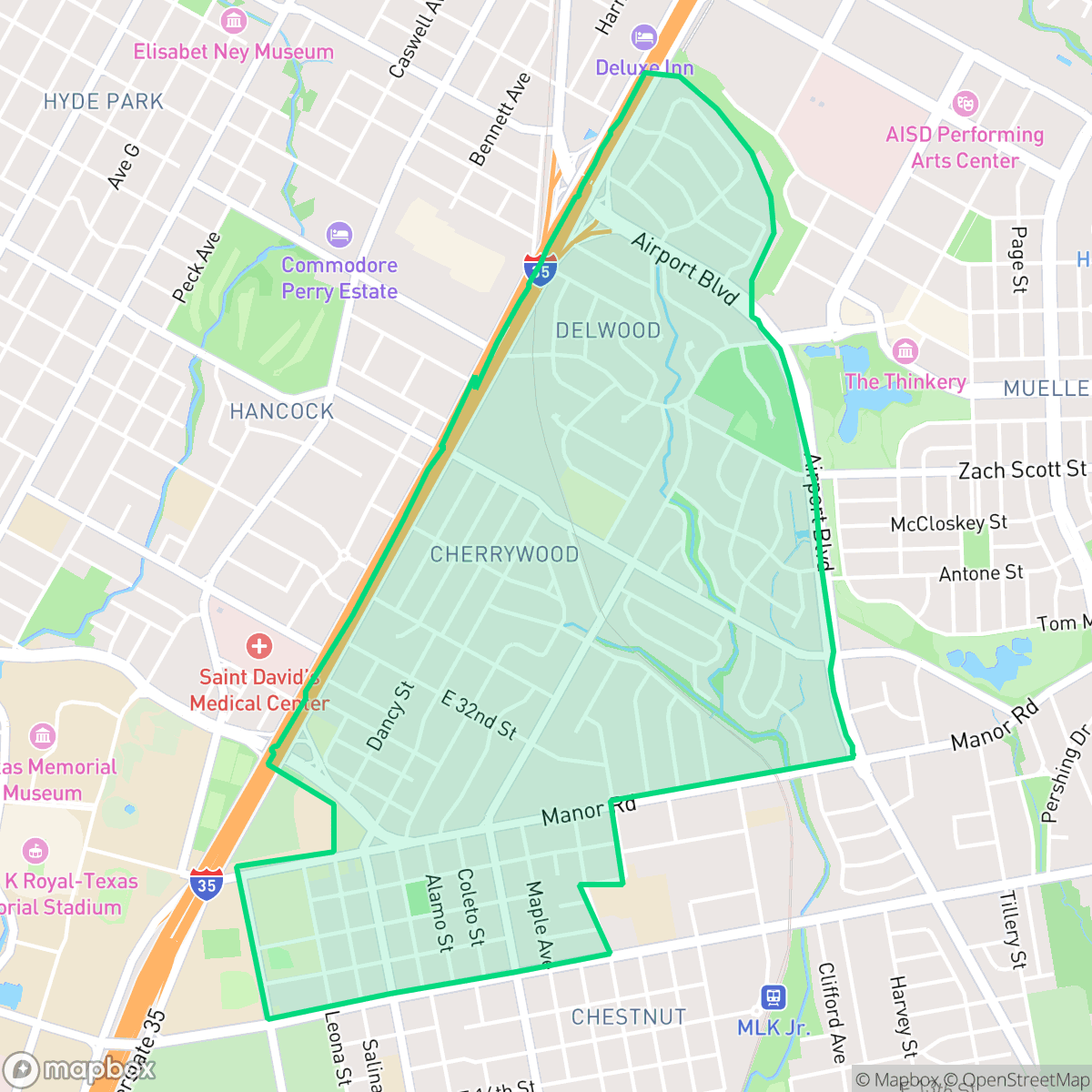
Upper Boggy Creek, an east-central Austin neighborhood bounded by Interstate 35 and Airport Boulevard, evolved from 19th-century agrarian roots—including a historic French family dairy farm—into a vibrant residential hub. The area comprises distinct sub-districts like French Place and Blackland. Following Austin’s segregationist 1928 Master Plan, Blackland transitioned from a Swedish enclave into a historically Black neighborhood. By the 1970s and 1980s, residents faced intense pressure from Interstate 35 and University of Texas expansions. This sparked fierce local activism, leading to the 1983 founding of the Blackland Community Development Corporation to preserve affordable housing and the 1980s formation of the Upper Boggy Creek Neighborhood Association. Today, the neighborhood maintains its bohemian, civic-minded character, anchored by local landmarks like Patterson Neighborhood Park, the historic Downs-Mabson Field, and the Upper Boggy Creek Trail.
The area features a diverse blend of housing, ranging from single-family homes to apartment complexes, set against a backdrop of established trees and institutional facilities. It serves as a central hub for those seeking a balance between urban accessibility and community-focused living, with local landmarks like Patterson Neighborhood Park and Downs-Mabson Field providing essential outdoor space. According to iHuus data, the neighborhood maintains a strong civic identity, supported by active community organizations that prioritize local preservation and resident engagement. The environment is characterized by a mix of residential and light commercial activity, with no significant industrial hazards present. While the area offers excellent walkability and proximity to dining and amenities, potential residents should note that acoustic comfort is a primary trade-off. Due to the proximity of major highways, road noise is a persistent factor for many blocks. However, the neighborhood remains highly desirable for those who value a central location, strong health insurance coverage, and a socially conscious environment. It is particularly well-suited for families and professionals who prioritize neighborhood connectivity and access to high-performing educational resources like Maplewood Elementary.
Neighborhood Scores Across 15 Qualities
Neighboring structures are spaced with a moderate amount of buffer between lots, providing a level of seclusion that is roughly in line with the Austin average. According to iHuus data, the density varies from single homes to apartments, though most residences maintain a typical suburban distance from one another.
Pedestrian movement is easy due to a grid-based street pattern with sidewalks and frequent crosswalks. This level of accessibility is notably higher than the Austin city average, though dense tree canopy can occasionally obscure some paths.
Residential streetscapes feature a mix of modest single-family homes and multi-family complexes with shared amenities. This visual environment is slightly below the Austin average for aesthetic variety and upscale features, according to iHuus data.
Abundant green space and large public parks in the north provide more opportunities for pet activity than the Austin average. Mature tree canopies and wide residential verges offer shaded, low-traffic routes for walking dogs.
Frequent open land and scattered homes amidst woodland provide a more rural feel than the typical Austin urban density. According to iHuus data, this area features a lower level of urbanization compared to the city average.
Active social pockets and diverse dining options provide a notable level of energy that is significantly higher than the Austin average. While suburban blocks offer calm green spaces, the area features a concentrated mix of local cafes and eateries according to iHuus data.
Frequent sounds from nearby heavy transit corridors and rail lines characterize this area. According to iHuus data, acoustic comfort in this neighborhood is slightly below the Austin average.
Air quality fluctuates between acceptable and unhealthy levels, though conditions are generally better than the Austin average. According to iHuus data, sensitive groups may experience occasional concern during certain periods.
Land use in this area is strictly residential, medical, and recreational, with no detectable warehouses or heavy industrial hazards. This lack of industrial activity is even more pronounced here than in the rest of Austin, according to iHuus data.
Health insurance access is exceptionally high among residents here, significantly outpacing the Austin average according to iHuus data.
Voting patterns and census indicators show a deeply liberal leaning that is even more pronounced than the Austin city average, according to iHuus data.
Residents live alongside a balanced mix of young adults, families, and seniors. This age distribution is largely in line with the broader Austin area.
Flood risk levels in this area are slightly above the Austin average, though FEMA has not yet completed a detailed study to finalize the risk profile. Residents should remain cautious as the specific vulnerability of properties in this neighborhood remains undetermined.
Address-Level Insights for Upper Boggy Creek


iHuus Neighborhood Intelligence Insights
Get address-level neighborhood insights for Upper Boggy Creek
- Street-level scores — see how individual blocks compare, not just neighborhood averages
- Micro-zone boundaries — identify quiet pockets, flood boundaries, and walkable clusters before you visit
- 15 dimensions in full — walkability, noise, air quality, school quality, insurance coverage, population age profile, urban/rural index, and more
- Boundary risk alerts — know if your address sits near a block boundary where scores drop, the kind of detail no listing will ever mention
- School insights — individual school ratings and insights, not just district-level data
- Compare before you commit — side-by-side data across neighborhoods, down to block precision
No credit card required
Compare with Any Neighborhood
| Dimension | Upper Boggy Creek | Allandale |
|---|---|---|
| 🚶 Walkabilityavg 6.73 | ||
| 🔊 Acoustic Comfortavg 3.73 | ||
| 🤫 Privacy Indexavg 5.87 | ||
| 🎨 Visual Appealavg 6.95 | ||
| 🐕 Dog Friendlinessavg 6.92 | ||
| 🗺️ Urban-Rural Indexavg 7.09 | ||
| ✨ Neighborhood Vibeavg 4.91 | ||
| 🏥 Health Insurance Coverageavg 7.56 | ||
| 🌿 Air Qualityavg 5.17 | ||
| 🏭 Industrial Proximityavg 8.86 | ||
| 🌊 Flood Safetyavg 4.83 | ||
| 🗳️ Ideological Leanavg 9.13 | ||
| 👥 Population Age Profileavg 4.52 | ||
| 🔥 Fire Safety | ||
| 🏫 School Quality |
Upper Boggy Creek Rankings
School Districts Serving Upper Boggy Creek
School Insights for Upper Boggy Creek
Below average outcomes; significant attendance and academic challenges.
School Insights
See what's really behind every school rating near Upper Boggy Creek
- Individual school ratings — each school's own score with outcome context, not just a district average
- Enrollment & class size data — student-to-teacher ratio and how it compares to the state average
- Full demographics breakdown — ethnicity and gender composition for every school in the enrollment zone
- Every school in the district — all schools within the enrollment boundary ranked by rating, not just the closest one
- Grade levels & benchmarks — elementary through high school, with below/above state-average flags
No credit card required