University of Texas, Austin
Updated · 9,268 residents
The University of Texas neighborhood is an exceptionally walkable, high-density urban hub defined by its proximity to campus life and a vibrant mix of student-focused dining and social venues. While the area offers unmatched convenience and a lively atmosphere, residents experience limited privacy due to the dense, multi-story residential architecture and frequent road traffic noise.
Key Highlights
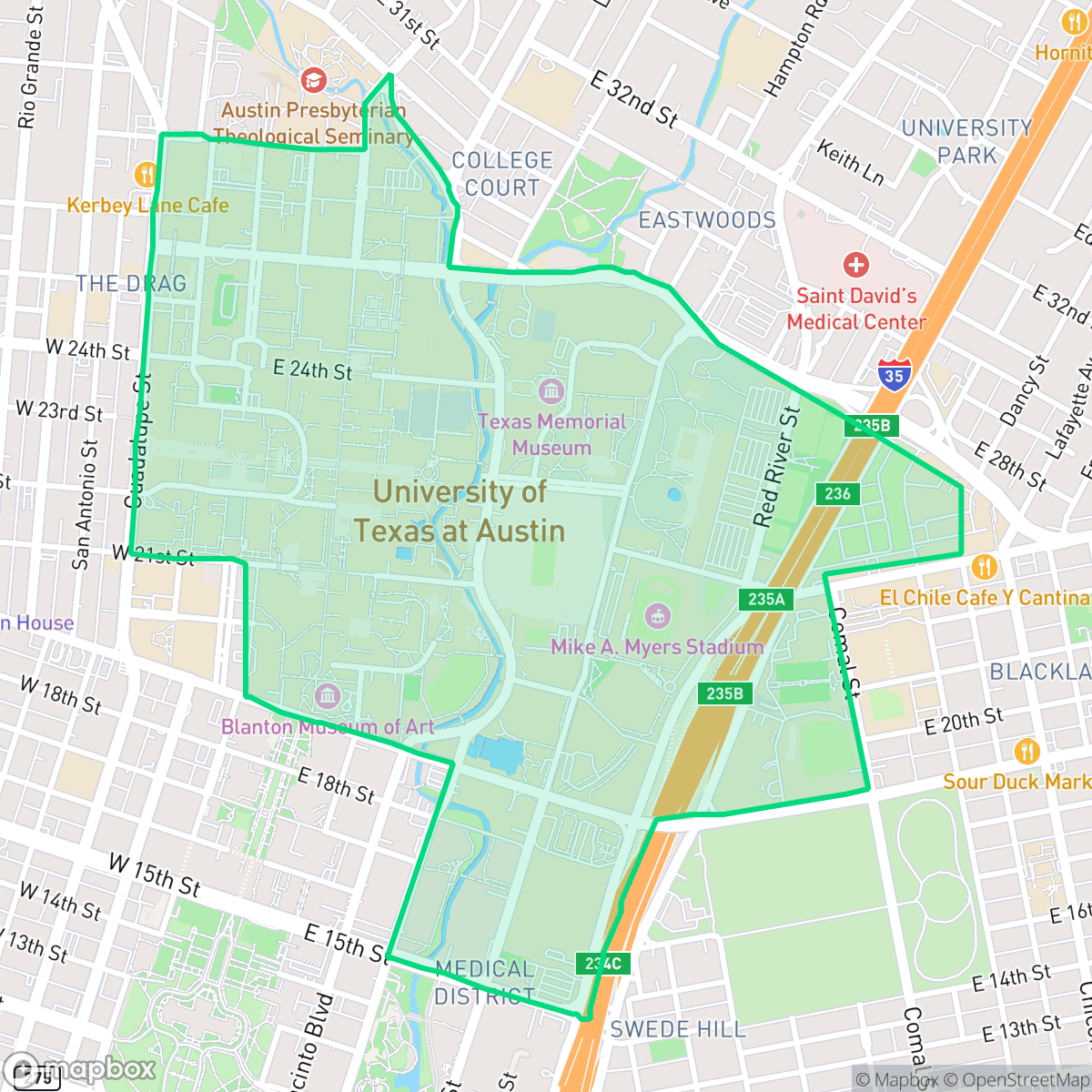
About University of Texas
The University of Texas neighborhood in Austin, encompassing West Campus and North University, has a rich history tied directly to the university’s 1883 founding on the "Forty Acres". Originally, the area included Wheatville, Austin’s first post-Civil War Black community, founded in 1867 by James Wheat. In 1871, the Whitis Addition became the first subdivision north of the campus. During the early 20th century, the neighborhood experienced a housing boom to accommodate UT faculty and students, leaving a legacy of Spanish Eclectic and vernacular architecture. The 1958 Austin Plan dramatically reshaped the area by rezoning West Campus for dense apartment developments, transforming the historic residential streets into a high-density student housing hub. Today, the neighborhood's character is defined by its proximity to campus, historic landmarks, and rapid urbanization.
Centered around the university campus, this area functions as a dense, pedestrian-oriented environment where institutional buildings, modern mid-rise apartments, and sports facilities dominate the landscape. The neighborhood maintains a high level of accessibility, with a robust network of sidewalks and clear pathways that make daily errands and campus commutes seamless. According to iHuus data, the area is entirely free from industrial hazards, creating a clean, institutional setting that caters to a young, transient population. The high density of the area ensures that essential services and social spots are always within a short walk.
Prospective residents should note that the neighborhood is characterized by a younger demographic and a high-energy environment, which results in moderate noise levels from nearby traffic. While the abundance of campus quads and lawns provides ample space for pets, the area lacks the seclusion found in more suburban settings, as many residential buildings are closely spaced. Those considering a move here should be aware that the area has a low flood safety rating, making it important to review specific property locations. It is an ideal location for students, faculty, and professionals who value a car-free lifestyle and immediate access to the city's academic and social core.
Neighborhood Scores Across 15 Qualities
High-density academic and residential buildings often sit closely together, resulting in less personal buffer between neighbors than the Austin average. According to iHuus data, the mix of multi-story structures and shared walls creates frequent visual and physical proximity to surrounding residents.
Pedestrian-oriented layouts and wide sidewalk networks make navigating the area on foot much easier than the Austin average. Extensive crosswalks and a dense grid connect residential streets directly to the university campus.
Architectural diversity ranges from modern apartment amenities and high-value institutional buildings to well-maintained residential structures. This area offers a slightly more visually engaging landscape than the Austin average according to iHuus data.
Extensive campus quads, tree-lined streets, and connected green spaces provide many safe areas for pets. According to iHuus data, these accessible walking paths and grassy verges make the area more dog-friendly than the Austin average.
Large institutional blocks and residential streets provide a balance of built environment and open space. This area feels significantly less dense than the typical Austin urban core according to iHuus data.
Vibrant urban density and a rich mix of diverse dining, parks, and cultural attractions make this area significantly more lively than the Austin average. According to iHuus data, the neighborhood offers a dense concentration of social spots ranging from mid-rise urban corridors to lively suburban pockets near major transit routes.
Constant traffic sounds from nearby busy streets are present; however, acoustic levels are notably higher than the Austin average according to iHuus data.
Air quality levels fluctuate between acceptable and unhealthy, presenting occasional concerns for sensitive groups. According to iHuus data, the air quality in this area is better than the Austin city average.
Industrial activity is entirely absent from this area, which consists exclusively of residential, educational, and institutional facilities. This lack of heavy industry or warehouses makes the neighborhood cleaner and quieter than the Austin average, according to iHuus data.
Health insurance accessibility remains high for area residents, though it sits slightly below the Austin city average according to iHuus data.
Voting patterns and census indicators show a deeply liberal political landscape that is more pronounced than the Austin city average, according to iHuus data.
A significant majority of the population consists of young adults, making the area notably younger than the Austin average. According to iHuus data, there is a limited presence of families or older residents in this neighborhood.
Significant flood risk exists due to the area's location within a 100-year floodplain, which is considerably higher than the Austin average. Residents should anticipate that flood insurance will likely be a requirement for properties in this neighborhood according to iHuus data.
Address-Level Insights for University of Texas


iHuus Neighborhood Intelligence Insights
Get address-level neighborhood insights for University of Texas
- Street-level scores — see how individual blocks compare, not just neighborhood averages
- Micro-zone boundaries — identify quiet pockets, flood boundaries, and walkable clusters before you visit
- 15 dimensions in full — walkability, noise, air quality, school quality, insurance coverage, population age profile, urban/rural index, and more
- Boundary risk alerts — know if your address sits near a block boundary where scores drop, the kind of detail no listing will ever mention
- School insights — individual school ratings and insights, not just district-level data
- Compare before you commit — side-by-side data across neighborhoods, down to block precision
No credit card required
Compare with Any Neighborhood
| Dimension | University of Texas | Allandale |
|---|---|---|
| 🚶 Walkabilityavg 6.73 | ||
| 🔊 Acoustic Comfortavg 3.73 | ||
| 🤫 Privacy Indexavg 5.87 | ||
| 🎨 Visual Appealavg 6.95 | ||
| 🐕 Dog Friendlinessavg 6.92 | ||
| 🗺️ Urban-Rural Indexavg 7.09 | ||
| ✨ Neighborhood Vibeavg 4.91 | ||
| 🏥 Health Insurance Coverageavg 7.56 | ||
| 🌿 Air Qualityavg 5.17 | ||
| 🏭 Industrial Proximityavg 8.86 | ||
| 🌊 Flood Safetyavg 4.83 | ||
| 🗳️ Ideological Leanavg 9.13 | ||
| 👥 Population Age Profileavg 4.52 | ||
| 🔥 Fire Safety | ||
| 🏫 School Quality |
University of Texas Rankings
School Districts Serving University of Texas
School Insights for University of Texas
Below average outcomes; significant attendance and academic challenges.
School Insights
See what's really behind every school rating near University of Texas
- Individual school ratings — each school's own score with outcome context, not just a district average
- Enrollment & class size data — student-to-teacher ratio and how it compares to the state average
- Full demographics breakdown — ethnicity and gender composition for every school in the enrollment zone
- Every school in the district — all schools within the enrollment boundary ranked by rating, not just the closest one
- Grade levels & benchmarks — elementary through high school, with below/above state-average flags
No credit card required