University Hills, Austin
Updated · 5,911 residents
University Hills is a quiet, mid-century residential enclave in Northeast Austin characterized by its hilly terrain and mature oak trees. While it offers a suburban atmosphere with reliable sidewalk connectivity, residents should expect moderate noise levels from nearby highway traffic.
Key Highlights
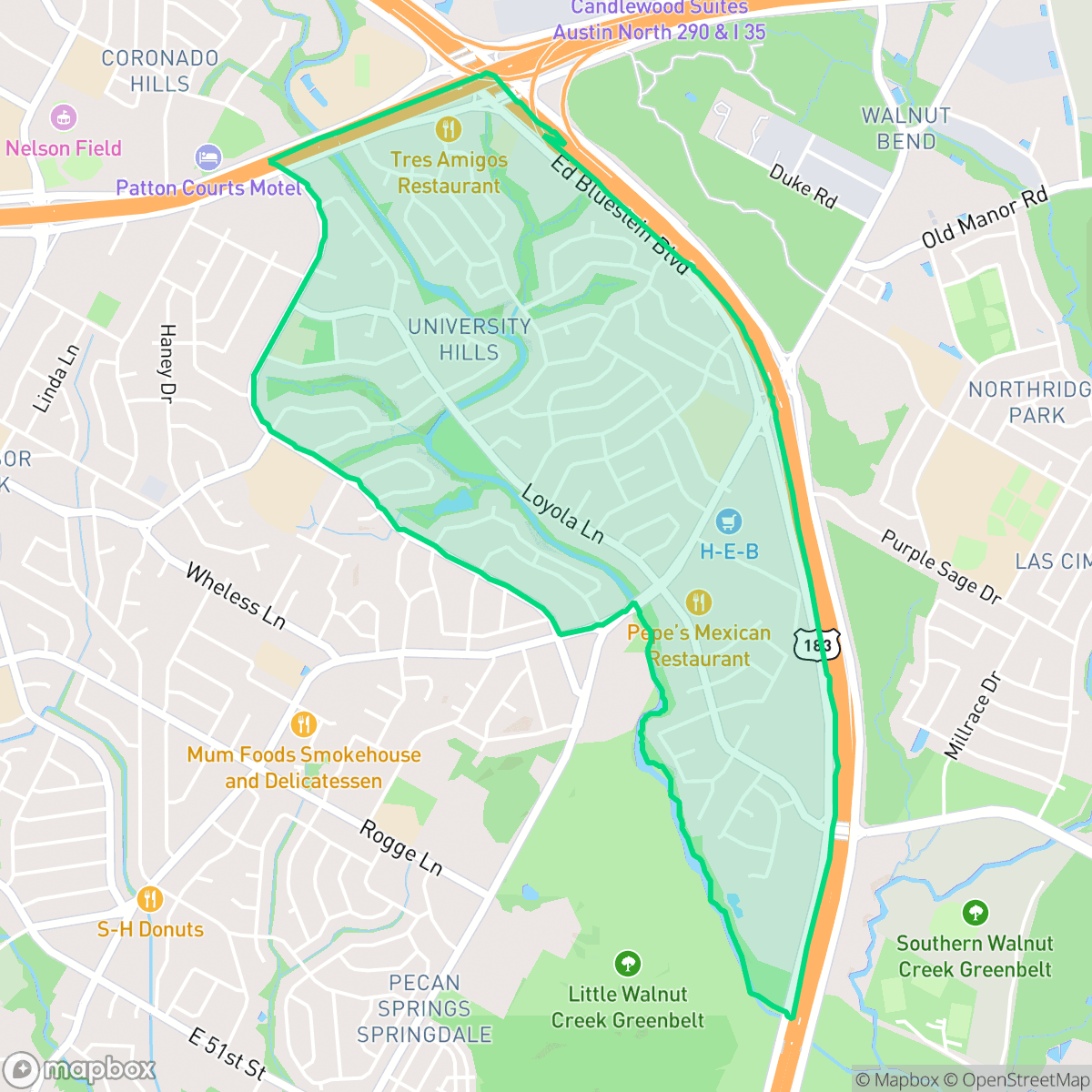
About University Hills
Developed primarily in the 1950s and 1960s on former Northeast Austin farmland, University Hills is characterized by its hilly streets, mature oak trees, and mid-century ranch-style homes. Historically, the neighborhood sat directly north of the Robert Mueller Municipal Airport, which subjected residents to loud overhead flight paths. The airport’s 1999 closure and subsequent redevelopment sparked a major revitalization of the area. Key local landmarks include the Dottie Jordan Recreation Center—which offers trails along Little Walnut Creek—and the University Hills Branch of the Austin Public Library, established on land donated by local developer Walter Carrington in 1983. Today, the neighborhood maintains its quiet residential character while benefiting from its proximity to modern East Austin developments.
The area provides a dense suburban environment that balances residential stability with access to essential retail. According to iHuus data, the neighborhood maintains a consistent walkability score, supported by an extensive network of sidewalks and a pedestrian bridge over the highway. Residents benefit from local amenities like the Dottie Jordan Recreation Center and the community library, which serve as central hubs for outdoor activity and public resources. The housing stock remains primarily composed of single-family homes, creating a uniform visual appeal across the hilly landscape. Prospective residents should consider the trade-offs of the location, particularly regarding acoustic comfort due to proximity to major roadways. While the area lacks heavy industrial presence, the suburban layout results in closely packed homes with limited private buffer space. The local school landscape is varied, with students served by both the Austin and Manor Independent School Districts. The neighborhood is well-suited for those seeking a quiet, established community with convenient highway access, though those prioritizing absolute silence or high-end retail proximity may find the environment distinct from more central urban cores.
Neighborhood Scores Across 15 Qualities
Residential spacing varies between shared-wall apartments and single-family homes with moderate buffers. This density is roughly in line with the average across Austin.
Residential streets offer safe walking spaces and a pedestrian bridge connects parts of the area, though sidewalk coverage is slightly below the Austin average. Low traffic volumes on many side streets provide a relatively stable environment for pedestrians.
Modest yards and boxy rooflines characterize this area, which offers less visual variety than the Austin average. Most residential pockets consist of typical tract housing and apartment complexes with shared amenities.
Access to public parks and wide grassy verges is below the Austin average, as much of the neighborhood's greenery is located in private backyards. Some areas feature walking trails and consistent sidewalks, but overall pet-friendly infrastructure is limited compared to other parts of the city.
A mix of single-family homes and apartment complexes features a significant tree canopy and frequent open land. This layout feels slightly less urban than the Austin average, according to iHuus data.
Suburban streets and green spaces define this area, which offers a more subdued pace of life than the Austin average. While some essential services are reachable on foot, the neighborhood lacks a dense concentration of businesses and social hubs.
A steady hum of local traffic from nearby busy streets defines the soundscape here. According to iHuus data, acoustic levels are slightly higher than the Austin average.
Air quality levels in this area are slightly below the Austin average. Residents may experience occasional periods of unhealthy air that could pose a concern for sensitive groups, according to iHuus data.
No warehouses, heavy industrial facilities, or hazardous sites are present within the neighborhood. According to iHuus data, this area is almost entirely residential and maintains a level of industrial separation similar to the rest of Austin.
Health insurance enrollment among residents is below the Austin average, according to iHuus data.
Voting patterns and census indicators show a highly liberal leaning that is even more pronounced than the Austin city average.
Residents live alongside a balanced spread of young adults, families, and older populations. According to iHuus data, the age distribution in University Hills is consistent with the broader Austin area.
Frequent flood risk exists here due to the area's location within a designated floodplain. According to iHuus data, this level of vulnerability is higher than the Austin average and often necessitates flood insurance.
Address-Level Insights for University Hills


iHuus Neighborhood Intelligence Insights
Get address-level neighborhood insights for University Hills
- Street-level scores — see how individual blocks compare, not just neighborhood averages
- Micro-zone boundaries — identify quiet pockets, flood boundaries, and walkable clusters before you visit
- 15 dimensions in full — walkability, noise, air quality, school quality, insurance coverage, population age profile, urban/rural index, and more
- Boundary risk alerts — know if your address sits near a block boundary where scores drop, the kind of detail no listing will ever mention
- School insights — individual school ratings and insights, not just district-level data
- Compare before you commit — side-by-side data across neighborhoods, down to block precision
No credit card required
Compare with Any Neighborhood
| Dimension | University Hills | Allandale |
|---|---|---|
| 🚶 Walkabilityavg 6.73 | ||
| 🔊 Acoustic Comfortavg 3.73 | ||
| 🤫 Privacy Indexavg 5.87 | ||
| 🎨 Visual Appealavg 6.95 | ||
| 🐕 Dog Friendlinessavg 6.92 | ||
| 🗺️ Urban-Rural Indexavg 7.09 | ||
| ✨ Neighborhood Vibeavg 4.91 | ||
| 🏥 Health Insurance Coverageavg 7.56 | ||
| 🌿 Air Qualityavg 5.17 | ||
| 🏭 Industrial Proximityavg 8.86 | ||
| 🌊 Flood Safetyavg 4.83 | ||
| 🗳️ Ideological Leanavg 9.13 | ||
| 👥 Population Age Profileavg 4.52 | ||
| 🔥 Fire Safety | ||
| 🏫 School Quality |
University Hills Rankings
School Districts Serving University Hills
School Insights for University Hills
Below average outcomes; significant attendance and academic challenges.
School Insights
See what's really behind every school rating near University Hills
- Individual school ratings — each school's own score with outcome context, not just a district average
- Enrollment & class size data — student-to-teacher ratio and how it compares to the state average
- Full demographics breakdown — ethnicity and gender composition for every school in the enrollment zone
- Every school in the district — all schools within the enrollment boundary ranked by rating, not just the closest one
- Grade levels & benchmarks — elementary through high school, with below/above state-average flags
No credit card required