Triangle State, Austin
Updated · 2,537 residents
The Triangle is a high-density, mixed-use hub in central Austin characterized by its exceptional walkability and immediate access to local dining and retail. Residents enjoy a vibrant, transit-oriented lifestyle, though the area experiences elevated noise levels due to surrounding road traffic.
Key Highlights
About Triangle State
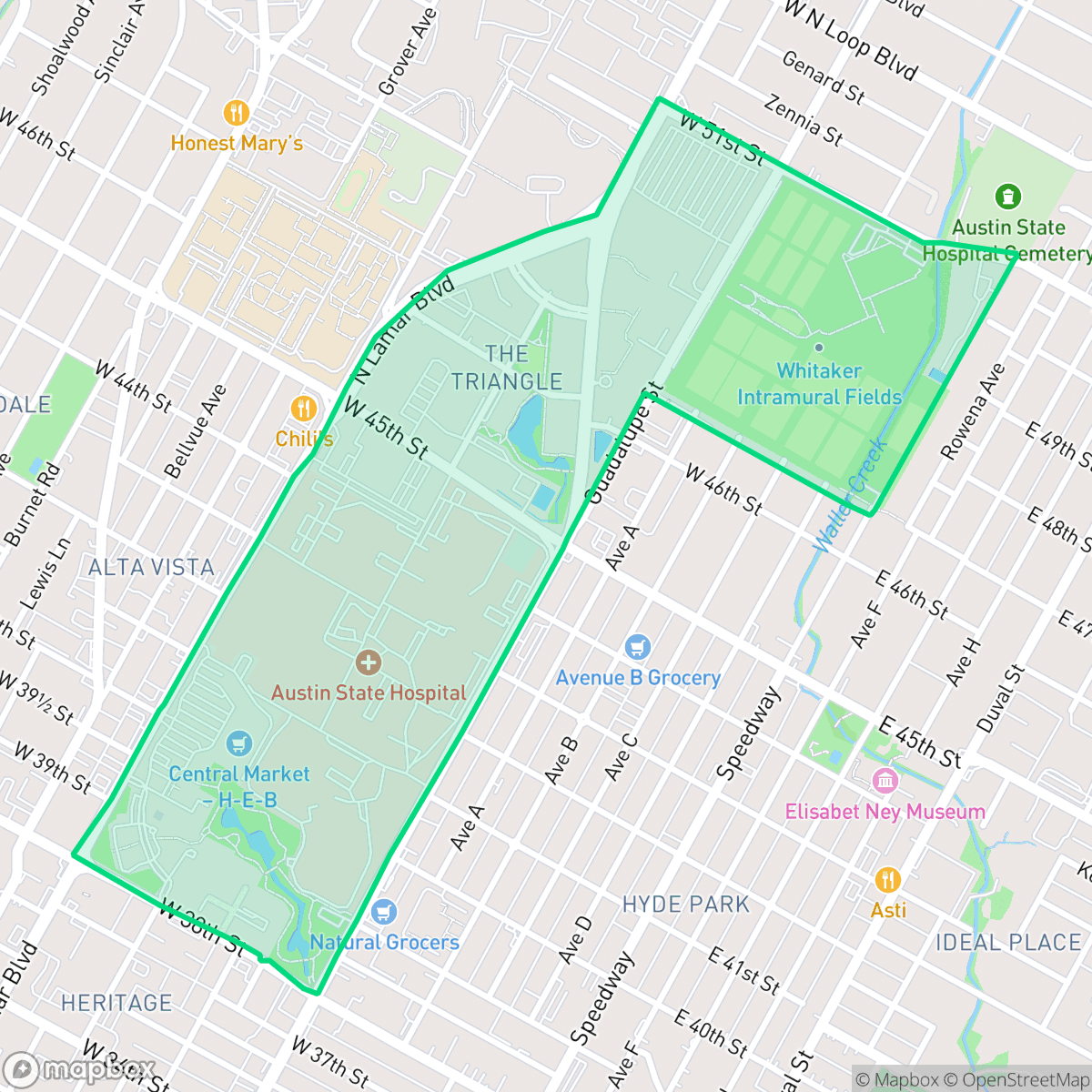
Originally a grassy, vacant tract of state-owned land associated with the neighboring Austin State Hospital, the Triangle State (or "The Triangle") neighborhood in central Austin was historically used as an open meadow where locals gathered. In the late 1990s and early 2000s, a joint effort by Austin Mayor Kirk Watson, Land Commissioner Garry Mauro, and the Texas General Land Office reimagined the 22-acre site. Following extensive negotiations with neighborhood associations over compatibility standards, the land was transformed into a pioneering, high-density, mixed-use transit-oriented development. Completed in the mid-2000s, the modern neighborhood features mid-rise luxury apartments, retail spaces, and restaurants surrounding Triangle Commons Park, which features a central pond and jogging trail, serving as a prominent early example of Austin's modern "live-work-play" urban planning.
This neighborhood serves as a primary example of urban planning in Austin, integrating residential apartments with a variety of commercial amenities like local cafes and restaurants. According to iHuus data, the area boasts a high walkability score, allowing residents to navigate daily errands and leisure activities without relying on personal vehicles. The presence of Triangle Commons Park provides a central green space that anchors the community, balancing the dense architectural footprint with accessible outdoor recreation.
Prospective residents should note that the neighborhood is situated near major thoroughfares, which contributes to higher ambient noise levels compared to quieter residential districts. While the area offers excellent access to healthcare and a strong sense of community, families should consider the broader challenges facing the Austin Independent School District. It is an ideal location for professionals and individuals who prioritize proximity to urban conveniences over absolute acoustic privacy.
Neighborhood Scores Across 15 Qualities
Residential spacing varies between closely packed structures and more buffered homes with mature trees. According to iHuus data, the level of separation between neighbors is roughly consistent with the Austin average.
Pedestrian movement is easy due to a consistent street grid and sidewalks that are notably more prevalent than the Austin average. Many interior streets feature mature tree canopy for shade, though some arterial roads carry higher traffic volumes.
Streetscapes vary between large homes with significant tree canopy and denser apartment complexes. This visual variety is slightly below the Austin average due to the presence of more tightly spaced multi-family housing.
Abundant tree-lined streets and accessible public sports fields provide ample walking areas for pets. According to iHuus data, the availability of connected green spaces and open fields in this area is higher than the Austin average.
A blend of low-density residential areas and institutional developments creates a semi-rural feel that is less urbanized than the Austin average. Residents will find a mix of single-family homes, wooded lots, and mid-sized commercial blocks according to iHuus data.
Lively blocks with a noticeable concentration of local dining, coffee shops, and cultural landmarks create an energetic atmosphere that is significantly more active than the Austin average. This area offers a balanced mix of green space and social hubs, providing more frequent opportunities for community engagement than most parts of the city.
Local traffic from nearby busy streets creates a persistent background noise. This level of acoustic activity is higher than the Austin average, according to iHuus data.
Air quality in Triangle State is generally acceptable, though it remains slightly better than the Austin city average. Sensitive groups should be aware of occasional days with higher levels of pollutants.
Residential and light commercial uses dominate the area, with no detectable warehouses or industrial hazards. This lack of heavy industry makes the neighborhood even cleaner of industrial activity than the Austin average, according to iHuus data.
Health insurance access is widespread among residents in this area. According to iHuus data, coverage levels in Triangle State are notably higher than the Austin city average.
Voting patterns and census indicators reflect a deeply liberal political leaning that is even more pronounced than the Austin city average, according to iHuus data.
Demographic patterns show a balanced mix of young professionals, families, and older residents, aligning closely with the Austin city average.
Flood risk in this area remains uncertain because FEMA has not yet finished a detailed study for this location. According to iHuus data, the level of potential risk is slightly below the Austin city average.
Address-Level Insights for Triangle State


iHuus Neighborhood Intelligence Insights
Get address-level neighborhood insights for Triangle State
- Street-level scores — see how individual blocks compare, not just neighborhood averages
- Micro-zone boundaries — identify quiet pockets, flood boundaries, and walkable clusters before you visit
- 15 dimensions in full — walkability, noise, air quality, school quality, insurance coverage, population age profile, urban/rural index, and more
- Boundary risk alerts — know if your address sits near a block boundary where scores drop, the kind of detail no listing will ever mention
- School insights — individual school ratings and insights, not just district-level data
- Compare before you commit — side-by-side data across neighborhoods, down to block precision
No credit card required
Compare with Any Neighborhood
| Dimension | Triangle State | Allandale |
|---|---|---|
| 🚶 Walkabilityavg 6.73 | ||
| 🔊 Acoustic Comfortavg 3.73 | ||
| 🤫 Privacy Indexavg 5.87 | ||
| 🎨 Visual Appealavg 6.95 | ||
| 🐕 Dog Friendlinessavg 6.92 | ||
| 🗺️ Urban-Rural Indexavg 7.09 | ||
| ✨ Neighborhood Vibeavg 4.91 | ||
| 🏥 Health Insurance Coverageavg 7.56 | ||
| 🌿 Air Qualityavg 5.17 | ||
| 🏭 Industrial Proximityavg 8.86 | ||
| 🌊 Flood Safetyavg 4.83 | ||
| 🗳️ Ideological Leanavg 9.13 | ||
| 👥 Population Age Profileavg 4.52 | ||
| 🔥 Fire Safety | ||
| 🏫 School Quality |
Triangle State Rankings
School Districts Serving Triangle State
School Insights for Triangle State
Below average outcomes; significant attendance and academic challenges.
School Insights
See what's really behind every school rating near Triangle State
- Individual school ratings — each school's own score with outcome context, not just a district average
- Enrollment & class size data — student-to-teacher ratio and how it compares to the state average
- Full demographics breakdown — ethnicity and gender composition for every school in the enrollment zone
- Every school in the district — all schools within the enrollment boundary ranked by rating, not just the closest one
- Grade levels & benchmarks — elementary through high school, with below/above state-average flags
No credit card required