St. Johns, Austin
Updated · 9,687 residents
St. Johns is a diverse neighborhood in northeast Austin characterized by a dense mix of residential blocks and industrial warehouses. While the area offers a variety of local dining options, residents rely heavily on car travel due to fragmented sidewalks and the significant barrier created by Interstate 35. According to iHuus data, the community experiences elevated noise levels and limited pedestrian infrastructure.
Key Highlights
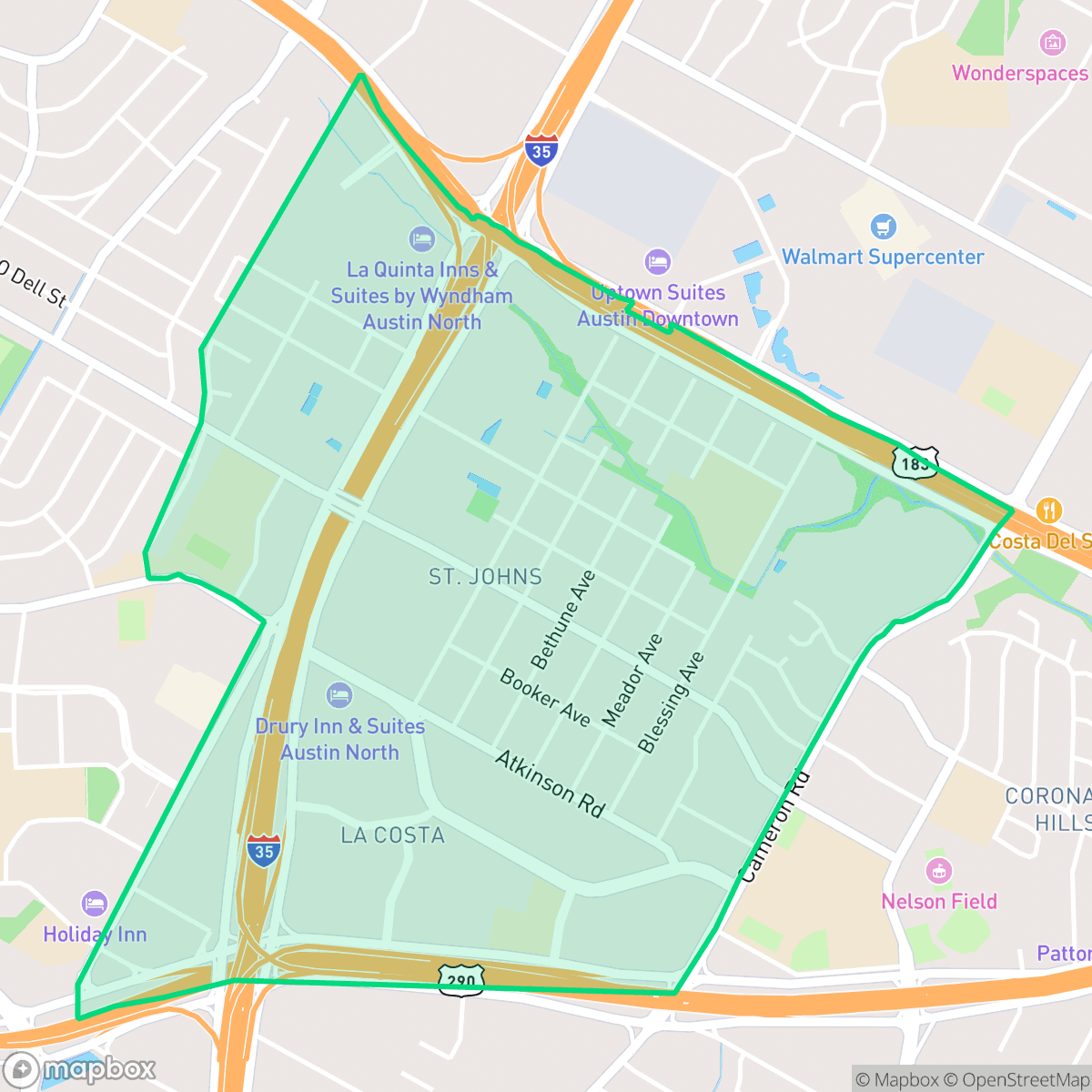
About St. Johns
Established in the 1890s as a freedman’s community in northeast Austin, St. Johns was founded by the St. John Regular Missionary Baptist District Association. In 1907, the association opened the St. John’s Industrial Institute and Home for Negro Orphans, which anchored a settlement of former sharecroppers and hosted massive annual summer encampments. The community was split in the 1950s by the construction of Interstate 35. Its western portion was later developed into the Highland Mall (now an Austin Community College campus featuring St. John’s Encampment Commons park), while the residential eastern portion was annexed by Austin in 1951. Despite decades of systemic underinvestment and fights for basic utilities, St. Johns remains a culturally rich, historically Black neighborhood that is currently undergoing community-led revitalization efforts.
The area functions as a vibrant, car-dependent hub where residential streets sit alongside light industrial corridors and logistics centers. The local landscape features a blend of single-family homes and apartment complexes, complemented by a diverse selection of restaurants that reflect the neighborhood's cultural variety. While the proximity to major transit routes provides logistical convenience, the environment is defined by its high-traffic surroundings and the constant presence of commercial activity. Prospective residents should note that the neighborhood presents specific livability trade-offs, particularly regarding acoustic comfort and pedestrian accessibility. High noise levels from road traffic are common, and the fragmented sidewalk network makes walking difficult. Educational needs are served by the Austin Independent School District, which currently faces operational challenges. As noted by iHuus, the area is best suited for those who prioritize central access and affordability over a quiet, highly walkable suburban environment.
Neighborhood Scores Across 15 Qualities
Privacy levels fluctuate due to a mix of closely spaced multi-unit complexes and single-family homes with moderate separation. According to iHuus data, this density of housing is slightly lower than the Austin average.
Navigating the area on foot can be challenging due to a fragmented sidewalk network and significant highway barriers. While some residential streets remain quiet and accessible, the lack of continuous infrastructure makes the neighborhood slightly less walkable than the Austin average.
Modest tract housing and mid-range apartment complexes define the landscape, offering a functional aesthetic that sits below the Austin average for visual variety.
Limited large public parks and narrow sidewalk verges in certain sections make pet activities less convenient than the Austin average. While residential lawns and some nearby athletic fields offer space for exercise, the area lacks the widespread, expansive green spaces found elsewhere in the city.
A dense suburban landscape prevails, featuring a blend of single-family homes, apartment complexes, and significant commercial retail zones. This area feels less urbanized than the Austin average due to the presence of more integrated greenery and open spaces.
Diverse dining options and social hubs create a more vibrant atmosphere than the Austin average; however, much of the area requires a vehicle due to the spread of businesses along major highway corridors. According to iHuus data, the neighborhood features a mix of lively pockets and quiet suburban blocks interspersed with light industrial zones.
Frequent noise from nearby freeway and railroad traffic makes this area louder than the Austin average. Residents can expect significant acoustic disruption due to these transit corridors, according to iHuus data.
Air quality in this area presents a mix of acceptable and unhealthy days, which is slightly lower than the Austin average. According to iHuus data, residents in sensitive groups may experience occasional concerns during certain periods.
Heavy industrial activity is largely absent from the neighborhood, though proximity to major highway interchanges and large warehouses can introduce notable noise. Residents can expect a landscape dominated by residential and retail uses rather than heavy manufacturing or hazardous sites.
Health insurance access among residents is consistent with the Austin average. According to iHuus data, a majority of the population maintains coverage.
Voting patterns and census indicators reflect a highly liberal political leaning that is even more pronounced than the Austin city average, according to iHuus data.
Residents live alongside a diverse range of age groups, ranging from young professionals to established families and seniors. This demographic distribution is consistent with the broader Austin area, according to iHuus data.
Significant flood risk exists here because parts of the neighborhood are located within a 100-year floodplain. According to iHuus data, this level of risk is considerably higher than the Austin average and often necessitates flood insurance.
Address-Level Insights for St. Johns


iHuus Neighborhood Intelligence Insights
Get address-level neighborhood insights for St. Johns
- Street-level scores — see how individual blocks compare, not just neighborhood averages
- Micro-zone boundaries — identify quiet pockets, flood boundaries, and walkable clusters before you visit
- 15 dimensions in full — walkability, noise, air quality, school quality, insurance coverage, population age profile, urban/rural index, and more
- Boundary risk alerts — know if your address sits near a block boundary where scores drop, the kind of detail no listing will ever mention
- School insights — individual school ratings and insights, not just district-level data
- Compare before you commit — side-by-side data across neighborhoods, down to block precision
No credit card required
Compare with Any Neighborhood
| Dimension | St. Johns | Allandale |
|---|---|---|
| 🚶 Walkabilityavg 6.73 | ||
| 🔊 Acoustic Comfortavg 3.73 | ||
| 🤫 Privacy Indexavg 5.87 | ||
| 🎨 Visual Appealavg 6.95 | ||
| 🐕 Dog Friendlinessavg 6.92 | ||
| 🗺️ Urban-Rural Indexavg 7.09 | ||
| ✨ Neighborhood Vibeavg 4.91 | ||
| 🏥 Health Insurance Coverageavg 7.56 | ||
| 🌿 Air Qualityavg 5.17 | ||
| 🏭 Industrial Proximityavg 8.86 | ||
| 🌊 Flood Safetyavg 4.83 | ||
| 🗳️ Ideological Leanavg 9.13 | ||
| 👥 Population Age Profileavg 4.52 | ||
| 🔥 Fire Safety | ||
| 🏫 School Quality |
St. Johns Rankings
School Districts Serving St. Johns
School Insights for St. Johns
Below average outcomes; significant attendance and academic challenges.
School Insights
See what's really behind every school rating near St. Johns
- Individual school ratings — each school's own score with outcome context, not just a district average
- Enrollment & class size data — student-to-teacher ratio and how it compares to the state average
- Full demographics breakdown — ethnicity and gender composition for every school in the enrollment zone
- Every school in the district — all schools within the enrollment boundary ranked by rating, not just the closest one
- Grade levels & benchmarks — elementary through high school, with below/above state-average flags
No credit card required