St. Edwards, Austin
Updated · 7,225 residents
St. Edwards is a South Austin neighborhood anchored by its namesake university, offering a blend of academic energy and convenient access to major thoroughfares. While the area provides ample green space and diverse local dining, residents should expect significant road noise and a car-dependent environment.
Key Highlights
About St. Edwards
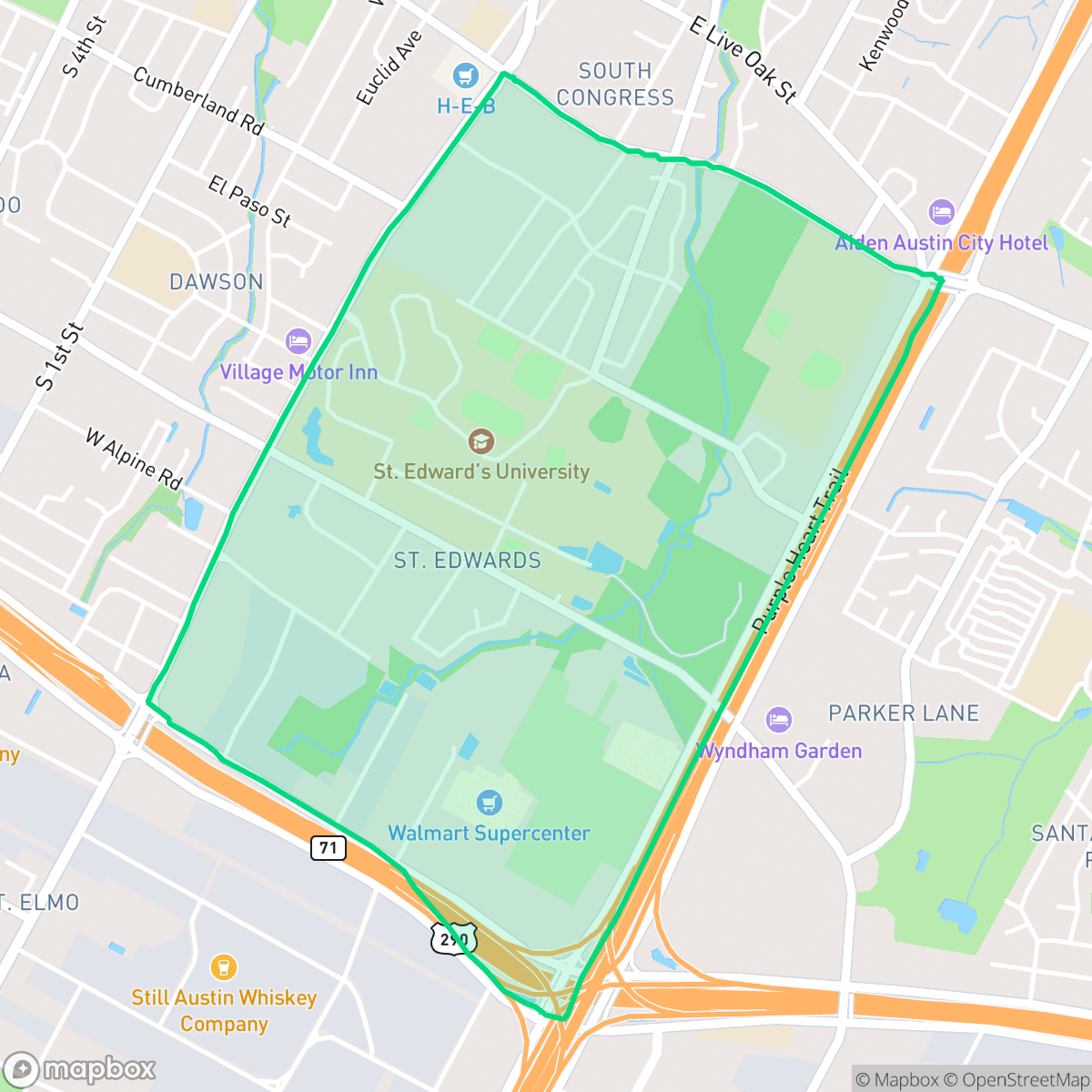
The St. Edwards neighborhood in South Austin developed in tandem with St. Edward’s University, founded in 1877 by Father Edward Sorin on a scenic hilltop south of the city. Bounded by East Oltorf Street, South Congress Avenue, Interstate 35, and Highway 290, the neighborhood grew to support the academic institution, establishing a distinct identity as an educational and cultural hub. Architecturally, the area features a mix of mid-century modern homes, contemporary remodels, and student-friendly housing. Its defining landmark is the university's striking Gothic Revival Main Building, designed by architect Nicholas J. Clayton, completed in 1888, and rebuilt in 1903 after a fire. Listed on the National Register of Historic Places, this iconic structure anchors the neighborhood, which seamlessly blends academic energy with classic South Austin charm.
The area functions as a dense suburban hub where institutional buildings and multi-family housing coexist with commercial retail centers. According to iHuus data, the neighborhood maintains a steady, active rhythm due to its proximity to major highways and logistics warehouses. Residents benefit from a variety of casual dining options and large, accessible sports fields, though the landscape is dominated by parking lots and high-density apartment complexes rather than private residential estates.
Living here requires navigating specific trade-offs, particularly regarding environmental factors. The proximity to major traffic arteries results in elevated noise levels and lower air quality compared to the city average. While the neighborhood offers a unique, calm suburban atmosphere, its layout is primarily designed for vehicle travel rather than pedestrians. This area is best suited for students, faculty, or individuals who prioritize proximity to the university and highway access over a quiet, highly walkable residential experience.
Neighborhood Scores Across 15 Qualities
Residential spacing fluctuates between dense apartment blocks with shared walls and detached homes separated by greenery. According to iHuus data, privacy levels are slightly lower than the Austin average due to these high-density student clusters.
Low traffic on internal residential streets and campus-style paths provides a quiet environment for walking, though the lack of sidewalks in certain areas and nearby highway congestion makes it less walkable than the Austin average.
Visual scenery consists primarily of standard tract housing, boxy apartment rooftops, and functional retail centers. This landscape is less varied than the Austin average, featuring modest yards and common amenities rather than luxury estates.
Walking routes are supported by wide grassy verges and tree-lined green belts, though access to dedicated large public parks is below the Austin average. Neighborhood greenery includes significant wooded areas and residential lawns, though nearby highway noise can impact the outdoor experience.
Frequent open land and scattered homes amid woodland provide a sense of space that is less dense than the Austin average. This mix of greenery and low-rise development creates a landscape that feels more semi-rural than the typical urban sprawl found elsewhere in the city.
Local dining and retail options provide a sense of activity that is higher than the Austin average. While various social hubs and eateries are present, the layout remains primarily car-dependent due to the suburban street patterns.
Frequent disturbances from nearby railroad tracks and freeway traffic characterize the area. This level of acoustic activity is notably higher than the Austin average, according to iHuus data.
Frequent unhealthy air quality levels pose significant risks to sensitive groups. According to iHuus data, the air quality in St. Edwards is notably worse than the Austin city average.
Industrial presence is minimal in most areas, though some large logistics warehouses and distribution centers bring increased truck traffic to certain pockets. Overall, the neighborhood features significantly less heavy industry than the Austin average.
Health insurance accessibility is slightly below the Austin average. According to iHuus data, a significant portion of the population maintains coverage, though fewer residents are insured compared to the broader city area.
Voting patterns and census indicators show a highly progressive political leaning that is even more pronounced than the Austin average, according to iHuus data.
A balanced mix of young adults, families, and older residents defines the area, though the population leans slightly more toward a younger demographic than the Austin average.
Flood risk in this area is considered moderate due to a lack of detailed federal studies, which is consistent with the overall average for Austin. According to iHuus data, the precise level of vulnerability remains undetermined for this specific neighborhood.
Address-Level Insights for St. Edwards


iHuus Neighborhood Intelligence Insights
Get address-level neighborhood insights for St. Edwards
- Street-level scores — see how individual blocks compare, not just neighborhood averages
- Micro-zone boundaries — identify quiet pockets, flood boundaries, and walkable clusters before you visit
- 15 dimensions in full — walkability, noise, air quality, school quality, insurance coverage, population age profile, urban/rural index, and more
- Boundary risk alerts — know if your address sits near a block boundary where scores drop, the kind of detail no listing will ever mention
- School insights — individual school ratings and insights, not just district-level data
- Compare before you commit — side-by-side data across neighborhoods, down to block precision
No credit card required
Compare with Any Neighborhood
| Dimension | St. Edwards | Allandale |
|---|---|---|
| 🚶 Walkabilityavg 6.73 | ||
| 🔊 Acoustic Comfortavg 3.73 | ||
| 🤫 Privacy Indexavg 5.87 | ||
| 🎨 Visual Appealavg 6.95 | ||
| 🐕 Dog Friendlinessavg 6.92 | ||
| 🗺️ Urban-Rural Indexavg 7.09 | ||
| ✨ Neighborhood Vibeavg 4.91 | ||
| 🏥 Health Insurance Coverageavg 7.56 | ||
| 🌿 Air Qualityavg 5.17 | ||
| 🏭 Industrial Proximityavg 8.86 | ||
| 🌊 Flood Safetyavg 4.83 | ||
| 🗳️ Ideological Leanavg 9.13 | ||
| 👥 Population Age Profileavg 4.52 | ||
| 🔥 Fire Safety | ||
| 🏫 School Quality |
St. Edwards Rankings
School Districts Serving St. Edwards
School Insights for St. Edwards
Below average outcomes; significant attendance and academic challenges.
School Insights
See what's really behind every school rating near St. Edwards
- Individual school ratings — each school's own score with outcome context, not just a district average
- Enrollment & class size data — student-to-teacher ratio and how it compares to the state average
- Full demographics breakdown — ethnicity and gender composition for every school in the enrollment zone
- Every school in the district — all schools within the enrollment boundary ranked by rating, not just the closest one
- Grade levels & benchmarks — elementary through high school, with below/above state-average flags
No credit card required