South River City, Austin
Updated · 7,080 residents
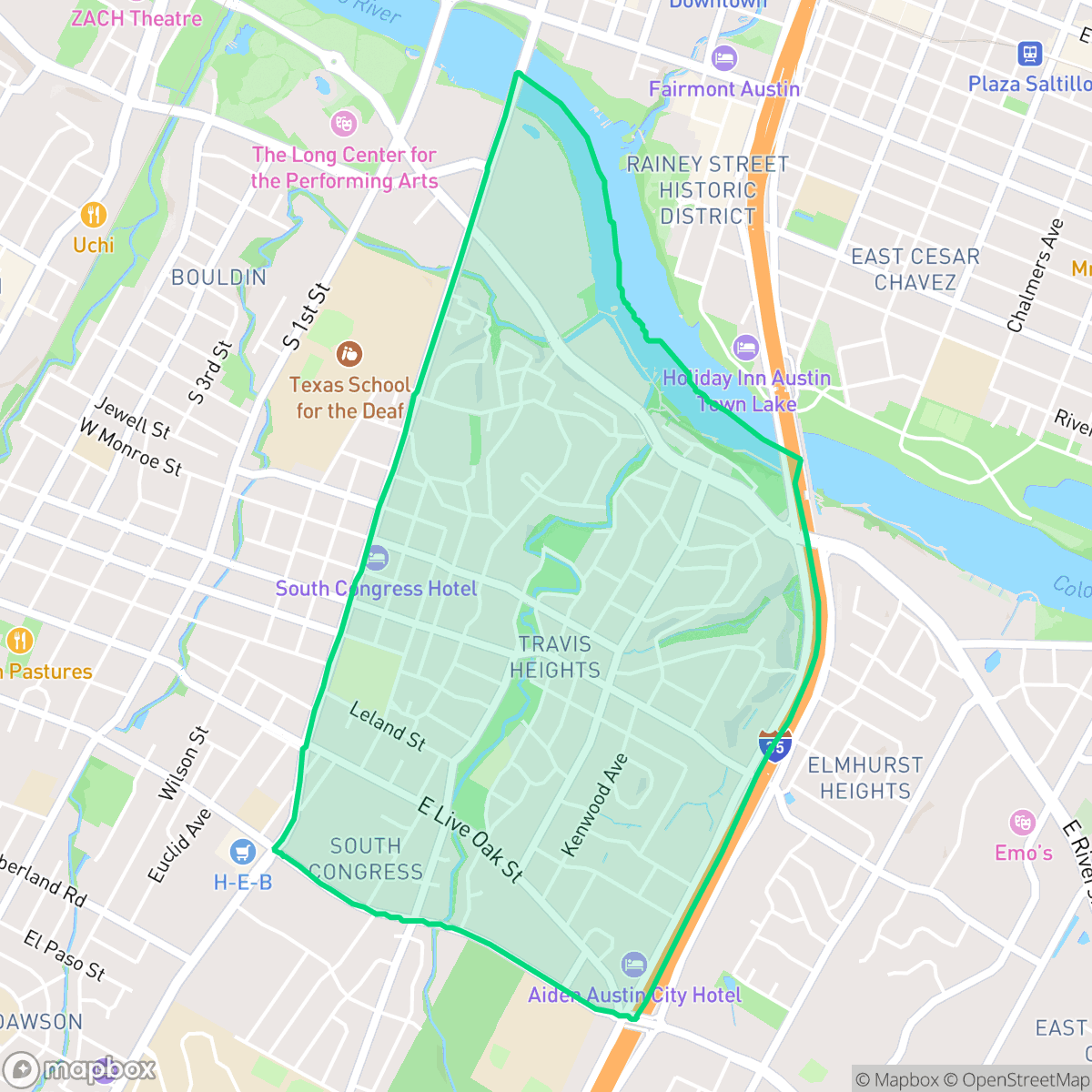
South River City, often referred to as Travis Heights, is a vibrant community known for its hilly terrain and proximity to the popular South Congress Avenue corridor. While the area offers a lively atmosphere with diverse local dining options, residents contend with significant road noise and car dependency despite the presence of scenic green belts.
Key Highlights
About South River City
South River City, commonly known as Travis Heights, developed in the late 19th and early 20th centuries as Austin’s first planned urban community south of the Colorado River. Early subdivisions included the 1877 Swisher Addition and the 1880s Fairview Park, a picturesque suburb inspired by Frederick Law Olmsted’s landscape designs. Growth exploded after the 1910 completion of the concrete Congress Avenue Bridge and the expansion of the streetcar system. In 1913, General William Harwood Stacy began promoting Travis Heights, donating land that became the neighborhood's beloved Big and Little Stacy Parks along Blunn Creek. The neighborhood is characterized by its rolling hills, winding streets, and diverse architecture, which includes Victorian-era homes, Craftsman bungalows, and Prairie School-style residences. Today, it remains defined by its historic charm and proximity to the bustling South Congress Avenue commercial corridor.
The neighborhood functions as a dense suburban enclave that balances residential comfort with immediate access to the commercial heartbeat of Austin. It maintains a distinct identity through its varied housing stock, which ranges from detached single-family homes to low-rise apartment complexes. Residents benefit from high levels of health insurance coverage and a strong sense of community, with local establishments like Curra's Grill and Whip In serving as popular social hubs. The area is characterized by its rolling topography and mature tree canopy, which provide a sense of visual continuity throughout the residential streets.
Prospective residents should note that the area is primarily car-dependent, as sidewalk infrastructure remains inconsistent near major thoroughfares. While the greenery provides aesthetic appeal, the proximity to major roadways results in elevated noise levels and lower air quality scores. According to iHuus data, the community is well-suited for those who prioritize proximity to central Austin amenities and a progressive neighborhood environment over total acoustic seclusion.
Neighborhood Scores Across 15 Qualities
Housing arrangements vary between detached homes with modest separation and denser multi-unit complexes. This level of privacy and spacing is slightly lower than the Austin average.
Sidewalks and safe crossings are generally available, though their presence varies depending on how close a location is to the highway. Most residential streets offer shaded paths, but accessibility is roughly in line with the Austin average according to iHuus data.
Manicured landscapes and large residences with private pools characterize this area, offering a more polished visual environment than the Austin average. According to iHuus data, the presence of well-maintained athletic grounds and high-end institutional facilities contributes to a premium streetscape.
Access to green space for pets is slightly below the Austin average. While some areas feature wide grassy verges and connected green belts, a major highway and dense residential lots can limit continuous walking paths.
Residential streets and green spaces are distributed fairly evenly, creating a landscape more suburban than the dense urban average for Austin. According to iHuus data, the area features a blend of single-family homes, apartment complexes, and accessible parkland.
Diverse dining options and established local hubs provide a high level of activity that is significantly higher than the Austin average. While the area offers many destinations, much of the landscape remains car-dependent.
Frequent disturbances from nearby railroad tracks and heavy freeway traffic characterize the area. According to iHuus data, the acoustic environment is notably louder than the Austin average.
Frequent unhealthy air quality levels pose significant risks to sensitive groups. According to iHuus data, the air quality in South River City is lower than the Austin average.
The area is entirely residential and light commercial, with no visible warehouses, factories, or hazardous industrial sites. This lack of heavy industry makes the neighborhood even more secluded from industrial activity than the Austin average.
Health insurance access among residents is notably higher than the Austin city average, according to iHuus data.
Voting patterns and census indicators reflect a highly progressive political leaning that is even more pronounced than the Austin city average.
A balanced mix of young adults, families, and older residents characterizes the area. This demographic spread is slightly more varied than the average seen across Austin.
Flood risk levels in this area remain undetermined because detailed federal studies have not yet been completed. According to iHuus data, the risk profile is slightly higher than the Austin average.
Address-Level Insights for South River City


iHuus Neighborhood Intelligence Insights
Get address-level neighborhood insights for South River City
- Street-level scores — see how individual blocks compare, not just neighborhood averages
- Micro-zone boundaries — identify quiet pockets, flood boundaries, and walkable clusters before you visit
- 15 dimensions in full — walkability, noise, air quality, school quality, insurance coverage, population age profile, urban/rural index, and more
- Boundary risk alerts — know if your address sits near a block boundary where scores drop, the kind of detail no listing will ever mention
- School insights — individual school ratings and insights, not just district-level data
- Compare before you commit — side-by-side data across neighborhoods, down to block precision
No credit card required
Compare with Any Neighborhood
| Dimension | South River City | Allandale |
|---|---|---|
| 🚶 Walkabilityavg 6.73 | ||
| 🔊 Acoustic Comfortavg 3.73 | ||
| 🤫 Privacy Indexavg 5.87 | ||
| 🎨 Visual Appealavg 6.95 | ||
| 🐕 Dog Friendlinessavg 6.92 | ||
| 🗺️ Urban-Rural Indexavg 7.09 | ||
| ✨ Neighborhood Vibeavg 4.91 | ||
| 🏥 Health Insurance Coverageavg 7.56 | ||
| 🌿 Air Qualityavg 5.17 | ||
| 🏭 Industrial Proximityavg 8.86 | ||
| 🌊 Flood Safetyavg 4.83 | ||
| 🗳️ Ideological Leanavg 9.13 | ||
| 👥 Population Age Profileavg 4.52 | ||
| 🔥 Fire Safety | ||
| 🏫 School Quality |
South River City Rankings
School Districts Serving South River City
School Insights for South River City
Below average outcomes; significant attendance and academic challenges.
School Insights
See what's really behind every school rating near South River City
- Individual school ratings — each school's own score with outcome context, not just a district average
- Enrollment & class size data — student-to-teacher ratio and how it compares to the state average
- Full demographics breakdown — ethnicity and gender composition for every school in the enrollment zone
- Every school in the district — all schools within the enrollment boundary ranked by rating, not just the closest one
- Grade levels & benchmarks — elementary through high school, with below/above state-average flags
No credit card required