South Lamar, Austin
Updated · 8,261 residents
South Lamar, often called SoLa, is a vibrant corridor defined by its eclectic mix of modern apartments, established single-family homes, and a high concentration of local dining and music venues. While the neighborhood offers a lively atmosphere with convenient access to social hubs, residents should expect notable noise levels from road traffic and a relatively dense, urban-suburban environment.
Key Highlights
About South Lamar
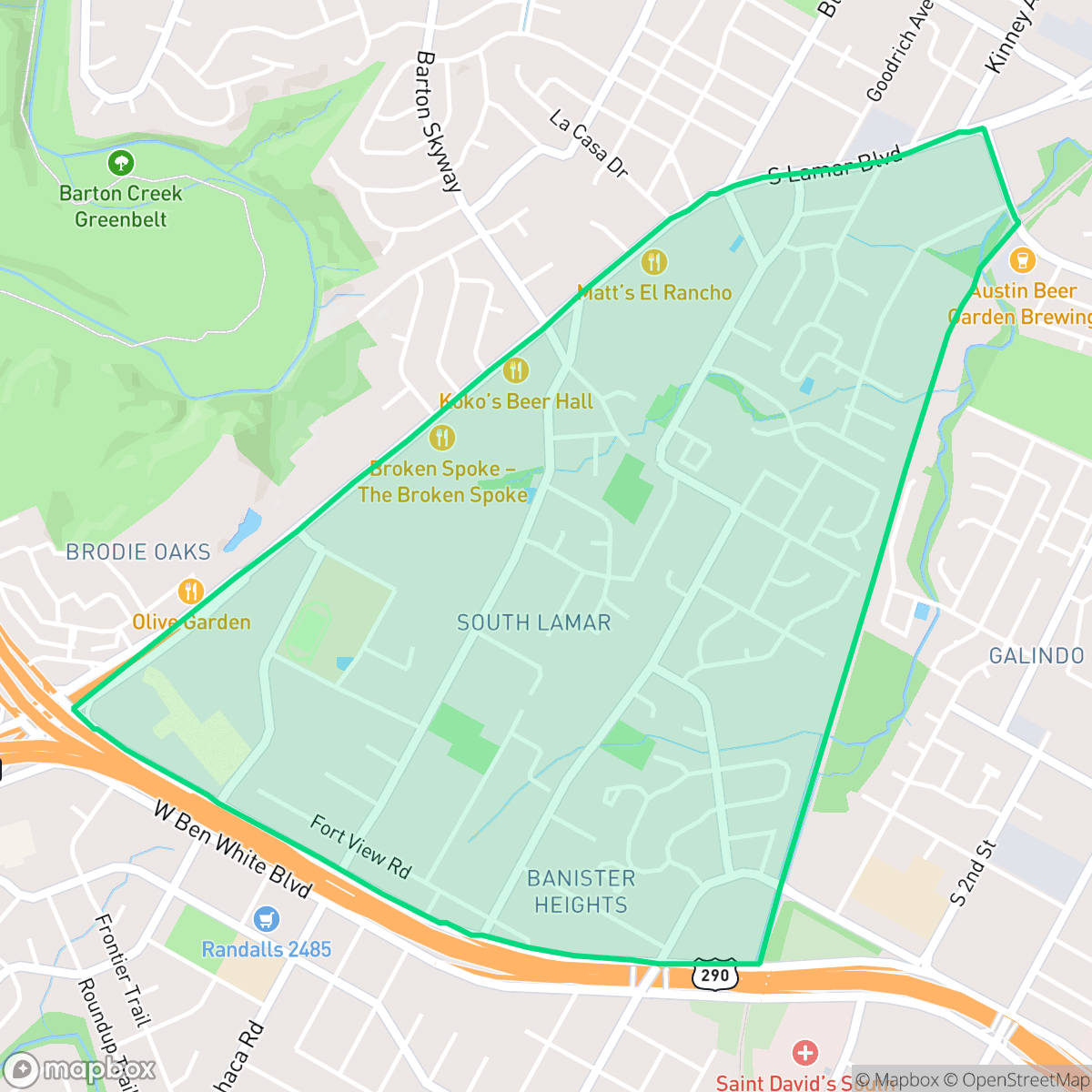
The first land grant incorporating Austin's South Lamar neighborhood was issued in 1835 to Isaac Decker as part of Ben Milam’s Colony. For much of the 20th century, South Lamar was a working-class district lined with used-car lots, repair shops, and modest mid-century homes. Its affordable rents made it a haven for artists and musicians, cementing its bohemian, laid-back identity. The neighborhood's defining cultural landmark is the Broken Spoke, a legendary honky-tonk founded in 1964 that hosted country music icons like Willie Nelson and George Strait. Alongside historic establishments like Matt’s El Rancho, which relocated here in the mid-20th century, South Lamar—often called "SoLa"—has evolved from a gritty commercial strip into a dense, eclectic hub of local businesses, music venues, and modern mixed-use developments.
The area functions as a dense, low-density urban and suburban hybrid that balances residential blocks with active commercial strips along major arterials. According to iHuus data, the neighborhood features a diverse range of housing types, from tightly packed multi-unit apartment complexes to standard single-family residences with modest yards. The streetscape is characterized by a mix of well-connected sidewalks on main roads and quieter residential streets, providing moderate walkability for those living near popular destinations like local coffee shops and eateries.
Prospective residents should note that the neighborhood experiences significant road traffic noise, which impacts the overall acoustic comfort of the area. While the location provides excellent access to local amenities and a strong sense of community engagement, the dense layout and proximity to major roads mean that privacy is often limited. This area is well-suited for individuals who prioritize proximity to the cultural life and dining scene of Austin over the quietude of a traditional suburban environment.
Neighborhood Scores Across 15 Qualities
Housing layouts offer a blend of tightly packed apartment clusters and single-family homes with moderate yard spacing. This density level is consistent with the Austin average, providing a mix of urban proximity and suburban-style buffers.
Pedestrian connectivity is slightly above the Austin average due to a dense grid of tree-lined residential streets and consistent sidewalk networks. While main arterials feature well-maintained crossings, a major high-speed highway can interrupt movement through certain sections of the neighborhood.
Visual variety ranges from upscale homes with private pools to denser apartment complexes. This level of aesthetic diversity is slightly below the Austin average according to iHuus data.
Abundant street trees, residential lawns, and nearby parklands provide ample space for walking pets. According to iHuus data, the availability of connected green spaces and athletic fields is consistent with the Austin average.
Residential pockets feature a blend of single-family homes and multi-family apartments alongside commercial strips. This landscape is slightly less dense than the Austin average, offering a transition between low-rise urbanity and suburban development.
Social activity and local dining options are more concentrated here than in most parts of Austin. While various pockets offer a lively atmosphere near popular eateries, the overall layout remains largely car-dependent for many residents.
Frequent noise from nearby railroad tracks and heavy traffic on major thoroughfares characterizes this area. According to iHuus data, acoustic comfort in South Lamar is lower than the Austin city average.
Frequent unhealthy air quality levels pose a significant risk to sensitive groups. According to iHuus data, the air quality in South Lamar is notably worse than the Austin city average.
Residential and light commercial uses dominate the landscape, with very few heavy industrial hazards or warehouses detected. According to iHuus data, the area maintains a level of industrial separation that is consistent with the rest of Austin.
Health insurance enrollment among residents is high and remains slightly above the Austin city average, according to iHuus data.
Voting patterns and census indicators reflect a deeply liberal political leaning that is even more pronounced than the Austin average, according to iHuus data.
Residents live alongside a balanced mix of young professionals, families, and older adults. According to iHuus data, this age distribution is largely consistent with the broader Austin area.
Flood risk in this area is slightly higher than the Austin average, though official FEMA studies for this specific zone are currently incomplete. Residents should remain aware of potential drainage considerations during heavy rain events.
Address-Level Insights for South Lamar


iHuus Neighborhood Intelligence Insights
Get address-level neighborhood insights for South Lamar
- Street-level scores — see how individual blocks compare, not just neighborhood averages
- Micro-zone boundaries — identify quiet pockets, flood boundaries, and walkable clusters before you visit
- 15 dimensions in full — walkability, noise, air quality, school quality, insurance coverage, population age profile, urban/rural index, and more
- Boundary risk alerts — know if your address sits near a block boundary where scores drop, the kind of detail no listing will ever mention
- School insights — individual school ratings and insights, not just district-level data
- Compare before you commit — side-by-side data across neighborhoods, down to block precision
No credit card required
Compare with Any Neighborhood
| Dimension | South Lamar | Allandale |
|---|---|---|
| 🚶 Walkabilityavg 6.73 | ||
| 🔊 Acoustic Comfortavg 3.73 | ||
| 🤫 Privacy Indexavg 5.87 | ||
| 🎨 Visual Appealavg 6.95 | ||
| 🐕 Dog Friendlinessavg 6.92 | ||
| 🗺️ Urban-Rural Indexavg 7.09 | ||
| ✨ Neighborhood Vibeavg 4.91 | ||
| 🏥 Health Insurance Coverageavg 7.56 | ||
| 🌿 Air Qualityavg 5.17 | ||
| 🏭 Industrial Proximityavg 8.86 | ||
| 🌊 Flood Safetyavg 4.83 | ||
| 🗳️ Ideological Leanavg 9.13 | ||
| 👥 Population Age Profileavg 4.52 | ||
| 🔥 Fire Safety | ||
| 🏫 School Quality |
South Lamar Rankings
School Districts Serving South Lamar
School Insights for South Lamar
Below average outcomes; significant attendance and academic challenges.
School Insights
See what's really behind every school rating near South Lamar
- Individual school ratings — each school's own score with outcome context, not just a district average
- Enrollment & class size data — student-to-teacher ratio and how it compares to the state average
- Full demographics breakdown — ethnicity and gender composition for every school in the enrollment zone
- Every school in the district — all schools within the enrollment boundary ranked by rating, not just the closest one
- Grade levels & benchmarks — elementary through high school, with below/above state-average flags
No credit card required