Rosewood, Austin
Updated · 5,183 residents
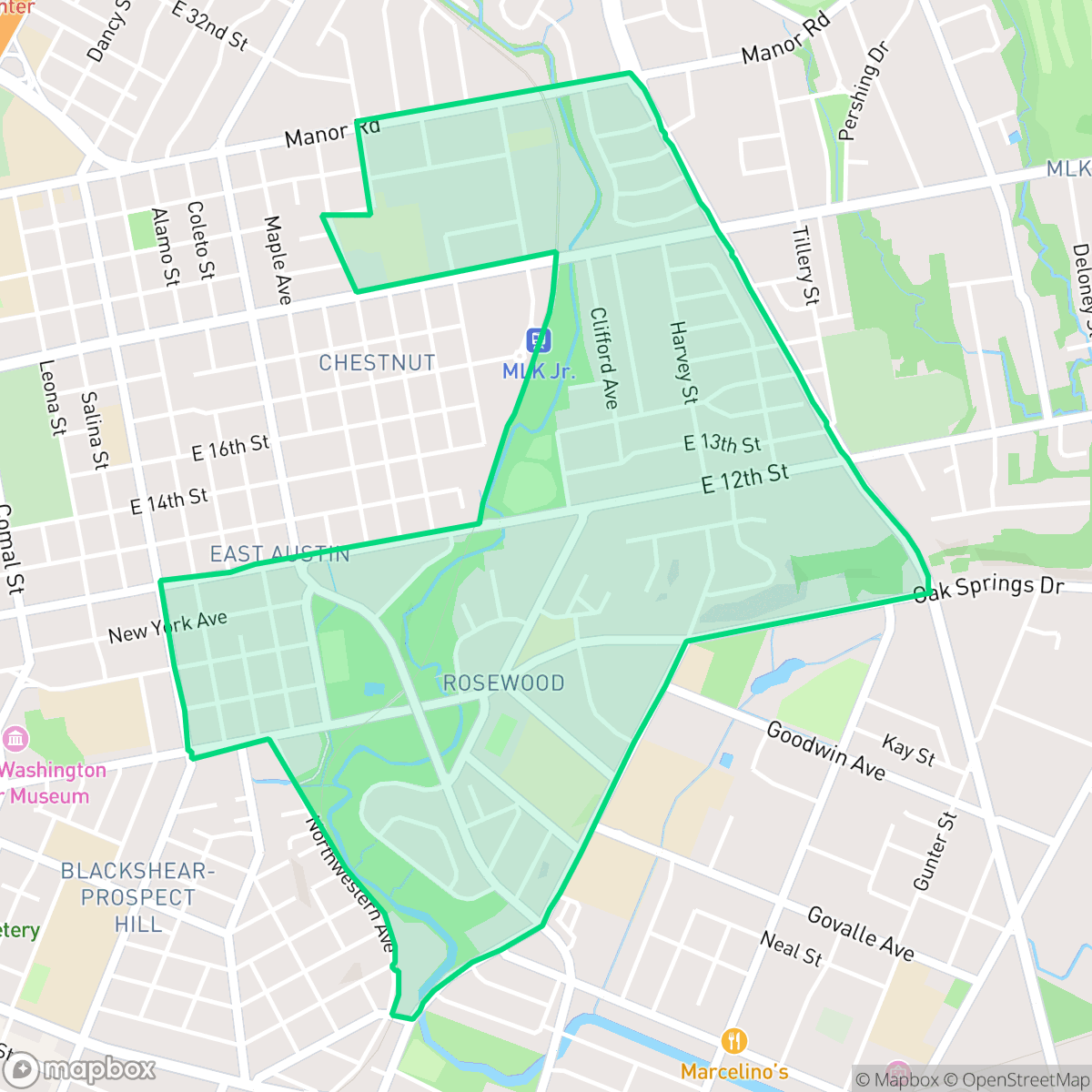
Rosewood is a culturally significant neighborhood in East Austin defined by its mix of historic residential blocks and active community spaces. Residents benefit from a walkable environment and easy access to public parks, though the area experiences moderate noise levels from nearby traffic and rail lines.
Key Highlights
About Rosewood
Rosewood, a historically African American neighborhood in East Austin, developed rapidly following the city's segregated 1928 Master Plan. At its heart lies Rosewood Park, established in 1929 as Austin's first public park for African Americans. The park features the Delores Duffie Recreation Center—housed in an 1870s stone homestead—and the Doris Miller Auditorium, a 1944 facility that hosted Black World War II servicemen and later became a stop on the historic Chitlin' Circuit. The park is also home to the 1860s log cabin of Henry G. Madison, Austin's first Black city councilman. Nearby, the historic Rosewood Courts, championed by Lyndon B. Johnson, opened in 1938 as one of the nation's first public housing projects for African Americans. Today, the neighborhood remains a cultural anchor and the traditional site of Austin's annual Juneteenth celebrations.
The neighborhood maintains a distinct character through its blend of single-family homes, apartment complexes, and local commercial blocks. It serves as a calm yet socially active area, featuring community hubs such as Mt. Zion Baptist Church and local coffee shops that foster a neighborhood-focused atmosphere. According to iHuus data, the area offers a balanced suburban feel that remains well-connected to the broader East Austin landscape, providing residents with consistent sidewalk networks and accessible green spaces perfect for outdoor recreation and dog walking.
Prospective residents should consider a few key trade-offs, including an acoustic environment that averages 60 decibels due to road traffic and railroad proximity, as well as a lower flood safety rating. While the neighborhood boasts high rates of health insurance coverage and a strong, consistent ideological alignment among residents, the local school landscape remains in transition under the Austin Independent School District. Those looking to move here will find a community that prioritizes its cultural roots while navigating the practical challenges of a dense, evolving urban environment.
Neighborhood Scores Across 15 Qualities
Residential spacing is consistent with the Austin average, featuring moderate setbacks and some buffer between neighboring houses. Apartment clusters provide more density, while single-family homes maintain typical suburban proximity without shared walls.
Pedestrian infrastructure is more robust here than the Austin average, featuring continuous sidewalk networks and frequent crosswalks near local parks and schools. While some paths are partially obscured by tree canopy, most residential streets offer safe and connected walking routes.
Standard middle-class housing defines the area with uniform rooflines and small yards. This visual landscape is less lush than the Austin average, featuring more multi-unit complexes and compact lots according to iHuus data.
Large public parks and wooded buffers provide good walking options, though some areas feature narrow sidewalks and less accessible green space. This level of pet accessibility is slightly below the Austin average, according to iHuus data.
Residential pockets feature a blend of single-family homes and low-density urban developments. This area feels slightly more open than the typical Austin urban core, with more frequent sightings of scattered woodland and fields.
Social hubs and diverse dining options create a more active atmosphere than the Austin average. While some residential blocks remain serene, many streets feature a notable concentration of coffee shops, cafes, and community landmarks.
Steady traffic sounds from nearby busy streets are present. This level of acoustic activity is slightly higher than the Austin average, according to iHuus data.
Air quality fluctuates between acceptable and unhealthy levels, which may cause occasional concern for sensitive groups. According to iHuus data, these conditions are roughly in line with the Austin city average.
Industrial activity is virtually non-existent here, matching the city average for low-impact land use. Residents can expect a landscape composed of residential, institutional, and light commercial spaces without the presence of heavy warehouses or manufacturing hazards.
Health insurance accessibility is notably higher than the Austin average, according to iHuus data. Residents in this area benefit from a greater proportion of insured individuals compared to the rest of the city.
Voting patterns and census indicators reflect a deeply liberal community that leans more progressive than the Austin average.
Residents can expect a balanced demographic of young adults, families, and older populations, aligning with the broader Austin average.
Flood risk levels in Rosewood are slightly above the Austin average, though a lack of detailed FEMA studies means the area remains under an undetermined risk classification. Residents should remain aware of potential local drainage patterns according to iHuus data.
Address-Level Insights for Rosewood


iHuus Neighborhood Intelligence Insights
Get address-level neighborhood insights for Rosewood
- Street-level scores — see how individual blocks compare, not just neighborhood averages
- Micro-zone boundaries — identify quiet pockets, flood boundaries, and walkable clusters before you visit
- 15 dimensions in full — walkability, noise, air quality, school quality, insurance coverage, population age profile, urban/rural index, and more
- Boundary risk alerts — know if your address sits near a block boundary where scores drop, the kind of detail no listing will ever mention
- School insights — individual school ratings and insights, not just district-level data
- Compare before you commit — side-by-side data across neighborhoods, down to block precision
No credit card required
Compare with Any Neighborhood
| Dimension | Rosewood | Allandale |
|---|---|---|
| 🚶 Walkabilityavg 6.73 | ||
| 🔊 Acoustic Comfortavg 3.73 | ||
| 🤫 Privacy Indexavg 5.87 | ||
| 🎨 Visual Appealavg 6.95 | ||
| 🐕 Dog Friendlinessavg 6.92 | ||
| 🗺️ Urban-Rural Indexavg 7.09 | ||
| ✨ Neighborhood Vibeavg 4.91 | ||
| 🏥 Health Insurance Coverageavg 7.56 | ||
| 🌿 Air Qualityavg 5.17 | ||
| 🏭 Industrial Proximityavg 8.86 | ||
| 🌊 Flood Safetyavg 4.83 | ||
| 🗳️ Ideological Leanavg 9.13 | ||
| 👥 Population Age Profileavg 4.52 | ||
| 🔥 Fire Safety | ||
| 🏫 School Quality |
Rosewood Rankings
School Districts Serving Rosewood
School Insights for Rosewood
Below average outcomes; significant attendance and academic challenges.
School Insights
See what's really behind every school rating near Rosewood
- Individual school ratings — each school's own score with outcome context, not just a district average
- Enrollment & class size data — student-to-teacher ratio and how it compares to the state average
- Full demographics breakdown — ethnicity and gender composition for every school in the enrollment zone
- Every school in the district — all schools within the enrollment boundary ranked by rating, not just the closest one
- Grade levels & benchmarks — elementary through high school, with below/above state-average flags
No credit card required