Rosedale, Austin
Updated · 6,548 residents
Rosedale is a quiet Austin neighborhood defined by its lush canopy and historic residential architecture, including classic Tudor cottages and bungalows. It offers a balanced suburban experience with high walkability and convenient access to local dining, though residents should expect moderate noise levels from nearby road traffic.
Key Highlights
About Rosedale
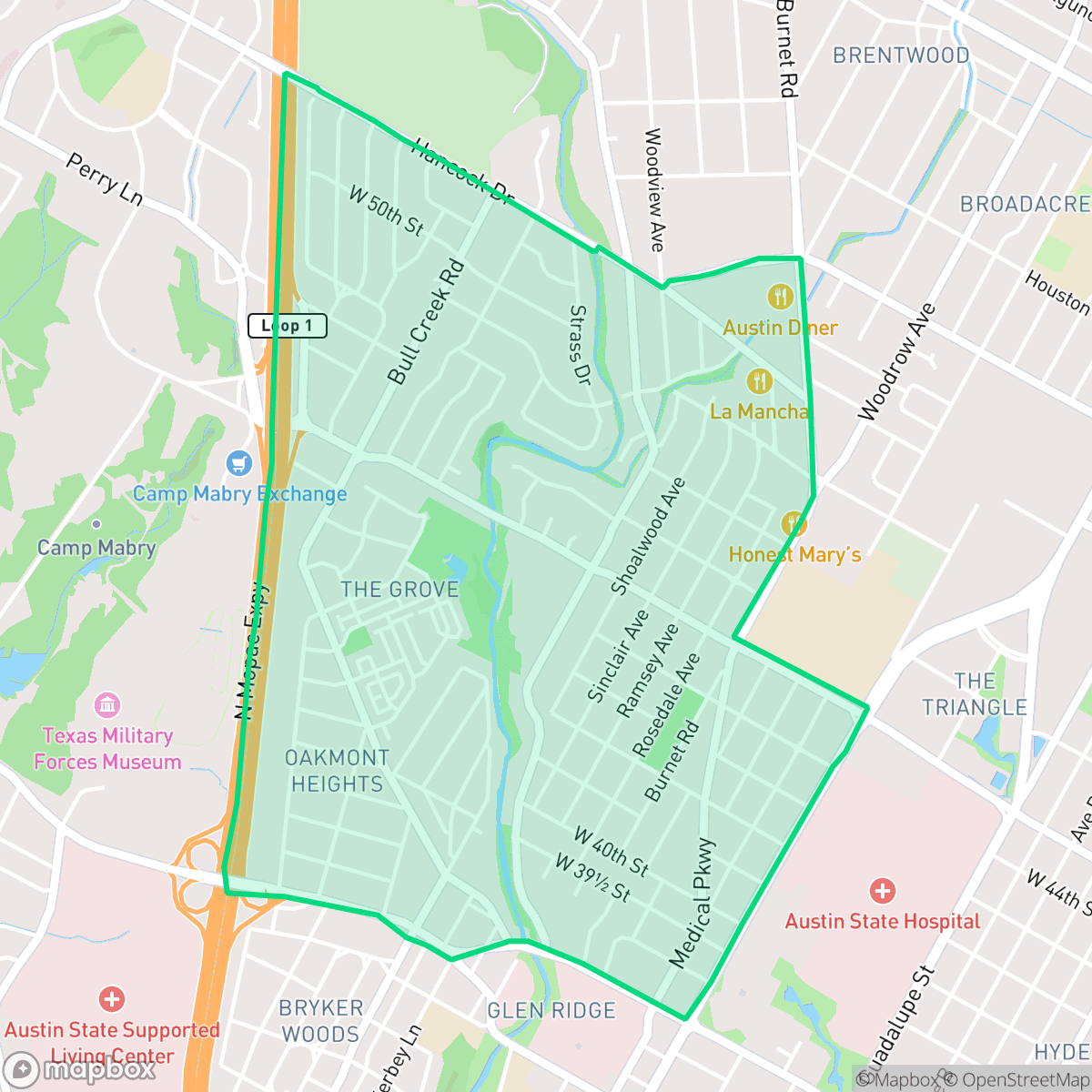
Originally developed as farm and dairy land in the 1860s, Austin’s Rosedale neighborhood transitioned into a hub for florists and nurseries in the early 1900s. Its name derives from the "Rosedale Arbor Vitae," a hybrid evergreen propagated in the area, and much of the neighborhood's lush canopy stems from these early nursery stocks. Residential subdivision began in the 1890s, but the area's defining building boom occurred during the 1930s and 1940s. Today, Rosedale is celebrated for its historic, compact Tudor cottages, bungalows, and Colonial Revival homes. Local landmarks include the mid-1800s Moore-Hancock Farmstead—one of Austin's oldest surviving pioneer structures—and Ramsey Park, a central community hub established in 1934 on land donated by the daughters of prominent nurseryman F.T. Ramsey.
The area serves as an established enclave characterized by its blend of residential streets and localized commercial hubs. It features diverse amenities, including popular spots like Kerbey Lane Cafe, Phoenicia Bakery, and Anderson's Coffee Company. The neighborhood benefits from significant green space, particularly around Ramsey Park, which acts as a central community anchor. According to iHuus data, the area maintains a high level of visual appeal and strong health insurance coverage, reflecting its stable and established character.
Prospective residents should weigh the benefits of its central location against specific livability trade-offs. While the neighborhood is relatively walkable compared to the city average, it experiences higher noise levels due to road traffic and presents challenges regarding flood safety. It is well-suited for those seeking an established community that balances suburban tranquility with proximity to diverse dining and essential services.
Neighborhood Scores Across 15 Qualities
Residential spacing is comparable to the Austin average, featuring a mix of single-family homes with moderate buffers and denser multi-family complexes. According to iHuus data, some areas offer more separation between neighbors than others due to the presence of shared-wall apartment and medical units.
Established sidewalks and safe crossings exist along many residential blocks, making this area more walkable than the Austin average. While heavy tree canopy can occasionally obscure paths, the street grid remains navigable for pedestrians.
Residential views consist primarily of typical middle-class housing and apartment complexes with moderate greenery. This level of visual variety is roughly in line with the Austin city average.
Residential yards and tree canopies provide plenty of shaded space for pets, though the area lacks large public parks and features narrower sidewalks than the Austin average. According to iHuus data, greenery is primarily found within private fenced backyards rather than in expansive open recreational areas.
Open land and wooded areas are frequently interspersed with scattered homes, providing a less dense environment than the Austin average. This mix of greenery and low-density housing creates a landscape that feels more semi-rural than the typical urban core.
Lively blocks with a noticeable concentration of local dining and social hubs make this area more active than the Austin average. While many residents enjoy access to diverse eateries near local green spaces, some parts of the neighborhood remain quiet and largely car dependent.
Steady noise from nearby busy streets creates a consistent background hum. According to iHuus data, this level of acoustic activity is slightly higher than the Austin average.
Air quality levels fluctuate between acceptable and unhealthy periods, though conditions generally remain better than the Austin city average. According to iHuus data, sensitive groups may occasionally experience concern during certain weather patterns.
Industrial presence is virtually non-existent here, consisting instead of residential, medical, and light commercial structures. This absence of warehouses and heavy industry makes the area cleaner and quieter than the Austin average, according to iHuus data.
Health insurance accessibility is very high among Rosedale residents, appearing significantly above the Austin average according to iHuus data.
Voting patterns and census indicators show a highly progressive political leaning that is even more pronounced than the Austin average, according to iHuus data.
Residents live alongside a varied mix of young professionals, families, and seniors. This demographic spread is slightly more balanced than the average found across Austin, according to iHuus data.
Flood risk levels in this area are difficult to determine because FEMA has not yet finished a detailed study for this location. According to iHuus data, this lack of clarity represents a higher level of uncertainty compared to the Austin average.
Address-Level Insights for Rosedale


iHuus Neighborhood Intelligence Insights
Get address-level neighborhood insights for Rosedale
- Street-level scores — see how individual blocks compare, not just neighborhood averages
- Micro-zone boundaries — identify quiet pockets, flood boundaries, and walkable clusters before you visit
- 15 dimensions in full — walkability, noise, air quality, school quality, insurance coverage, population age profile, urban/rural index, and more
- Boundary risk alerts — know if your address sits near a block boundary where scores drop, the kind of detail no listing will ever mention
- School insights — individual school ratings and insights, not just district-level data
- Compare before you commit — side-by-side data across neighborhoods, down to block precision
No credit card required
Compare with Any Neighborhood
| Dimension | Rosedale | Allandale |
|---|---|---|
| 🚶 Walkabilityavg 6.73 | ||
| 🔊 Acoustic Comfortavg 3.73 | ||
| 🤫 Privacy Indexavg 5.87 | ||
| 🎨 Visual Appealavg 6.95 | ||
| 🐕 Dog Friendlinessavg 6.92 | ||
| 🗺️ Urban-Rural Indexavg 7.09 | ||
| ✨ Neighborhood Vibeavg 4.91 | ||
| 🏥 Health Insurance Coverageavg 7.56 | ||
| 🌿 Air Qualityavg 5.17 | ||
| 🏭 Industrial Proximityavg 8.86 | ||
| 🌊 Flood Safetyavg 4.83 | ||
| 🗳️ Ideological Leanavg 9.13 | ||
| 👥 Population Age Profileavg 4.52 | ||
| 🔥 Fire Safety | ||
| 🏫 School Quality |
Rosedale Rankings
School Districts Serving Rosedale
School Insights for Rosedale
Below average outcomes; significant attendance and academic challenges.
School Insights
See what's really behind every school rating near Rosedale
- Individual school ratings — each school's own score with outcome context, not just a district average
- Enrollment & class size data — student-to-teacher ratio and how it compares to the state average
- Full demographics breakdown — ethnicity and gender composition for every school in the enrollment zone
- Every school in the district — all schools within the enrollment boundary ranked by rating, not just the closest one
- Grade levels & benchmarks — elementary through high school, with below/above state-average flags
No credit card required