RMMA, Austin
Updated · 3,328 residents
Mueller is an exceptionally walkable and dog-friendly neighborhood that prioritizes pedestrian access and outdoor recreation. While it offers a modern, master-planned environment with high health insurance coverage, residents should expect frequent road traffic noise and limited privacy due to the density of the housing.
Key Highlights
About RMMA
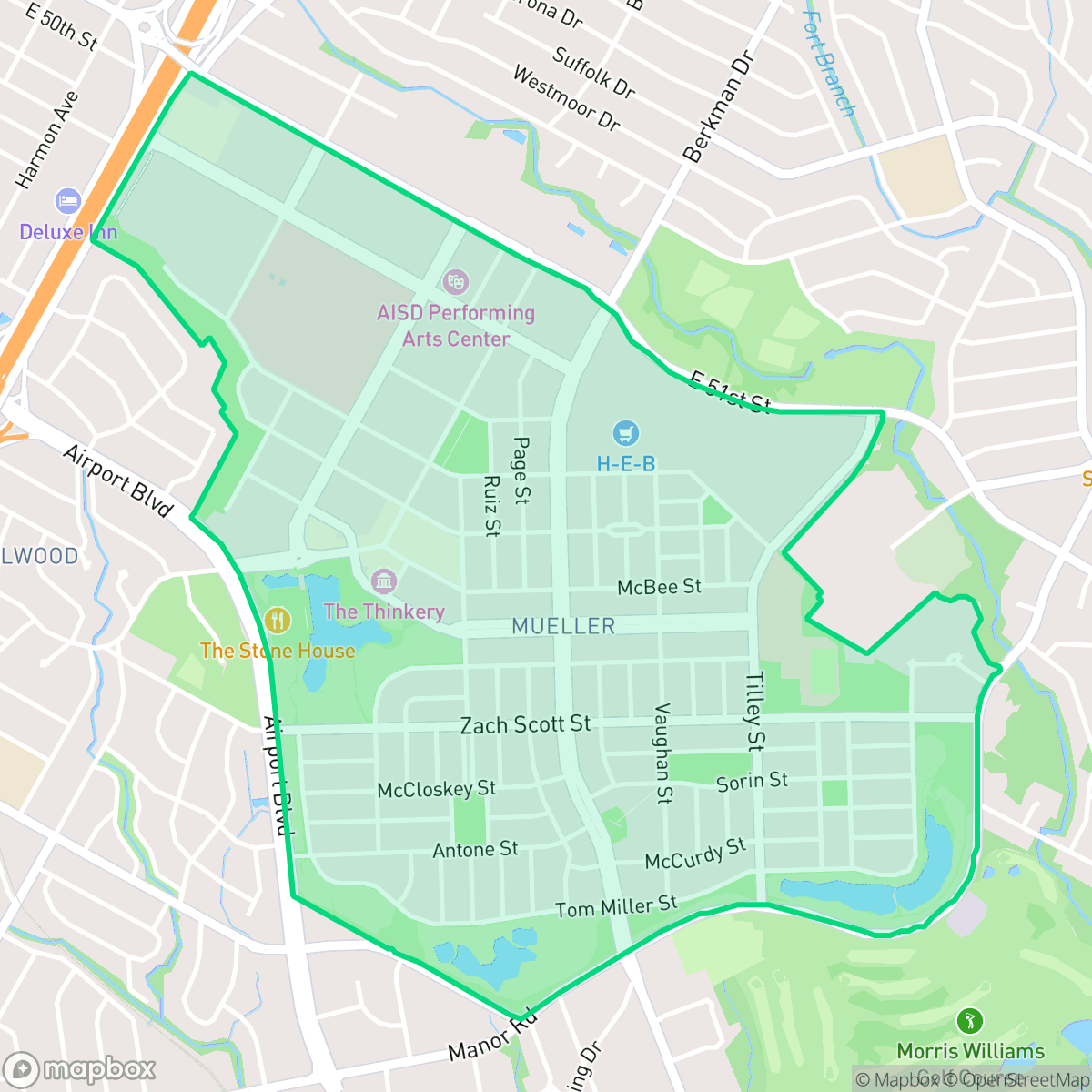
The RMMA neighborhood, commonly known as Mueller, is a 711-acre master-planned community built on the former site of the Robert Mueller Municipal Airport, which served Austin from 1930 to 1999. Following a grassroots planning effort that began in the 1980s, the land was transformed through a public-private partnership into a model of New Urbanism and sustainable design, earning a LEED Neighborhood Development certification. The neighborhood preserves its aviation history through iconic landmarks, including the 1961 blue-and-white tiled control tower and the historic wooden Browning Hangar, now a centerpiece of Lake Park. Today, Mueller is defined by its extensive green spaces, pedestrian-friendly streets, and prominent local institutions such as the Dell Children’s Medical Center and the Thinkery children’s museum.
The area functions as a dense, modern urban hub characterized by its commitment to sustainability and active living. Residents benefit from high walkability and proximity to essential services like the Dell Children’s Medical Center. The neighborhood maintains a strong sense of community through its extensive park system and public gathering spaces, which cater to families and pet owners alike.
Prospective residents should consider the trade-offs of living in such a centralized, master-planned environment. While the area is largely free from industrial hazards and maintains good flood safety, the close proximity of homes results in a lower privacy index. Additionally, the ambient noise levels from surrounding road traffic are notable, and the local school district presents a mixed academic landscape with some campuses facing significant operational challenges.
Neighborhood Scores Across 15 Qualities
Residential spacing is mixed with some buffer between neighbors, though this level of privacy is slightly lower than the Austin average according to iHuus data.
Pedestrian travel is supported by sidewalks on one side of the street and designated safe crossings. This level of walkability is notably higher than the Austin average, according to iHuus data.
Large homes and frequent upscale amenities define the local landscape. This area remains roughly in line with the overall Austin average for visual appeal.
Expansive green spaces and wide, traffic-safe paths make this area highly suitable for pet owners. According to iHuus data, the availability of connected outdoor environments is significantly higher than the Austin average.
Residential streets and green spaces are distributed in nearly equal measure, offering a more suburban character than the denser Austin average. According to iHuus data, this provides a moderate balance of open space and built environment.
Residential blocks offer a quiet, suburban atmosphere characterized by green spaces and proximity to water. While a few local social hubs and dining options are accessible, the area is slightly less active than the Austin average and remains largely car-dependent.
Frequent noise from nearby highways and rail lines creates a louder environment than the Austin average. Residents may experience consistent auditory disturbances from passing transit and heavy traffic.
Air quality in RMMA fluctuates between acceptable and unhealthy levels, presenting occasional concerns for sensitive groups. According to iHuus data, these conditions are better than the average found throughout Austin.
Residential life remains undisturbed by heavy industry, as the area consists primarily of quiet streets and light commercial services. This lack of industrial activity is very similar to the broader Austin area according to iHuus data.
Health insurance accessibility is notably higher here than the Austin average, according to iHuus data. This indicates a resident population with greater access to medical coverage.
Voting patterns and census indicators show a deeply liberal political leaning that is even more pronounced than the Austin average.
Residents of all ages, from young professionals to families and seniors, are represented here in a distribution that is largely consistent with the rest of Austin.
Flood risk levels in this area are difficult to determine because a detailed FEMA study has not yet been completed. This lack of clarity means the neighborhood sits slightly below the Austin average for verified flood safety.
Address-Level Insights for RMMA


iHuus Neighborhood Intelligence Insights
Get address-level neighborhood insights for RMMA
- Street-level scores — see how individual blocks compare, not just neighborhood averages
- Micro-zone boundaries — identify quiet pockets, flood boundaries, and walkable clusters before you visit
- 15 dimensions in full — walkability, noise, air quality, school quality, insurance coverage, population age profile, urban/rural index, and more
- Boundary risk alerts — know if your address sits near a block boundary where scores drop, the kind of detail no listing will ever mention
- School insights — individual school ratings and insights, not just district-level data
- Compare before you commit — side-by-side data across neighborhoods, down to block precision
No credit card required
Compare with Any Neighborhood
| Dimension | RMMA | Allandale |
|---|---|---|
| 🚶 Walkabilityavg 6.73 | ||
| 🔊 Acoustic Comfortavg 3.73 | ||
| 🤫 Privacy Indexavg 5.87 | ||
| 🎨 Visual Appealavg 6.95 | ||
| 🐕 Dog Friendlinessavg 6.92 | ||
| 🗺️ Urban-Rural Indexavg 7.09 | ||
| ✨ Neighborhood Vibeavg 4.91 | ||
| 🏥 Health Insurance Coverageavg 7.56 | ||
| 🌿 Air Qualityavg 5.17 | ||
| 🏭 Industrial Proximityavg 8.86 | ||
| 🌊 Flood Safetyavg 4.83 | ||
| 🗳️ Ideological Leanavg 9.13 | ||
| 👥 Population Age Profileavg 4.52 | ||
| 🔥 Fire Safety | ||
| 🏫 School Quality |
RMMA Rankings
School Districts Serving RMMA
School Insights for RMMA
Below average outcomes; significant attendance and academic challenges.
School Insights
See what's really behind every school rating near RMMA
- Individual school ratings — each school's own score with outcome context, not just a district average
- Enrollment & class size data — student-to-teacher ratio and how it compares to the state average
- Full demographics breakdown — ethnicity and gender composition for every school in the enrollment zone
- Every school in the district — all schools within the enrollment boundary ranked by rating, not just the closest one
- Grade levels & benchmarks — elementary through high school, with below/above state-average flags
No credit card required