Riverside, Austin
Updated · 14,989 residents
Riverside is a vibrant, transit-oriented hub known for its eclectic cultural venues and proximity to the Lady Bird Lake Boardwalk. While the neighborhood offers good walkability and a lively atmosphere with diverse dining, residents should expect moderate noise levels from nearby road traffic and limited privacy in the densely packed residential complexes.
Key Highlights
About Riverside
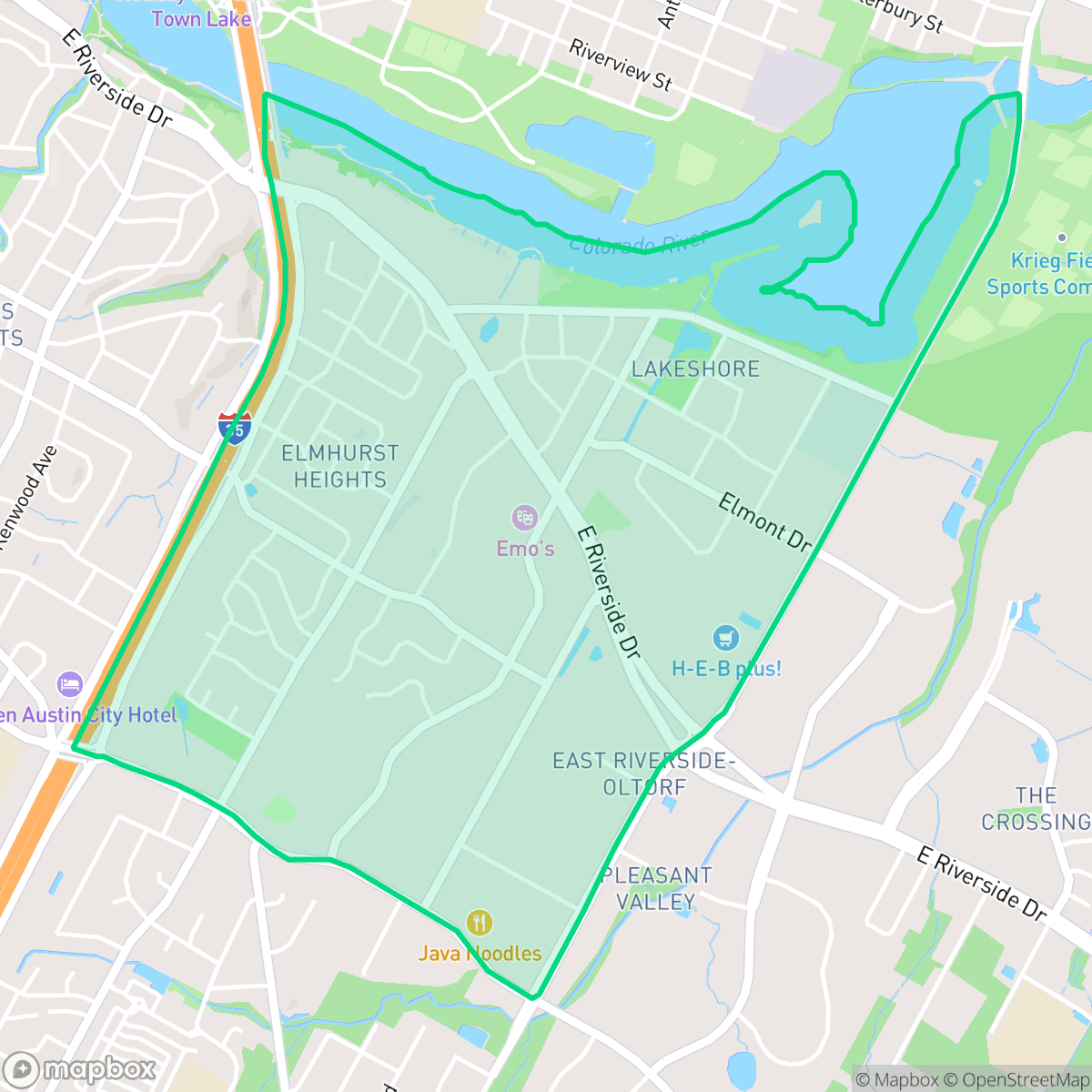
Originally part of the 1825 Santiago Del Valle land grant, the Riverside neighborhood (historically East Riverside-Oltorf) remained predominantly rural cropland until the mid-20th century. In 1949, the Austin Country Club opened here, prompting legendary golfer Harvey Penick to build a cluster of homes along the course. The neighborhood shifted dynamically in the 1970s when the City of Austin partnered with the University of Texas to construct off-campus student housing, establishing Riverside as an affordable hub for students, musicians, and artists. Today, the area is defined by rapid transit-oriented redevelopment, the Austin Community College Riverside Campus (located on the former country club grounds), and scenic public spaces like the Roy G. Guerrero Colorado River Metro Park and the Lady Bird Lake Boardwalk. Iconic local venues like Emo’s and Buzz Mill coffee further anchor its eclectic cultural identity.
The area functions as a dense suburban mix characterized by its proximity to major thoroughfares and accessible green spaces. It maintains a high level of activity, supported by popular local dining destinations and essential commercial strips that cater to a diverse population. The neighborhood benefits from significant natural buffers and forested areas, which provide residents with recreational space despite the prevalence of multi-family apartment complexes.
Prospective residents should weigh the benefits of a central location against specific environmental and infrastructure trade-offs. The neighborhood faces challenges regarding air quality and flood safety, and residents often experience elevated noise levels due to road traffic. While the area is highly dog-friendly and socially active, it is best suited for those who prioritize proximity to urban amenities and transit over absolute acoustic seclusion or low-density living.
Neighborhood Scores Across 15 Qualities
Residential spacing is mixed, featuring both shared-wall structures and areas with wooded buffers. According to iHuus data, privacy levels are slightly below the Austin average due to the presence of high-density multi-family housing and shared common areas.
Sidewalk networks are available along main roads and within many multi-family complexes, offering slightly better pedestrian accessibility than the Austin average. While internal residential loops are easy to navigate, some areas near the highway lack continuous pavement or safe crossings.
Standard multi-family complexes and tightly packed suburban housing characterize the landscape. This level of visual variety is slightly lower than the Austin average, as the area primarily features functional architecture and shared amenities like communal pools.
Abundant tree canopies, green belts, and connected park corridors provide ample space for pet walking. According to iHuus data, these features offer slightly better opportunities for dog owners than the Austin city average.
Predominantly suburban in character, this area features a mix of multi-family apartment complexes and wooded residential pockets. The landscape is slightly less developed than the Austin average, offering more open space and scattered greenery.
Diverse dining hubs and social spots create a more active atmosphere than the Austin average. While many areas feature a balanced mix of green space and local eateries, some blocks remain primarily car-dependent due to their proximity to major highways.
Continuous traffic sounds from nearby thoroughfares are a common feature here. This level of acoustic activity is higher than the Austin average.
Air quality in this area fluctuates between acceptable and unhealthy levels, appearing lower than the Austin average according to iHuus data. Sensitive groups may experience occasional respiratory discomfort during periods of poor air quality.
Industrial presence is minimal, as the area consists almost entirely of residential and light commercial zones without heavy warehouses or hazardous sites. This lack of industrial activity is consistent with the broader Austin average.
Health insurance access is notably lower in this area than the Austin average. According to iHuus data, a significant portion of the population lacks coverage.
Voting patterns and census indicators show a highly liberal political leaning that is even more pronounced than the Austin city average.
A balanced distribution of young adults, families, and older residents defines the area, though the population leans slightly younger than the Austin average according to iHuus data.
Flood vulnerability is significantly higher than the Austin average because much of the area sits within a designated floodplain. Residents should expect that flood insurance is typically a requirement for properties in this neighborhood, according to iHuus data.
Address-Level Insights for Riverside


iHuus Neighborhood Intelligence Insights
Get address-level neighborhood insights for Riverside
- Street-level scores — see how individual blocks compare, not just neighborhood averages
- Micro-zone boundaries — identify quiet pockets, flood boundaries, and walkable clusters before you visit
- 15 dimensions in full — walkability, noise, air quality, school quality, insurance coverage, population age profile, urban/rural index, and more
- Boundary risk alerts — know if your address sits near a block boundary where scores drop, the kind of detail no listing will ever mention
- School insights — individual school ratings and insights, not just district-level data
- Compare before you commit — side-by-side data across neighborhoods, down to block precision
No credit card required
Compare with Any Neighborhood
| Dimension | Riverside | Allandale |
|---|---|---|
| 🚶 Walkabilityavg 6.73 | ||
| 🔊 Acoustic Comfortavg 3.73 | ||
| 🤫 Privacy Indexavg 5.87 | ||
| 🎨 Visual Appealavg 6.95 | ||
| 🐕 Dog Friendlinessavg 6.92 | ||
| 🗺️ Urban-Rural Indexavg 7.09 | ||
| ✨ Neighborhood Vibeavg 4.91 | ||
| 🏥 Health Insurance Coverageavg 7.56 | ||
| 🌿 Air Qualityavg 5.17 | ||
| 🏭 Industrial Proximityavg 8.86 | ||
| 🌊 Flood Safetyavg 4.83 | ||
| 🗳️ Ideological Leanavg 9.13 | ||
| 👥 Population Age Profileavg 4.52 | ||
| 🔥 Fire Safety | ||
| 🏫 School Quality |
Riverside Rankings
School Districts Serving Riverside
School Insights for Riverside
Below average outcomes; significant attendance and academic challenges.
School Insights
See what's really behind every school rating near Riverside
- Individual school ratings — each school's own score with outcome context, not just a district average
- Enrollment & class size data — student-to-teacher ratio and how it compares to the state average
- Full demographics breakdown — ethnicity and gender composition for every school in the enrollment zone
- Every school in the district — all schools within the enrollment boundary ranked by rating, not just the closest one
- Grade levels & benchmarks — elementary through high school, with below/above state-average flags
No credit card required