Pleasant Valley, Austin
Updated · 15,873 residents
Pleasant Valley is a dense residential area southeast of downtown Austin, characterized by a high concentration of multi-family apartment complexes and proximity to significant green spaces. While the neighborhood offers decent walkability and access to pet-friendly corridors, residents experience limited privacy due to high-density housing and notable noise from road traffic.
Key Highlights
About Pleasant Valley
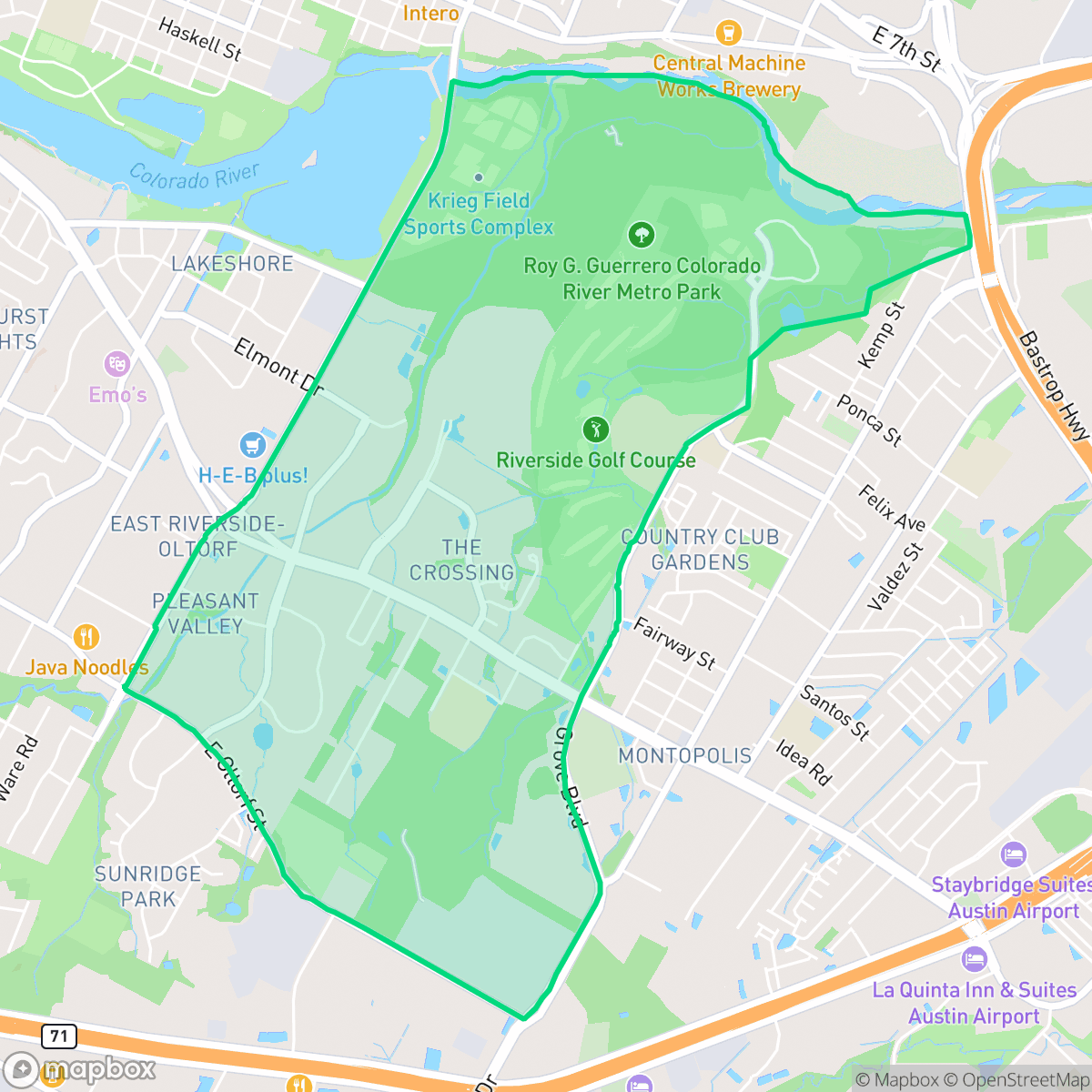
Located southeast of downtown Austin, the Pleasant Valley neighborhood was historically part of the 19th-century Santiago Del Valle land grant. In 1949, the Austin Country Club opened in the area, where legendary golf instructor Harvey Penick built a cluster of homes along Penick Place. Much of the surrounding land was originally Faro Farm, a cattle ranch owned by Fagan Dickson and civic leader Roberta Crenshaw. In 1973, they proposed a massive planned development called "The Crossing". Although only partially realized, Crenshaw donated 30 acres of the tract to establish the Roy G. Guerrero Colorado River Park. By the late 1970s, the city partnered with the University of Texas to build dense off-campus student housing in the area. In recent years, Pleasant Valley has transitioned rapidly from student-centric complexes to major corporate campuses and mixed-use developments.
The area functions as a dense suburban landscape, blending large-scale multi-family housing with commercial footprints and accessible outdoor recreation. It benefits from proximity to the Colorado River and local parks, providing residents with ample space for walking pets and enjoying green belts. The architectural aesthetic is primarily defined by modern, functional apartment complexes and shared amenities like pools, which contribute to a uniform visual character across the neighborhood.
Living here involves specific trade-offs, particularly regarding acoustic comfort and privacy, as the high-density design often results in shared walls and common areas. According to iHuus data, the area faces challenges with flood safety and health insurance coverage, which potential residents should consider. The neighborhood is well-suited for those who prioritize proximity to major thoroughfares and outdoor leisure over the seclusion of single-family housing, as it offers a balance of urban convenience and suburban green space.
Neighborhood Scores Across 15 Qualities
Residential spacing varies between closely packed apartment complexes and houses separated by woodland buffers. According to iHuus data, the level of separation between neighbors is slightly lower than the Austin average.
Pedestrian access is consistent within residential loops and apartment complexes, though some arterial roads lack dedicated priority for walkers. This level of connectivity is comparable to the average for Austin.
Visual variety is somewhat limited by standardized apartment complexes and multi-family housing. The landscape consists mainly of functional architecture with boxy roofs and shared amenities, which is less visually diverse than the Austin average.
Abundant green belts, golf courses, and tree-lined paths provide ample space for walking pets. This accessibility to interconnected parks and grassy verges is notably higher than the Austin average.
Large commercial footprints and significant tree canopy create a landscape of scattered homes and wooded areas. This environment is comparable to the broader Austin area in its balance of open land and suburban development.
A tranquil, low-density atmosphere prevails here, with many areas consisting of suburban streets and green spaces near water. The neighborhood offers a more subdued pace of life than the Austin average, featuring scattered dining and industrial pockets rather than dense urban activity.
Steady traffic sounds from a nearby busy street are common here. This level of acoustic activity is slightly more pronounced than the average found throughout Austin.
Air quality levels in Pleasant Valley fluctuate between acceptable and unhealthy, sitting below the Austin average. Sensitive groups may experience periodic issues during certain weather patterns, according to iHuus data.
Residential and light commercial spaces define this area, with no detectable warehouses, heavy industrial footprints, or hazardous sites nearby. This lack of industrial activity is consistent with the broader Austin average.
Health insurance accessibility is lower in this area than the Austin average, according to iHuus data. Residents may face more challenges accessing employer-sponsored or private coverage compared to other parts of the city.
Voting patterns and census indicators show a predominantly liberal political leaning that is even more pronounced than the Austin average, according to iHuus data.
A majority of residents are young adults, creating a demographic profile that is younger than the Austin average. According to iHuus data, the area maintains a modest presence of families and older residents.
Property within the 100-year floodplain carries a higher risk of inundation; according to iHuus data, this area is significantly more prone to flooding than the Austin average. Residents should be prepared for the likely requirement of flood insurance.
Address-Level Insights for Pleasant Valley


iHuus Neighborhood Intelligence Insights
Get address-level neighborhood insights for Pleasant Valley
- Street-level scores — see how individual blocks compare, not just neighborhood averages
- Micro-zone boundaries — identify quiet pockets, flood boundaries, and walkable clusters before you visit
- 15 dimensions in full — walkability, noise, air quality, school quality, insurance coverage, population age profile, urban/rural index, and more
- Boundary risk alerts — know if your address sits near a block boundary where scores drop, the kind of detail no listing will ever mention
- School insights — individual school ratings and insights, not just district-level data
- Compare before you commit — side-by-side data across neighborhoods, down to block precision
No credit card required
Compare with Any Neighborhood
| Dimension | Pleasant Valley | Allandale |
|---|---|---|
| 🚶 Walkabilityavg 6.73 | ||
| 🔊 Acoustic Comfortavg 3.73 | ||
| 🤫 Privacy Indexavg 5.87 | ||
| 🎨 Visual Appealavg 6.95 | ||
| 🐕 Dog Friendlinessavg 6.92 | ||
| 🗺️ Urban-Rural Indexavg 7.09 | ||
| ✨ Neighborhood Vibeavg 4.91 | ||
| 🏥 Health Insurance Coverageavg 7.56 | ||
| 🌿 Air Qualityavg 5.17 | ||
| 🏭 Industrial Proximityavg 8.86 | ||
| 🌊 Flood Safetyavg 4.83 | ||
| 🗳️ Ideological Leanavg 9.13 | ||
| 👥 Population Age Profileavg 4.52 | ||
| 🔥 Fire Safety | ||
| 🏫 School Quality |
Pleasant Valley Rankings
School Districts Serving Pleasant Valley
School Insights for Pleasant Valley
Below average outcomes; significant attendance and academic challenges.
School Insights
See what's really behind every school rating near Pleasant Valley
- Individual school ratings — each school's own score with outcome context, not just a district average
- Enrollment & class size data — student-to-teacher ratio and how it compares to the state average
- Full demographics breakdown — ethnicity and gender composition for every school in the enrollment zone
- Every school in the district — all schools within the enrollment boundary ranked by rating, not just the closest one
- Grade levels & benchmarks — elementary through high school, with below/above state-average flags
No credit card required