Pecan Springs Springdale, Austin
Updated · 5,536 residents
Pecan Springs Springdale is a quiet, residential enclave in East Austin defined by its mid-century ranch-style homes and a grid-like street layout. The area offers residents a walkable environment with consistent green verges and proximity to local landmarks like Springdale Station. While the neighborhood maintains a peaceful, low-density atmosphere, it remains well-connected to the broader city through major thoroughfares.
Key Highlights
About Pecan Springs Springdale
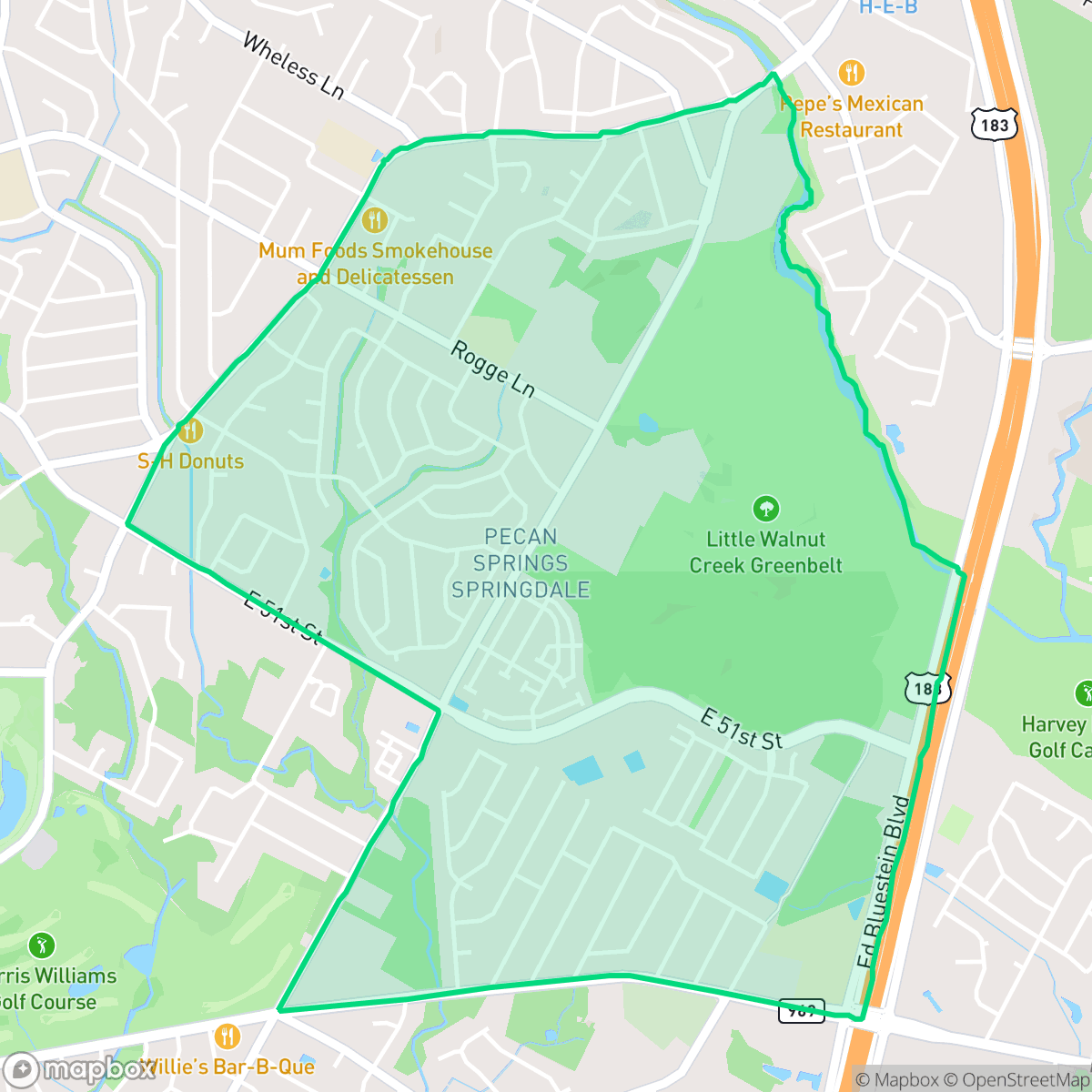
The Pecan Springs Springdale neighborhood in East Austin carries a rich history tracing back to the 19th century. The area was home to the historic Pecan Springs School, established in 1875 as a one-room schoolhouse on Manor Road. Serving Travis County Common School District 61, the school operated for decades before being annexed into the city of Austin in 1951 and closing in 1956. Residential development in the neighborhood flourished during the mid-to-late 20th century, particularly starting in the 1960s, leaving a legacy of mid-century ranch-style single-family homes. Today, the neighborhood is bounded by major thoroughfares like Springdale Road and features local landmarks such as Springdale Station—a restored historic 1920s train station originally known as Boone Station, which now serves as a prominent local event space and cultural venue.
This East Austin neighborhood is characterized by a stable, suburban environment that balances residential density with ample open space. The landscape features a classic grid of streets lined with mid-century architecture, providing a consistent aesthetic that reflects the area's mid-twentieth-century development. Residents benefit from above-average walkability for the region, supported by continuous sidewalks and accessible green verges that facilitate local commuting and pet exercise. The community maintains a tranquil vibe, punctuated by select local dining spots and community-focused institutions that serve as neighborhood anchors.
Prospective residents should note that the area is primarily residential with limited commercial density, resulting in a quieter lifestyle that may require travel for extensive shopping or entertainment. While the neighborhood offers a peaceful retreat from the city center, it is positioned near major traffic arteries, which contributes to moderate noise levels. The local school options are part of the Austin Independent School District, which currently faces operational challenges, making the area a primary consideration for those prioritizing a quiet, well-connected suburban setting over high-intensity urban amenities.
Neighborhood Scores Across 15 Qualities
Residential structures feature mixed spacing with some buffers between neighbors, aligning closely with the Austin average. According to iHuus data, the density is typical of mid-century suburban layouts where homes are relatively closely packed.
Continuous sidewalk networks and a pedestrian bridge over the highway facilitate easy movement on foot. This level of accessibility for pedestrians is higher than the Austin average.
Modest lot sizes and typical tract housing define the landscape here. According to iHuus data, the visual variety of rooftops and greenery is slightly below the Austin average.
Accessible walking trails and green verges provide ample space for pets, offering a slightly higher level of dog friendliness than the Austin average. Wide paths and proximity to sports fields create a safe environment for exercise away from traffic.
Open land and woodland are frequently interspersed with scattered homes, providing a slightly less dense environment than the Austin average. According to iHuus data, this area maintains a mix of single-family residences and some suburban apartment complexes.
Primarily residential and low-density, this area offers a subdued atmosphere with limited commercial activity. The level of local activity and access to services is below the Austin average, consisting mostly of scattered essential businesses and nearby greenery.
Steady traffic sounds from a nearby busy street are present. According to iHuus data, acoustic comfort in this area is slightly higher than the Austin average.
Air quality in this area fluctuates between acceptable and unhealthy levels, though it remains slightly better than the Austin average according to iHuus data. Residents in sensitive groups should monitor local conditions during periods of occasional concern.
Industrial presence is virtually nonexistent in this area, which consists primarily of residential streets and light commercial services. According to iHuus data, this neighborhood lacks the warehouses or heavy industrial hazards found more frequently in other parts of Austin.
Health insurance enrollment in this area is slightly below the Austin average, according to iHuus data.
Voting patterns and census indicators show a distinctly liberal political leaning that is even more pronounced than the Austin city average, according to iHuus data.
Residents live alongside a balanced variety of young adults, families, and older populations. This demographic spread is largely in line with the broader Austin area.
Flood risk in this area is difficult to determine because FEMA has not completed a detailed study for this specific location. This level of uncertainty is slightly higher than the Austin average, according to iHuus data.
Address-Level Insights for Pecan Springs Springdale


iHuus Neighborhood Intelligence Insights
Get address-level neighborhood insights for Pecan Springs Springdale
- Street-level scores — see how individual blocks compare, not just neighborhood averages
- Micro-zone boundaries — identify quiet pockets, flood boundaries, and walkable clusters before you visit
- 15 dimensions in full — walkability, noise, air quality, school quality, insurance coverage, population age profile, urban/rural index, and more
- Boundary risk alerts — know if your address sits near a block boundary where scores drop, the kind of detail no listing will ever mention
- School insights — individual school ratings and insights, not just district-level data
- Compare before you commit — side-by-side data across neighborhoods, down to block precision
No credit card required
Compare with Any Neighborhood
| Dimension | Pecan Springs Springdale | Allandale |
|---|---|---|
| 🚶 Walkabilityavg 6.73 | ||
| 🔊 Acoustic Comfortavg 3.73 | ||
| 🤫 Privacy Indexavg 5.87 | ||
| 🎨 Visual Appealavg 6.95 | ||
| 🐕 Dog Friendlinessavg 6.92 | ||
| 🗺️ Urban-Rural Indexavg 7.09 | ||
| ✨ Neighborhood Vibeavg 4.91 | ||
| 🏥 Health Insurance Coverageavg 7.56 | ||
| 🌿 Air Qualityavg 5.17 | ||
| 🏭 Industrial Proximityavg 8.86 | ||
| 🌊 Flood Safetyavg 4.83 | ||
| 🗳️ Ideological Leanavg 9.13 | ||
| 👥 Population Age Profileavg 4.52 | ||
| 🔥 Fire Safety | ||
| 🏫 School Quality |
Pecan Springs Springdale Rankings
School Districts Serving Pecan Springs Springdale
School Insights for Pecan Springs Springdale
Below average outcomes; significant attendance and academic challenges.
School Insights
See what's really behind every school rating near Pecan Springs Springdale
- Individual school ratings — each school's own score with outcome context, not just a district average
- Enrollment & class size data — student-to-teacher ratio and how it compares to the state average
- Full demographics breakdown — ethnicity and gender composition for every school in the enrollment zone
- Every school in the district — all schools within the enrollment boundary ranked by rating, not just the closest one
- Grade levels & benchmarks — elementary through high school, with below/above state-average flags
No credit card required