Parker Lane, Austin
Updated · 10,273 residents
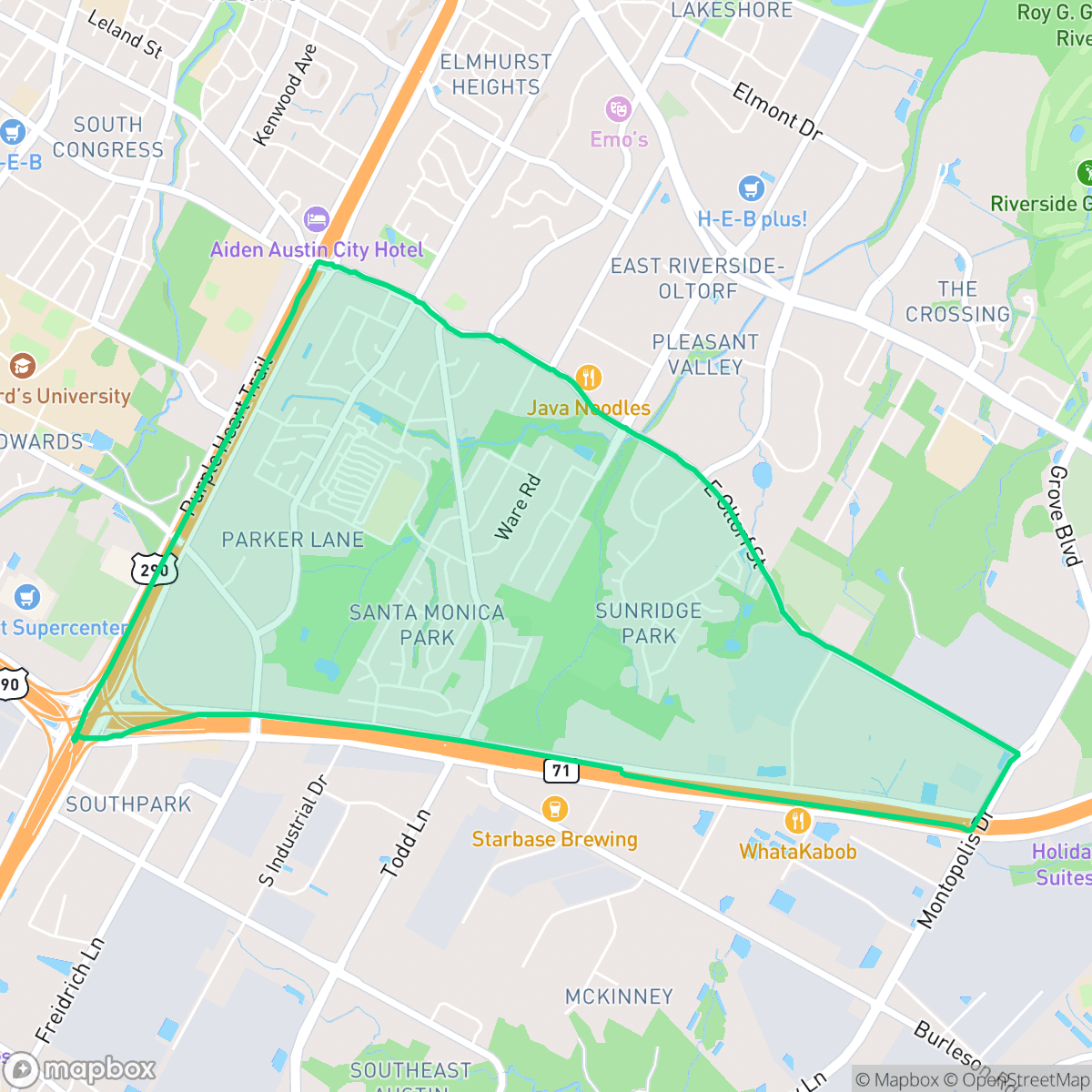
Parker Lane is a quiet South Austin neighborhood defined by a mix of multi-family housing, wooded green belts, and proximity to major logistics hubs. It offers moderate walkability and significant outdoor space for dog owners, though residents should expect consistent road noise from nearby highways.
Key Highlights
About Parker Lane
Located southeast of Austin's urban core, the Parker Lane neighborhood remained largely undeveloped farmland until the mid-20th century. A central focal point of the area's physical and environmental transformation is Mabel Davis District Park; the site operated as a gravel quarry until 1944 and as a municipal landfill from 1944 to 1955 before being remediated and dedicated as a park in 1979. Named after local civic leader Mabel Davis, the park is notably home to Austin's first public concrete skatepark, which opened in 2005. The neighborhood's transition to a bustling residential and industrial hub was further cemented in November 1979 when semiconductor giant Advanced Micro Devices (AMD) opened its first manufacturing facility outside of California along East Ben White Boulevard, anchoring Parker Lane as an early tech-sector outpost in South Austin.
The neighborhood functions as a transition zone between residential living and industrial activity. While it lacks a dense commercial core, the area provides a suburban feel punctuated by large, mature trees and shared amenities like community pools. The layout prioritizes internal road networks and cul-de-sacs, which support a relatively safe pedestrian environment despite the presence of nearby industrial warehouses and logistics centers.
Prospective residents should weigh the benefits of ample green space and dog-friendly walking paths against the realities of living near a major thoroughfare. The area is well-suited for those seeking a quiet, functional environment who prioritize accessibility to South Austin over a high-energy nightlife scene. While the neighborhood provides a stable residential base, families should note that local school performance varies significantly, and the area faces challenges regarding air quality and noise levels typical of its industrial-adjacent location.
Neighborhood Scores Across 15 Qualities
Residential spacing varies throughout the area, ranging from shared walls in denser blocks to homes separated by wooded buffers. According to iHuus data, the level of separation between neighbors is slightly below the Austin average.
Walking is primarily restricted to low-traffic internal loops and main roads, as the presence of major highway interchanges and large parking lots makes the area less walkable than the Austin average. According to iHuus data, the lack of sidewalks in certain sections may pose challenges for navigating the broader neighborhood on foot.
Standard multi-family complexes and mid-sized homes define the landscape, which offers less visual variety than the Austin average. Residential views consist mostly of tidy, functional yards and shared amenities like rectangular pools.
Large forested areas and green belts provide ample space for pet exercise, offering higher accessibility for dog owners than the Austin average. Extensive green buffers and wooded clusters allow for walking even near residential fences, though proximity to highway noise is a factor.
Open land and wooded patches provide a more tranquil landscape than the denser urban sprawl found elsewhere in Austin. This area features a mix of scattered homes and significant greenery, offering a slightly less developed atmosphere than the city average.
A balanced blend of quiet suburban blocks and light industrial zones provides a steady rhythm of residential and commercial life. Residents can access a variety of local dining and service hubs, with activity levels closely mirroring the city average according to iHuus data.
Steady traffic sounds from nearby busy streets are noticeable. This level of ambient noise is slightly higher than the Austin average, according to iHuus data.
Frequent unhealthy air quality levels pose a significant risk to sensitive groups. According to iHuus data, the air quality in this area is notably worse than the Austin average.
No industrial warehouses or hazardous facilities are present in this area. The neighborhood maintains a residential and light commercial character that is nearly identical to the Austin average.
Health insurance enrollment among residents is lower than the Austin average, according to iHuus data.
Voting patterns and census indicators show a predominantly liberal political leaning that is even more pronounced than the Austin average, according to iHuus data.
Residents live alongside a balanced mix of young adults, families, and older individuals. This demographic distribution is slightly lower than the Austin average, indicating a slightly less even spread of age groups across the area.
Flood vulnerability is significantly higher than the Austin average, as much of the area sits within a designated floodplain. According to iHuus data, property owners should prepare for potential drainage issues and the likely requirement of flood insurance.
Address-Level Insights for Parker Lane


iHuus Neighborhood Intelligence Insights
Get address-level neighborhood insights for Parker Lane
- Street-level scores — see how individual blocks compare, not just neighborhood averages
- Micro-zone boundaries — identify quiet pockets, flood boundaries, and walkable clusters before you visit
- 15 dimensions in full — walkability, noise, air quality, school quality, insurance coverage, population age profile, urban/rural index, and more
- Boundary risk alerts — know if your address sits near a block boundary where scores drop, the kind of detail no listing will ever mention
- School insights — individual school ratings and insights, not just district-level data
- Compare before you commit — side-by-side data across neighborhoods, down to block precision
No credit card required
Compare with Any Neighborhood
| Dimension | Parker Lane | Allandale |
|---|---|---|
| 🚶 Walkabilityavg 6.73 | ||
| 🔊 Acoustic Comfortavg 3.73 | ||
| 🤫 Privacy Indexavg 5.87 | ||
| 🎨 Visual Appealavg 6.95 | ||
| 🐕 Dog Friendlinessavg 6.92 | ||
| 🗺️ Urban-Rural Indexavg 7.09 | ||
| ✨ Neighborhood Vibeavg 4.91 | ||
| 🏥 Health Insurance Coverageavg 7.56 | ||
| 🌿 Air Qualityavg 5.17 | ||
| 🏭 Industrial Proximityavg 8.86 | ||
| 🌊 Flood Safetyavg 4.83 | ||
| 🗳️ Ideological Leanavg 9.13 | ||
| 👥 Population Age Profileavg 4.52 | ||
| 🔥 Fire Safety | ||
| 🏫 School Quality |
Parker Lane Rankings
School Districts Serving Parker Lane
School Insights for Parker Lane
Below average outcomes; significant attendance and academic challenges.
School Insights
See what's really behind every school rating near Parker Lane
- Individual school ratings — each school's own score with outcome context, not just a district average
- Enrollment & class size data — student-to-teacher ratio and how it compares to the state average
- Full demographics breakdown — ethnicity and gender composition for every school in the enrollment zone
- Every school in the district — all schools within the enrollment boundary ranked by rating, not just the closest one
- Grade levels & benchmarks — elementary through high school, with below/above state-average flags
No credit card required