Onion Creek, Austin
Updated · 209 residents
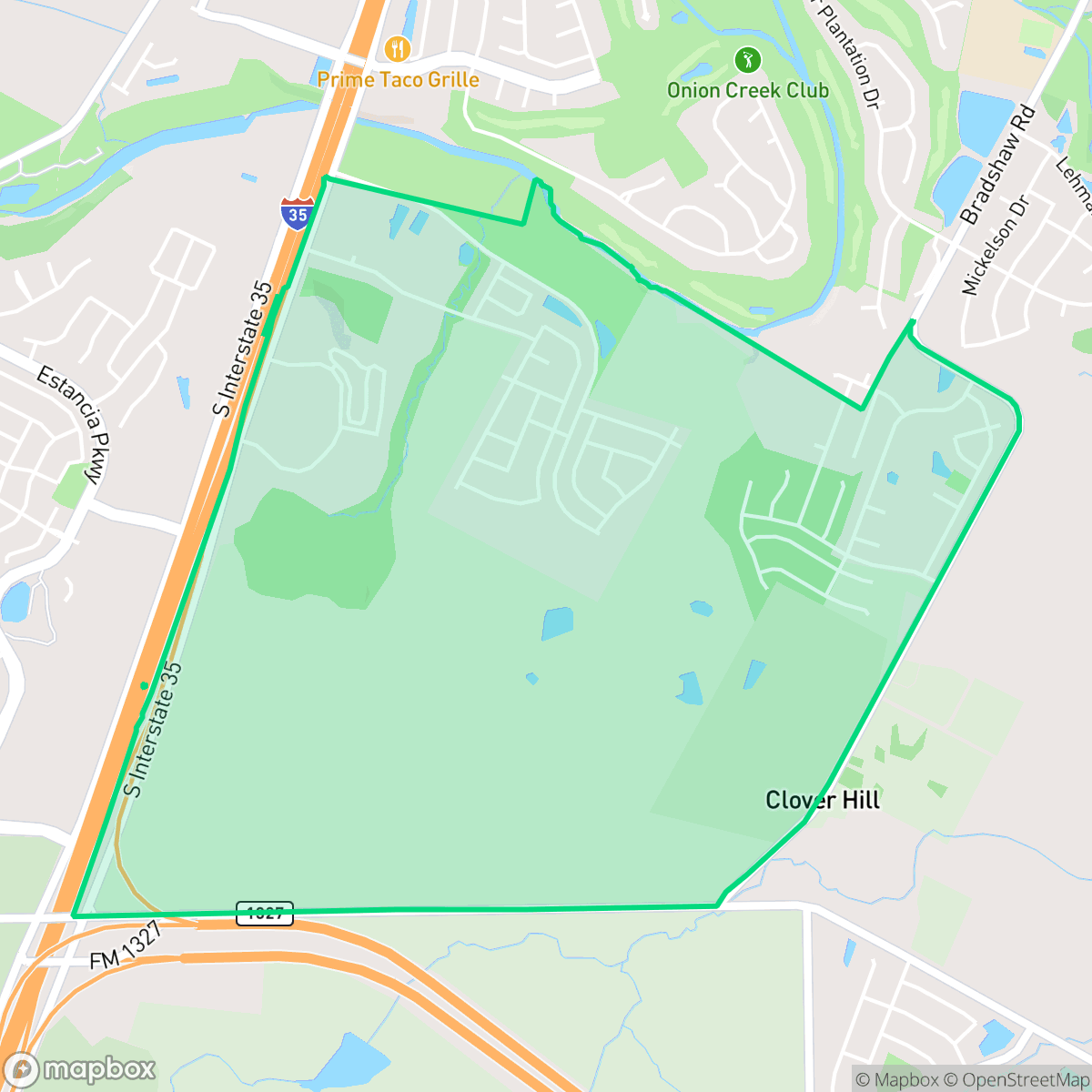
Onion Creek is a quiet, semi-rural residential community in Southeast Austin known for its spacious properties and scenic, golf-course-adjacent landscape. While the neighborhood offers a peaceful atmosphere with ample green space, residents should expect frequent aircraft noise due to proximity to the airport and a high reliance on personal vehicles for daily errands.
Key Highlights
About Onion Creek
The Onion Creek neighborhood in Southeast Austin was established in the early 1970s as a master-planned residential community centered around the Onion Creek Club. Founded in 1974 by legendary golfer Jimmy Demaret and developer Jimmie Connolly, the club gained national prominence as the birthplace of the Senior PGA Tour, hosting the prestigious Legends of Golf tournament. While the neighborhood is defined by its golf-centric identity and scenic creek-side landscape, it has also been shaped by a history of severe flooding. Following catastrophic events, particularly the 2013 Halloween flood, the City of Austin engaged in extensive property buyouts, leading to the demolition of numerous homes and the creation of the Onion Creek Metropolitan Park. Today, the area remains a blend of established residential development and preserved natural floodplains.
Onion Creek provides a spacious, semi-rural environment characterized by large residential lots and well-maintained landscapes. The area lacks industrial activity, ensuring a strictly residential atmosphere that appeals to those seeking a break from the density of central Austin. Its layout promotes walkability through accessible sidewalks, though the lack of a concentrated commercial core necessitates driving for most daily tasks. Prospective residents should consider the trade-offs of living in this area, particularly regarding acoustic comfort and infrastructure. Frequent aircraft noise is a notable feature of the local environment, and the neighborhood experiences a wide range of age demographics. Families should be aware that local school options, split between Austin and Hays school districts, are currently navigating significant financial and operational transitions. The area is well-suited for dog owners who appreciate the connectivity of local parks and the open, spacious feel of the surrounding landscape.
Neighborhood Scores Across 15 Qualities
Residential layouts provide a mix of spacing and buffers between neighbors. According to iHuus data, this level of privacy is roughly in line with the Austin average.
Sidewalks are available along one side of the streets and safe crossings are provided. According to iHuus data, the walkability in this area is higher than the Austin average.
Large residential properties and frequent upscale amenities provide a visual environment that is slightly above the Austin average. According to iHuus data, the area features wide driveways and well-maintained landscapes.
Accessible green spaces and wide, protected paths make this area well suited for pet owners. According to iHuus data, the connectivity of local parks provides a higher level of pet-friendly infrastructure than the Austin average.
Open land and woodland areas are frequent throughout the neighborhood, offering a more spacious setting than the Austin average. According to iHuus data, the landscape features scattered homes situated among fields.
Low-density residential pockets and suburban streets offer a serene environment, but local commerce is sparse. Most daily errands and social hubs require a vehicle due to the lack of a concentrated commercial core, placing the area's liveliness below the Austin average.
Frequent aircraft noise from the nearby airport runway and heavy rail proximity create a loud environment; this level of acoustic disturbance is significantly higher than the Austin average, according to iHuus data.
Air quality in Onion Creek is notably cleaner than the Austin average, with infrequent instances of elevated pollutants. Residents can expect mostly clear conditions according to iHuus data.
Industrial activity and warehouse facilities are absent from this area, providing a more residential atmosphere than the Austin average. According to iHuus data, the landscape consists of quiet streets and open green spaces with no detected hazard sites.
Health insurance accessibility in this area is lower than the Austin average, according to iHuus data. Residents may find fewer options for comprehensive coverage compared to other parts of the city.
Voting patterns and census indicators reflect a strong liberal leaning, though this political profile is slightly less pronounced than the Austin city average according to iHuus data.
Residents live alongside a broad spectrum of age groups, ranging from young professionals to families and seniors. This demographic variety is more widely distributed than the average seen across Austin, according to iHuus data.
Flood risk levels in this area remain uncertain because official FEMA studies are not yet complete. This level of risk is roughly in line with the average for Austin.
Address-Level Insights for Onion Creek


iHuus Neighborhood Intelligence Insights
Get address-level neighborhood insights for Onion Creek
- Street-level scores — see how individual blocks compare, not just neighborhood averages
- Micro-zone boundaries — identify quiet pockets, flood boundaries, and walkable clusters before you visit
- 15 dimensions in full — walkability, noise, air quality, school quality, insurance coverage, population age profile, urban/rural index, and more
- Boundary risk alerts — know if your address sits near a block boundary where scores drop, the kind of detail no listing will ever mention
- School insights — individual school ratings and insights, not just district-level data
- Compare before you commit — side-by-side data across neighborhoods, down to block precision
No credit card required
Compare with Any Neighborhood
| Dimension | Onion Creek | Allandale |
|---|---|---|
| 🚶 Walkabilityavg 6.73 | ||
| 🔊 Acoustic Comfortavg 3.73 | ||
| 🤫 Privacy Indexavg 5.87 | ||
| 🎨 Visual Appealavg 6.95 | ||
| 🐕 Dog Friendlinessavg 6.92 | ||
| 🗺️ Urban-Rural Indexavg 7.09 | ||
| ✨ Neighborhood Vibeavg 4.91 | ||
| 🏥 Health Insurance Coverageavg 7.56 | ||
| 🌿 Air Qualityavg 5.17 | ||
| 🏭 Industrial Proximityavg 8.86 | ||
| 🌊 Flood Safetyavg 4.83 | ||
| 🗳️ Ideological Leanavg 9.13 | ||
| 👥 Population Age Profileavg 4.52 | ||
| 🔥 Fire Safety | ||
| 🏫 School Quality |
Onion Creek Rankings
School Districts Serving Onion Creek
School Insights for Onion Creek
Below average outcomes; significant attendance and academic challenges.
School Insights
See what's really behind every school rating near Onion Creek
- Individual school ratings — each school's own score with outcome context, not just a district average
- Enrollment & class size data — student-to-teacher ratio and how it compares to the state average
- Full demographics breakdown — ethnicity and gender composition for every school in the enrollment zone
- Every school in the district — all schools within the enrollment boundary ranked by rating, not just the closest one
- Grade levels & benchmarks — elementary through high school, with below/above state-average flags
No credit card required