Old West Austin, Austin
Updated · 4,833 residents
Old West Austin is a visually striking, affluent residential enclave known for its diverse architectural styles and proximity to Pease Park. While the area offers access to top-rated schools, residents should be prepared for significant road noise and specific environmental considerations like flood risks.
Key Highlights
About Old West Austin
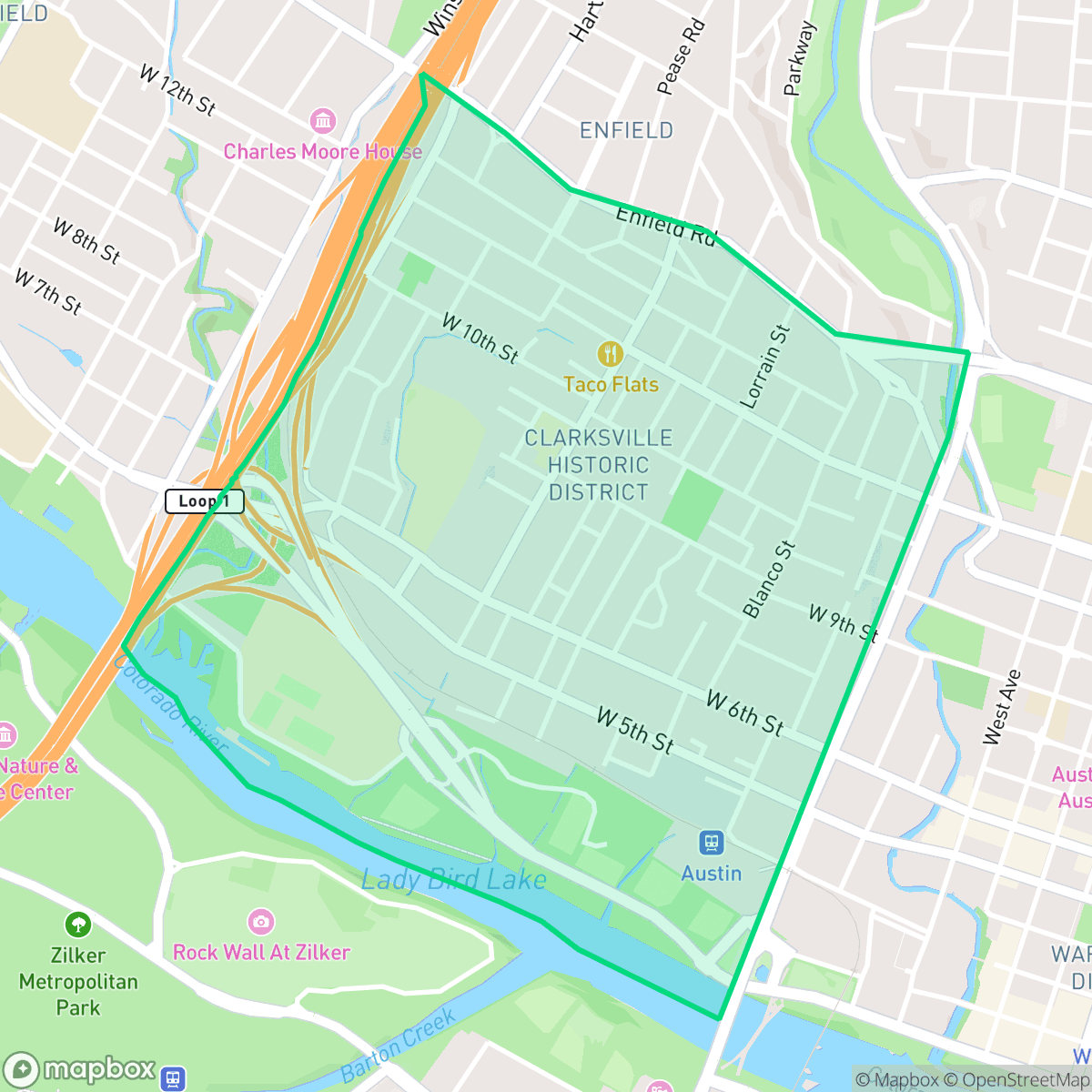
The Old West Austin Historic District, added to the National Register of Historic Places in 2003, comprises three distinct neighborhoods: Old Enfield, Pemberton Heights, and Bryker Woods. Developed primarily between 1886 and 1953, the area emerged as Austin’s first automobile-oriented suburb. Its history is rooted in the mid-19th-century Woodlawn plantation. Woodlawn’s landmark Greek Revival mansion, built in 1853 by architect Abner Cook and later owned by Texas Governor Elisha M. Pease, still stands as the area's oldest home. The Pease family also donated the land for the adjacent Pease Park along Shoal Creek, which forms the district’s eastern boundary. Characterized by rolling topography, heritage oaks, and eclectic architecture ranging from Tudor and Spanish Revival homes to modest bungalows, Old West Austin sits adjacent to Clarksville, one of the oldest post-Civil War freedman's towns west of the Mississippi.
The neighborhood maintains a distinct character defined by its rolling topography, mature heritage oaks, and a blend of historic Tudor, Spanish Revival, and bungalow homes. It functions primarily as a quiet, residential area with light commercial activity, offering a dense, established urban environment that feels removed from the high-intensity bustle of the city center. The area is highly regarded for its aesthetic appeal and strong community identity, making it a desirable location for those seeking a balance of historic charm and central convenience.
Living in the area involves specific trade-offs, particularly regarding acoustic comfort, as road traffic noise is a common factor for many residents. While the neighborhood provides a high quality of life with excellent health insurance coverage and proximity to high-performing schools like Mathews Elementary and Austin High, pet owners may find the limited public park access and narrow sidewalk verges restrictive. Potential residents should also consider the local flood safety profile when evaluating property options in this otherwise prestigious and well-connected part of Austin.
Neighborhood Scores Across 15 Qualities
Residential spacing varies from dense multi-unit structures to single-family homes, though heavy tree cover provides significant buffering in many areas. According to iHuus data, the level of separation between neighbors is slightly lower than the Austin average.
Pedestrian mobility is significantly higher than the Austin average due to a dense grid of low traffic interior streets and sidewalk access. While central arterials can be busier, much of the area offers a connected environment for walking.
Manicured grounds, large custom homes, and frequent private pools create a highly aesthetic environment that is more visually pleasing than the Austin average. According to iHuus data, the area features well-maintained properties and premium amenities.
Abundant greenbelt access and central park paths provide excellent exercise areas for dogs, making this area slightly more pet friendly than the Austin average. While some residential streets feature narrow sidewalks, the integrated urban green spaces and river access offer ample walking opportunities.
Residential streets and green spaces are balanced with commercial areas, creating a landscape that is less dense than the Austin average. According to iHuus data, the neighborhood features a significant tree canopy alongside established single-family homes.
Local dining, wellness spots, and social hubs create a noticeably more active environment than the Austin average. Residents can find a diverse mix of energy ranging from quiet green spaces to lively, street-level social destinations according to iHuus data.
Frequent noise from nearby major highways and rail lines is common in this area. According to iHuus data, acoustic levels here are notably higher than the Austin average.
Air quality in this area fluctuates between acceptable and unhealthy levels, posing occasional risks for sensitive groups. This rating is slightly better than the average for Austin, according to iHuus data.
Industrial activity and heavy warehouses are absent from this area, which consists entirely of residential and light commercial spaces. According to iHuus data, this lack of industrial proximity is even more pronounced here than in the rest of Austin.
Health insurance rates among residents are lower than the Austin city average, according to iHuus data.
Voting patterns and census indicators show a predominantly liberal leaning that is slightly more pronounced than the Austin city average, according to iHuus data.
A balanced mix of young adults, families, and older residents characterizes the area, aligning closely with the typical age distribution found across Austin.
Flood risk levels in this area remain uncertain because official federal studies have not been completed for this specific location. According to iHuus data, the potential for flooding is slightly higher than the average found across Austin.
Address-Level Insights for Old West Austin


iHuus Neighborhood Intelligence Insights
Get address-level neighborhood insights for Old West Austin
- Street-level scores — see how individual blocks compare, not just neighborhood averages
- Micro-zone boundaries — identify quiet pockets, flood boundaries, and walkable clusters before you visit
- 15 dimensions in full — walkability, noise, air quality, school quality, insurance coverage, population age profile, urban/rural index, and more
- Boundary risk alerts — know if your address sits near a block boundary where scores drop, the kind of detail no listing will ever mention
- School insights — individual school ratings and insights, not just district-level data
- Compare before you commit — side-by-side data across neighborhoods, down to block precision
No credit card required
Compare with Any Neighborhood
| Dimension | Old West Austin | Allandale |
|---|---|---|
| 🚶 Walkabilityavg 6.73 | ||
| 🔊 Acoustic Comfortavg 3.73 | ||
| 🤫 Privacy Indexavg 5.87 | ||
| 🎨 Visual Appealavg 6.95 | ||
| 🐕 Dog Friendlinessavg 6.92 | ||
| 🗺️ Urban-Rural Indexavg 7.09 | ||
| ✨ Neighborhood Vibeavg 4.91 | ||
| 🏥 Health Insurance Coverageavg 7.56 | ||
| 🌿 Air Qualityavg 5.17 | ||
| 🏭 Industrial Proximityavg 8.86 | ||
| 🌊 Flood Safetyavg 4.83 | ||
| 🗳️ Ideological Leanavg 9.13 | ||
| 👥 Population Age Profileavg 4.52 | ||
| 🔥 Fire Safety | ||
| 🏫 School Quality |
Old West Austin Rankings
School Districts Serving Old West Austin
School Insights for Old West Austin
Below average outcomes; significant attendance and academic challenges.
School Insights
See what's really behind every school rating near Old West Austin
- Individual school ratings — each school's own score with outcome context, not just a district average
- Enrollment & class size data — student-to-teacher ratio and how it compares to the state average
- Full demographics breakdown — ethnicity and gender composition for every school in the enrollment zone
- Every school in the district — all schools within the enrollment boundary ranked by rating, not just the closest one
- Grade levels & benchmarks — elementary through high school, with below/above state-average flags
No credit card required