North University, Austin
Updated · 5,512 residents
North University is a highly walkable neighborhood defined by its proximity to the University of Texas campus and a blend of historic architecture and student-focused amenities. Residents enjoy a vibrant, dog-friendly environment with easy access to local dining and a well-connected grid of pedestrian-friendly streets.
Key Highlights
About North University
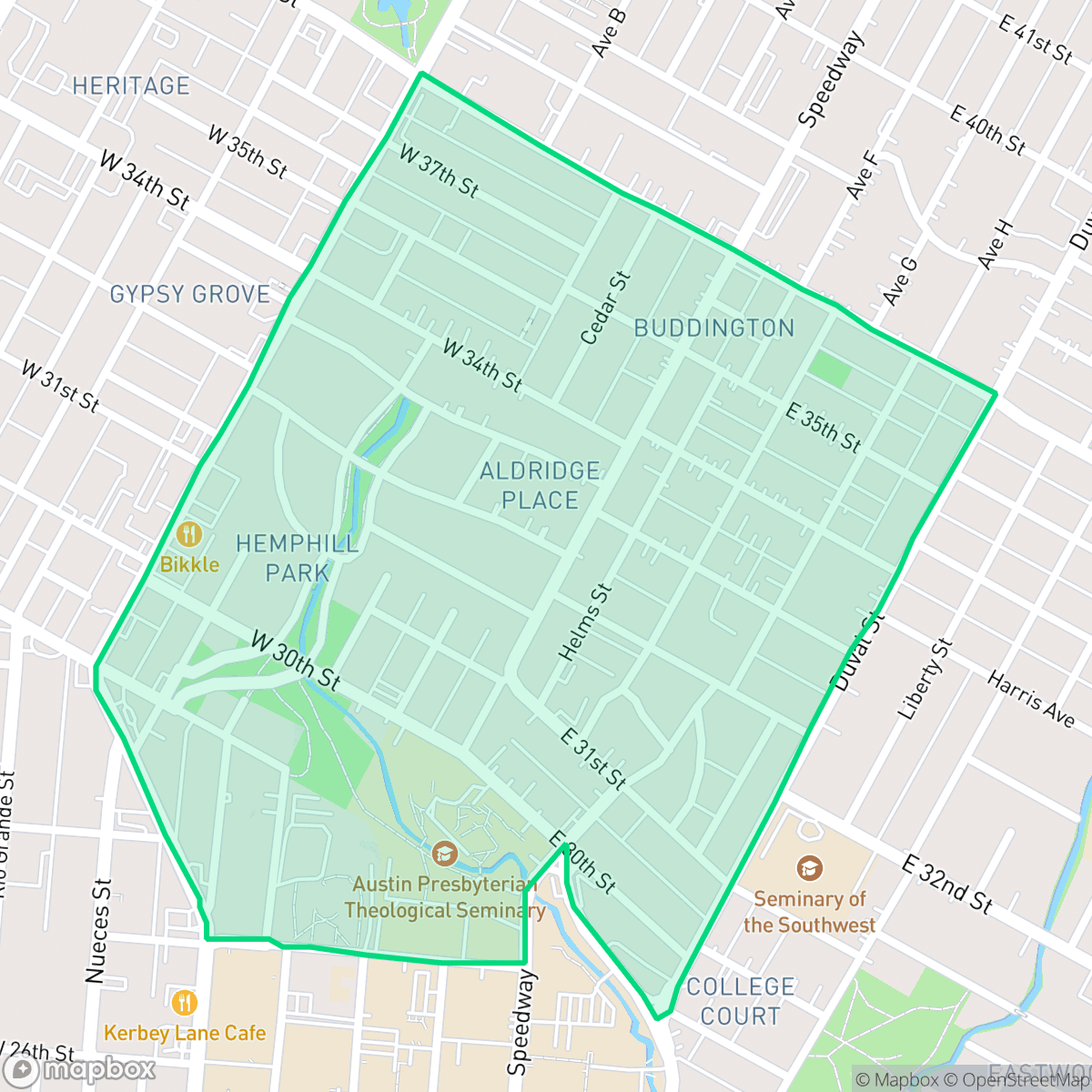
North University, located north of the University of Texas at Austin, dates back to 1840s land grants, with its oldest surviving structure being the 1860 limestone Albert Buddington house. Originally a rural area, it transitioned to residential subdivisions in the late 19th and early 20th centuries. Notable historic subdivisions include the Grooms Addition (1890), famed for its Arts and Crafts bungalows, and the Aldridge Place Historic District (1912). Platted by former Austin Mayor Lewis Hancock in the City Beautiful style, Aldridge Place features winding, tree-lined streets and homes designed by prominent architects like Hugo Kuehne. Other local landmarks include the 1908 Confederate Women’s Home and the vibrant Guadalupe Street corridor. Today, the neighborhood preserves its historic character alongside student-oriented venues like the Crown and Anchor Pub.
The area functions as a bridge between the academic intensity of the university and an established residential community. It features a dense, low-rise urban fabric that prioritizes pedestrian access, making it a convenient location for those who work or study nearby. The streetscape is characterized by a high degree of visual appeal, with well-maintained homes and a mature tree canopy that supports an active outdoor lifestyle for both residents and their pets. The neighborhood is entirely residential and institutional in nature, ensuring a quiet, non-industrial environment that remains lively due to its central location.
While the area offers excellent walkability and a strong sense of place, prospective residents should consider specific environmental and administrative factors. The neighborhood has a low flood safety rating, and ambient noise levels are influenced by consistent road traffic. Additionally, the local school district is currently navigating financial and operational transitions, which may be a point of consideration for families. The area is best suited for students, faculty, and professionals who value proximity to the university and a dense, historic urban setting.
Neighborhood Scores Across 15 Qualities
Residential density varies between compact apartment complexes and detached homes with mature tree buffers. This area offers a similar level of privacy and spacing to the rest of Austin.
Pedestrian connectivity is strong here due to a dense street grid and safe crossings that link residential zones to the university campus. This level of walkability is notably higher than the Austin average, according to iHuus data.
Large custom homes, dense tree canopy, and visible private pools create an aesthetic that is more visually appealing than the Austin average. High-end multi-family complexes and well-maintained institutional architecture contribute to a polished streetscape according to iHuus data.
Abundant tree canopy and proximity to large wooded green belts provide excellent walking opportunities for pets. According to iHuus data, these connected green spaces and shaded paths offer a higher level of dog friendliness than the Austin average.
A high concentration of institutional blocks, apartment complexes, and medical facilities creates a developed urban fabric that is slightly less sprawling than the Austin average. According to iHuus data, the area features a notable tree canopy alongside multi-story residential and office structures.
Diverse dining options and a high density of social destinations create an energetic atmosphere that is significantly more active than the Austin average. Residents have access to a variety of local eateries and leisure spots situated near green spaces and water features.
Steady sounds from nearby busy streets are common here, though acoustic levels are slightly more tranquil than the Austin average.
Air quality levels in this area fluctuate between acceptable and unhealthy, particularly for sensitive groups. According to iHuus data, the air quality here is generally better than the Austin city average.
Land use is exclusively residential, medical, and institutional with no visible warehouses or heavy industrial hazards. This lack of industrial proximity is even more pronounced here than the city average, according to iHuus data.
Health insurance accessibility is notably higher than the Austin average, according to iHuus data. This indicates a resident population with greater access to medical coverage and stability.
Voting patterns and census indicators show a very high concentration of liberal-leaning residents, notably more so than the Austin average according to iHuus data.
Residents are significantly younger than the Austin average, with a population profile concentrated in the young adult demographic. According to iHuus data, there is a minimal presence of families or older adults in this area.
Flood risk in this area remains uncertain because FEMA has not yet completed a detailed study for this specific location. According to iHuus data, the potential for flooding is roughly in line with the average found throughout Austin.
Address-Level Insights for North University


iHuus Neighborhood Intelligence Insights
Get address-level neighborhood insights for North University
- Street-level scores — see how individual blocks compare, not just neighborhood averages
- Micro-zone boundaries — identify quiet pockets, flood boundaries, and walkable clusters before you visit
- 15 dimensions in full — walkability, noise, air quality, school quality, insurance coverage, population age profile, urban/rural index, and more
- Boundary risk alerts — know if your address sits near a block boundary where scores drop, the kind of detail no listing will ever mention
- School insights — individual school ratings and insights, not just district-level data
- Compare before you commit — side-by-side data across neighborhoods, down to block precision
No credit card required
Compare with Any Neighborhood
| Dimension | North University | Allandale |
|---|---|---|
| 🚶 Walkabilityavg 6.73 | ||
| 🔊 Acoustic Comfortavg 3.73 | ||
| 🤫 Privacy Indexavg 5.87 | ||
| 🎨 Visual Appealavg 6.95 | ||
| 🐕 Dog Friendlinessavg 6.92 | ||
| 🗺️ Urban-Rural Indexavg 7.09 | ||
| ✨ Neighborhood Vibeavg 4.91 | ||
| 🏥 Health Insurance Coverageavg 7.56 | ||
| 🌿 Air Qualityavg 5.17 | ||
| 🏭 Industrial Proximityavg 8.86 | ||
| 🌊 Flood Safetyavg 4.83 | ||
| 🗳️ Ideological Leanavg 9.13 | ||
| 👥 Population Age Profileavg 4.52 | ||
| 🔥 Fire Safety | ||
| 🏫 School Quality |
North University Rankings
School Districts Serving North University
School Insights for North University
Below average outcomes; significant attendance and academic challenges.
School Insights
See what's really behind every school rating near North University
- Individual school ratings — each school's own score with outcome context, not just a district average
- Enrollment & class size data — student-to-teacher ratio and how it compares to the state average
- Full demographics breakdown — ethnicity and gender composition for every school in the enrollment zone
- Every school in the district — all schools within the enrollment boundary ranked by rating, not just the closest one
- Grade levels & benchmarks — elementary through high school, with below/above state-average flags
No credit card required