North Shoal Creek, Austin
Updated · 5,157 residents
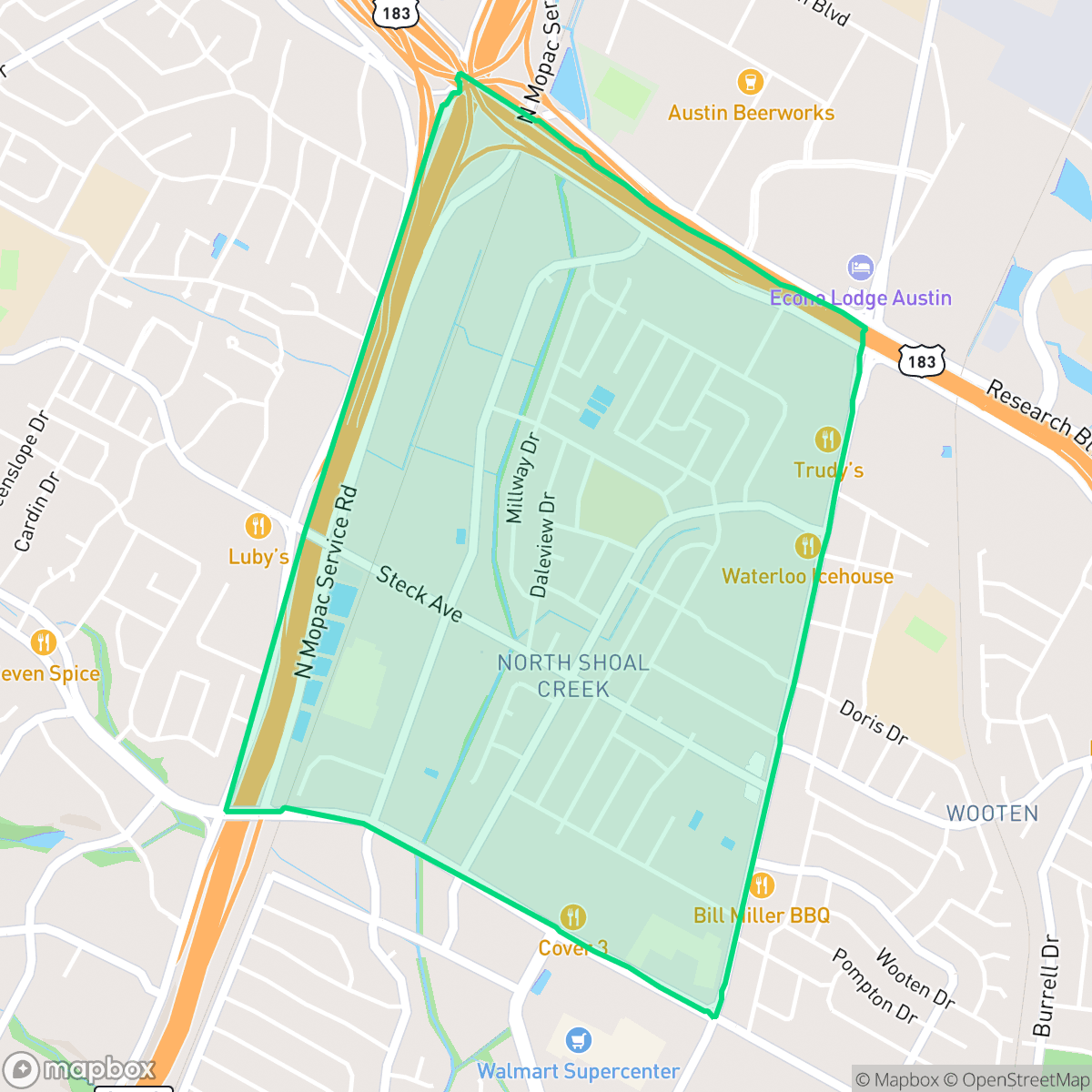
North Shoal Creek is a north-central Austin community defined by its mid-century suburban roots and proximity to major transit corridors like MoPac and US-183. Residents enjoy a mix of established residential blocks and accessible commercial hubs, though the area experiences notable road noise and limited walkability. It offers a practical, central location for those who prioritize convenience over a quiet, pedestrian-focused lifestyle.
Key Highlights
About North Shoal Creek
Prior to 1960, the North Shoal Creek area in north-central Austin was a rural farming region outside city limits, situated where historic pioneer trails (now MoPac Expressway and US-183) converged. The neighborhood transitioned to a suburban community in the late 1950s and 1960s, characterized by mid-century ranch homes. Notable local history includes the 1958 Steck Company printing facility and the 19th-century Robinson family homestead on Burnet Road. Additionally, a historic 19th-century ranch stable remains preserved behind the former Radian Company campus. Culturally, the neighborhood’s commercial edge on Anderson Lane holds a unique claim to fame: in 1976, singer-songwriter Jimmy Buffett wrote his hit song “Margaritaville” after enjoying a margarita at Lung’s Cocina del Sur, a local restaurant formerly located in the neighborhood.
The neighborhood maintains a distinct suburban character, blending mid-century single-family homes with denser apartment complexes and commercial zones. It serves as a functional hub for residents who value central access to the city, with popular local spots like Epoch Coffee, Korea House, and Cabo Bob's providing a steady social rhythm. The area is marked by a blend of residential streets and light industrial units, creating a landscape that is both active during the day and quiet in the evenings. Its location near major highways provides excellent connectivity, though this proximity contributes to the neighborhood's overall acoustic environment.
Living in this area involves certain trade-offs, particularly regarding transit and infrastructure. Because sidewalks are often inconsistent or obstructed by trees, the neighborhood is largely car-dependent, and residents should expect a moderate level of road noise. However, the area benefits from relatively good air quality and high health insurance coverage rates among its population. It is well-suited for individuals or families seeking a central Austin address with reliable access to services and a mix of established, modest housing options.
Neighborhood Scores Across 15 Qualities
Housing density varies between closely packed apartment blocks and single-family homes with private backyards. This level of separation is slightly lower than the Austin average, according to iHuus data.
Low-traffic, tree-lined streets offer pleasant walking conditions, though major highway corridors and inconsistent sidewalk networks create notable barriers for pedestrians. This level of walkability is slightly below the Austin city average according to iHuus data.
Uniform rooflines and modest yards define this residential area. The visual landscape is less varied than the Austin average due to the prevalence of standard tract housing and shared apartment amenities.
Public green space is relatively sparse compared to the Austin average, though a large school field and track offer some accessible area for exercise. Most greenery in the neighborhood is found within private yards or enclosed apartment complexes, with narrow sidewalk verges making street walking more difficult.
Residential pockets transition into commercial strips and industrial zones, offering a less dense environment than the Austin average. According to iHuus data, the landscape features a blend of single-family homes and larger-scale office parks.
Diverse dining options and social hubs provide more activity than the city average, though the presence of industrial units and major highways creates a mix of lively streets and quieter, car-dependent areas. According to iHuus data, the neighborhood offers a blend of suburban greenery and accessible amenities.
Frequent noise from nearby major freeways and rail lines makes this a loud environment. According to iHuus data, acoustic comfort in this area is notably lower than the Austin average.
Air quality in this area fluctuates between acceptable and unhealthy levels, though conditions are generally better than the Austin average. Sensitive groups should remain aware of occasional periods of concern, according to iHuus data.
Active commercial zones and large warehouses on the western edge bring more industrial activity and truck traffic than the Austin average. According to iHuus data, this proximity to logistics hubs and highway corridors may result in increased noise levels for nearby residents.
Health insurance accessibility is notably higher than the Austin average, according to iHuus data. Most residents in this area possess comprehensive medical coverage.
Voting patterns and census indicators show a predominantly liberal leaning that is even more pronounced than the Austin average, according to iHuus data.
A balanced mix of young adults, families, and older residents characterizes this area. According to iHuus data, the age distribution is slightly more varied than the Austin average.
Flood risk in this area is higher than the Austin average, though detailed FEMA studies for this specific zone are currently unavailable. Residents should remain aware of potential drainage concerns during heavy rain events according to iHuus data.
Address-Level Insights for North Shoal Creek


iHuus Neighborhood Intelligence Insights
Get address-level neighborhood insights for North Shoal Creek
- Street-level scores — see how individual blocks compare, not just neighborhood averages
- Micro-zone boundaries — identify quiet pockets, flood boundaries, and walkable clusters before you visit
- 15 dimensions in full — walkability, noise, air quality, school quality, insurance coverage, population age profile, urban/rural index, and more
- Boundary risk alerts — know if your address sits near a block boundary where scores drop, the kind of detail no listing will ever mention
- School insights — individual school ratings and insights, not just district-level data
- Compare before you commit — side-by-side data across neighborhoods, down to block precision
No credit card required
Compare with Any Neighborhood
| Dimension | North Shoal Creek | Allandale |
|---|---|---|
| 🚶 Walkabilityavg 6.73 | ||
| 🔊 Acoustic Comfortavg 3.73 | ||
| 🤫 Privacy Indexavg 5.87 | ||
| 🎨 Visual Appealavg 6.95 | ||
| 🐕 Dog Friendlinessavg 6.92 | ||
| 🗺️ Urban-Rural Indexavg 7.09 | ||
| ✨ Neighborhood Vibeavg 4.91 | ||
| 🏥 Health Insurance Coverageavg 7.56 | ||
| 🌿 Air Qualityavg 5.17 | ||
| 🏭 Industrial Proximityavg 8.86 | ||
| 🌊 Flood Safetyavg 4.83 | ||
| 🗳️ Ideological Leanavg 9.13 | ||
| 👥 Population Age Profileavg 4.52 | ||
| 🔥 Fire Safety | ||
| 🏫 School Quality |
North Shoal Creek Rankings
School Districts Serving North Shoal Creek
School Insights for North Shoal Creek
Below average outcomes; significant attendance and academic challenges.
School Insights
See what's really behind every school rating near North Shoal Creek
- Individual school ratings — each school's own score with outcome context, not just a district average
- Enrollment & class size data — student-to-teacher ratio and how it compares to the state average
- Full demographics breakdown — ethnicity and gender composition for every school in the enrollment zone
- Every school in the district — all schools within the enrollment boundary ranked by rating, not just the closest one
- Grade levels & benchmarks — elementary through high school, with below/above state-average flags
No credit card required