North Loop, Austin
Updated · 5,686 residents
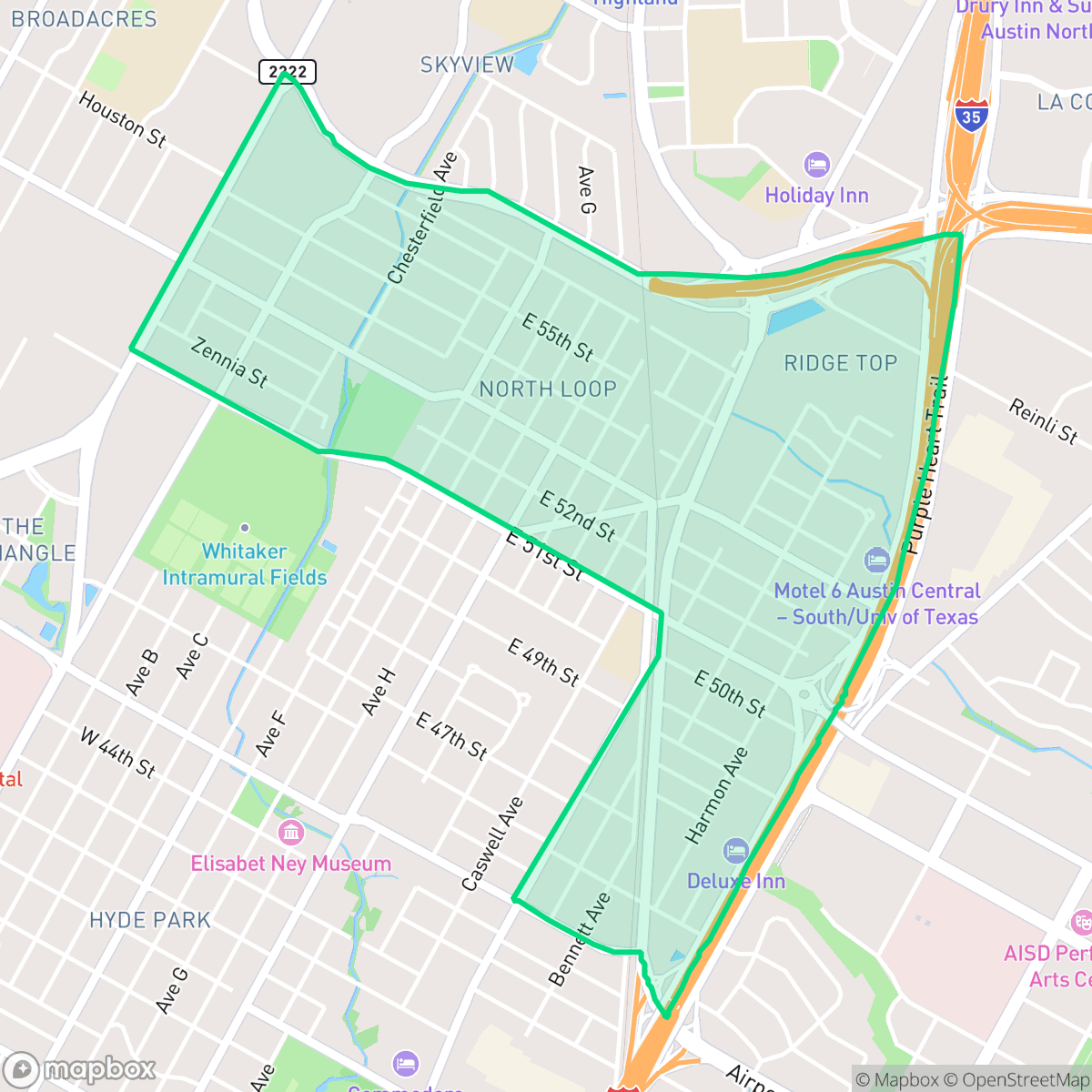
North Loop is a vibrant, bohemian enclave defined by its mid-century bungalow architecture and a lively, independent business scene. While the neighborhood offers a strong sense of community and high health insurance coverage, residents should expect moderate road noise and should be aware of significant flood risks in the area.
Key Highlights
About North Loop
Once a rural area home to "Doc" Haile’s airfield, Austin’s North Loop neighborhood—originally called Northfield—was rapidly developed after World War II to house veterans attending the University of Texas under the G.I. Bill. The area was built up with modest, mid-century bungalows. For decades, its location directly under the flight path of the nearby Robert Mueller Municipal Airport suppressed property values and kept the area relatively isolated. However, after the airport’s 1999 closure, the neighborhood experienced a major renaissance. Today, North Loop is celebrated for its quirky, independent spirit. The "North Loop Strip" serves as its cultural hub, anchored by iconic local businesses like Room Service Vintage, Blue Velvet, and Epoch Coffee, which showcase the neighborhood's bohemian, "Keep Austin Weird" character.
The area serves as a hub for local culture, characterized by a dense grid of residential streets and a bustling commercial corridor. It maintains a distinct identity through its eclectic mix of vintage shops, coffee houses, and diverse dining options. The environment is notably progressive, with a community that prioritizes local commerce and a distinct, non-conformist atmosphere that sets it apart from more conventional suburban developments in the region.
Prospective residents will find that while the neighborhood is lively and well-connected to local amenities, it remains largely car-dependent due to interrupted sidewalk networks. The housing stock consists primarily of modest single-family homes, though some multi-family complexes are present. Those considering a move should account for the moderate ambient noise levels from nearby traffic and the necessity of reviewing specific property flood maps, as the area faces notable challenges regarding flood safety.
Neighborhood Scores Across 15 Qualities
Residential spacing is somewhat compressed due to a mix of closely packed houses and multi-unit complexes. This level of density is slightly higher than the Austin average, resulting in limited buffers between neighbors in certain pockets of the neighborhood.
Pedestrian movement is hindered by interrupted sidewalks and large highway interchanges, making the area slightly less walkable than the Austin average. While residential streets are generally quiet, large commercial arterials and street parking can create obstacles for walkers and strollers.
Residential views consist primarily of uniform single-family homes and multi-family apartment blocks. This level of visual variety is slightly below the Austin city average according to iHuus data.
Access to large public parks with open fields provides good opportunities for exercise, though the availability of green space is slightly below the Austin average. Residential yards are mostly fenced, but narrow sidewalk verges and heavy tree canopy can sometimes obscure walking paths.
Dense residential grids and mixed-use commercial corridors define this area, making it more developed than the typical Austin landscape. According to iHuus data, the neighborhood features a prominent mix of single-family homes and large apartment complexes rather than open farmland.
Frequent social hubs and a variety of dining options create a more active atmosphere than the Austin average. While many blocks feature a notable concentration of local eateries and coffee shops, several areas remain car-dependent due to the surrounding industrial and highway features.
Frequent disturbances from nearby railroad tracks and heavy freeway traffic characterize the area. According to iHuus data, acoustic comfort in this neighborhood is lower than the Austin average.
Air quality in this area fluctuates between acceptable and unhealthy levels, though it remains better than the Austin average according to iHuus data. Sensitive groups should be aware of occasional days with higher pollution concentrations.
Low levels of heavy industry characterize most of the area; however, proximity to warehouses and rail lines creates more noise than the city average. Some residents may experience increased traffic from nearby commercial hubs and highway interchanges.
Health insurance enrollment is very high among North Loop residents, significantly outpacing the Austin city average according to iHuus data.
Voting patterns and census indicators show a highly liberal political lean that is more pronounced than the Austin city average, according to iHuus data.
Residents will find a diverse age distribution ranging from young professionals to older adults. According to iHuus data, this demographic spread is largely consistent with the broader Austin area.
Frequent flooding is a concern in this area as it sits within a designated floodplain, which is significantly more vulnerable than most parts of Austin. Residents should anticipate higher risks of water damage and may find that flood insurance is a standard requirement for properties here.
Address-Level Insights for North Loop


iHuus Neighborhood Intelligence Insights
Get address-level neighborhood insights for North Loop
- Street-level scores — see how individual blocks compare, not just neighborhood averages
- Micro-zone boundaries — identify quiet pockets, flood boundaries, and walkable clusters before you visit
- 15 dimensions in full — walkability, noise, air quality, school quality, insurance coverage, population age profile, urban/rural index, and more
- Boundary risk alerts — know if your address sits near a block boundary where scores drop, the kind of detail no listing will ever mention
- School insights — individual school ratings and insights, not just district-level data
- Compare before you commit — side-by-side data across neighborhoods, down to block precision
No credit card required
Compare with Any Neighborhood
| Dimension | North Loop | Allandale |
|---|---|---|
| 🚶 Walkabilityavg 6.73 | ||
| 🔊 Acoustic Comfortavg 3.73 | ||
| 🤫 Privacy Indexavg 5.87 | ||
| 🎨 Visual Appealavg 6.95 | ||
| 🐕 Dog Friendlinessavg 6.92 | ||
| 🗺️ Urban-Rural Indexavg 7.09 | ||
| ✨ Neighborhood Vibeavg 4.91 | ||
| 🏥 Health Insurance Coverageavg 7.56 | ||
| 🌿 Air Qualityavg 5.17 | ||
| 🏭 Industrial Proximityavg 8.86 | ||
| 🌊 Flood Safetyavg 4.83 | ||
| 🗳️ Ideological Leanavg 9.13 | ||
| 👥 Population Age Profileavg 4.52 | ||
| 🔥 Fire Safety | ||
| 🏫 School Quality |
North Loop Rankings
School Districts Serving North Loop
School Insights for North Loop
Below average outcomes; significant attendance and academic challenges.
School Insights
See what's really behind every school rating near North Loop
- Individual school ratings — each school's own score with outcome context, not just a district average
- Enrollment & class size data — student-to-teacher ratio and how it compares to the state average
- Full demographics breakdown — ethnicity and gender composition for every school in the enrollment zone
- Every school in the district — all schools within the enrollment boundary ranked by rating, not just the closest one
- Grade levels & benchmarks — elementary through high school, with below/above state-average flags
No credit card required