North Burnett, Austin
Updated · 8,668 residents
North Burnet is a high-density district in northwest Austin defined by its blend of industrial warehouses, modern office parks, and major entertainment venues like Q2 Stadium. While the area offers diverse dining and proximity to retail hubs, residents should expect a car-dependent environment with moderate noise levels from nearby highway traffic.
Key Highlights
About North Burnett
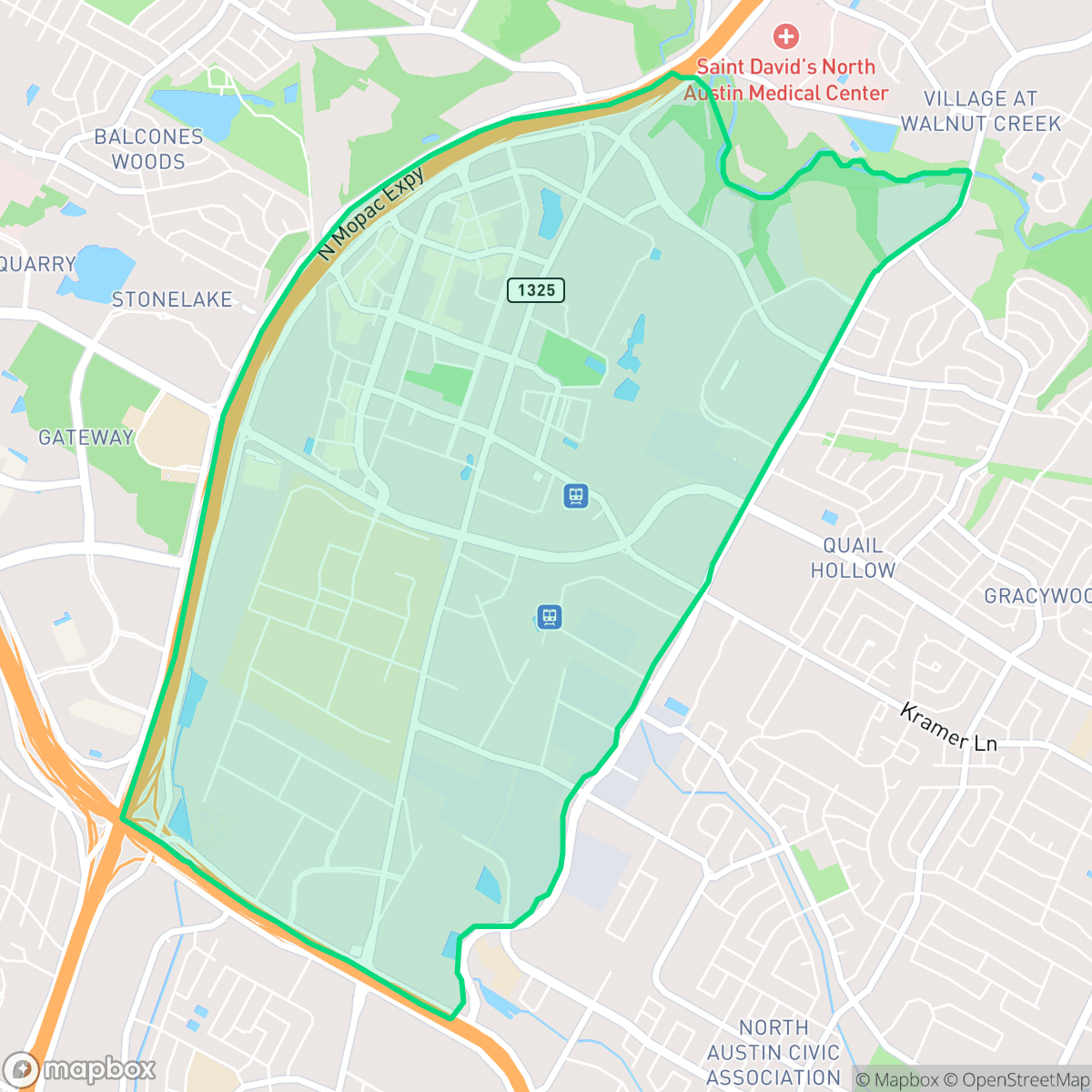
North Burnet (often called North Burnet–Gateway) is a 2,300-acre neighborhood in northwest Austin that transitioned from rural agricultural land into a major institutional and commercial hub. During World War II, the federal government constructed a magnesium processing plant in the area. In 1949, with assistance from then-Congressman Lyndon B. Johnson, the University of Texas acquired the site, which evolved from the Balcones Research Center into the J.J. Pickle Research Campus. In 2006, the City of Austin established the North Burnet/Gateway Master Plan to transform this low-density, industrial area into a high-density, mixed-use "second downtown." Today, the neighborhood is defined by major developments like the upscale Domain shopping and residential complex and Q2 Stadium, home of the Austin FC professional soccer team.
The neighborhood functions as a significant commercial and residential hub, characterized by a dense mix of multi-story apartment complexes, light industrial warehouses, and large-scale office structures. It serves as a center of activity for those drawn to the convenience of the Domain and the energy of professional soccer matches at Q2 Stadium. The landscape is primarily defined by its suburban-industrial transition, where paved lots and logistics-focused infrastructure sit alongside modern residential developments.
Living in the area requires a reliance on personal vehicles, as the layout is largely optimized for commercial traffic rather than pedestrians. While the neighborhood provides access to various dining options and coffee shops, the overall acoustic environment is influenced by road noise. Prospective residents will find a mix of housing types, though the density results in varying levels of privacy between units. Families may consider local educational options, which range from the Austin and Pflugerville Independent School Districts to specialized charter schools like the Harmony School of Science.
Neighborhood Scores Across 15 Qualities
Privacy varies significantly across the area due to the combination of closely packed apartment blocks and detached single-family homes. According to iHuus data, the level of separation between neighbors is slightly lower than the Austin average.
Sidewalks are available along major roads and residential loops, though a large highway and fragmented paths create notable barriers for pedestrians. Overall connectivity is slightly below the Austin average due to these infrastructure gaps.
Visual variety is somewhat limited due to the prevalence of multi-family complexes and tract housing. According to iHuus data, the area presents a more functional, utilitarian landscape compared to the more visually diverse city average.
Wooded buffers and forested trails between residential clusters provide ample space for pet exercise. While much of the neighborhood greenery is enclosed within private complexes, these areas remain comparable to the Austin average for dog friendliness.
Frequent open land and scattered homes among woodlands provide a more open landscape than the more densely developed Austin average. Large-scale warehouse complexes and industrial zones are interspersed with pockets of significant tree canopy.
A steady rhythm of services and dining is available, but the neighborhood's layout is primarily car-dependent with a subdued energy compared to the Austin average. Many areas feature a mix of light industrial units and green space, offering a tranquil atmosphere that lacks a high level of pedestrian activity.
Local traffic from nearby busy streets creates a consistent ambient hum, which is roughly in line with the average noise levels found across Austin.
Air quality is notably better than the Austin average, with mostly clean conditions and only infrequent periods of elevated readings according to iHuus data.
Residential life remains largely uninterrupted by heavy industry, though some warehouse and distribution activity is visible on the western edges. This area has significantly less industrial density than the Austin average.
Most residents in this area are covered by health insurance, though the rate of coverage is slightly lower than the Austin average according to iHuus data.
Voting patterns and census indicators show a predominantly liberal leaning that is even more pronounced than the Austin average, according to iHuus data.
Residents live alongside a balanced mix of young adults, families, and older individuals. This demographic spread is slightly lower than the Austin average, according to iHuus data.
Flood risk levels in this area remain uncertain because official federal studies have not been completed for this specific location. According to iHuus data, the potential for flooding is slightly higher than the average found across Austin.
Address-Level Insights for North Burnett


iHuus Neighborhood Intelligence Insights
Get address-level neighborhood insights for North Burnett
- Street-level scores — see how individual blocks compare, not just neighborhood averages
- Micro-zone boundaries — identify quiet pockets, flood boundaries, and walkable clusters before you visit
- 15 dimensions in full — walkability, noise, air quality, school quality, insurance coverage, population age profile, urban/rural index, and more
- Boundary risk alerts — know if your address sits near a block boundary where scores drop, the kind of detail no listing will ever mention
- School insights — individual school ratings and insights, not just district-level data
- Compare before you commit — side-by-side data across neighborhoods, down to block precision
No credit card required
Compare with Any Neighborhood
| Dimension | North Burnett | Allandale |
|---|---|---|
| 🚶 Walkabilityavg 6.73 | ||
| 🔊 Acoustic Comfortavg 3.73 | ||
| 🤫 Privacy Indexavg 5.87 | ||
| 🎨 Visual Appealavg 6.95 | ||
| 🐕 Dog Friendlinessavg 6.92 | ||
| 🗺️ Urban-Rural Indexavg 7.09 | ||
| ✨ Neighborhood Vibeavg 4.91 | ||
| 🏥 Health Insurance Coverageavg 7.56 | ||
| 🌿 Air Qualityavg 5.17 | ||
| 🏭 Industrial Proximityavg 8.86 | ||
| 🌊 Flood Safetyavg 4.83 | ||
| 🗳️ Ideological Leanavg 9.13 | ||
| 👥 Population Age Profileavg 4.52 | ||
| 🔥 Fire Safety | ||
| 🏫 School Quality |
North Burnett Rankings
School Districts Serving North Burnett
School Insights for North Burnett
Below average outcomes; significant attendance and academic challenges.
School Insights
See what's really behind every school rating near North Burnett
- Individual school ratings — each school's own score with outcome context, not just a district average
- Enrollment & class size data — student-to-teacher ratio and how it compares to the state average
- Full demographics breakdown — ethnicity and gender composition for every school in the enrollment zone
- Every school in the district — all schools within the enrollment boundary ranked by rating, not just the closest one
- Grade levels & benchmarks — elementary through high school, with below/above state-average flags
No credit card required