North Austin, Austin
Updated · 32,275 residents
North Austin is a dense suburban community characterized by a mix of mid-century tract housing, apartment complexes, and light industrial corridors. While it offers a central location with diverse local dining, residents should expect moderate noise levels from nearby highway traffic and limited public green space.
Key Highlights
About North Austin
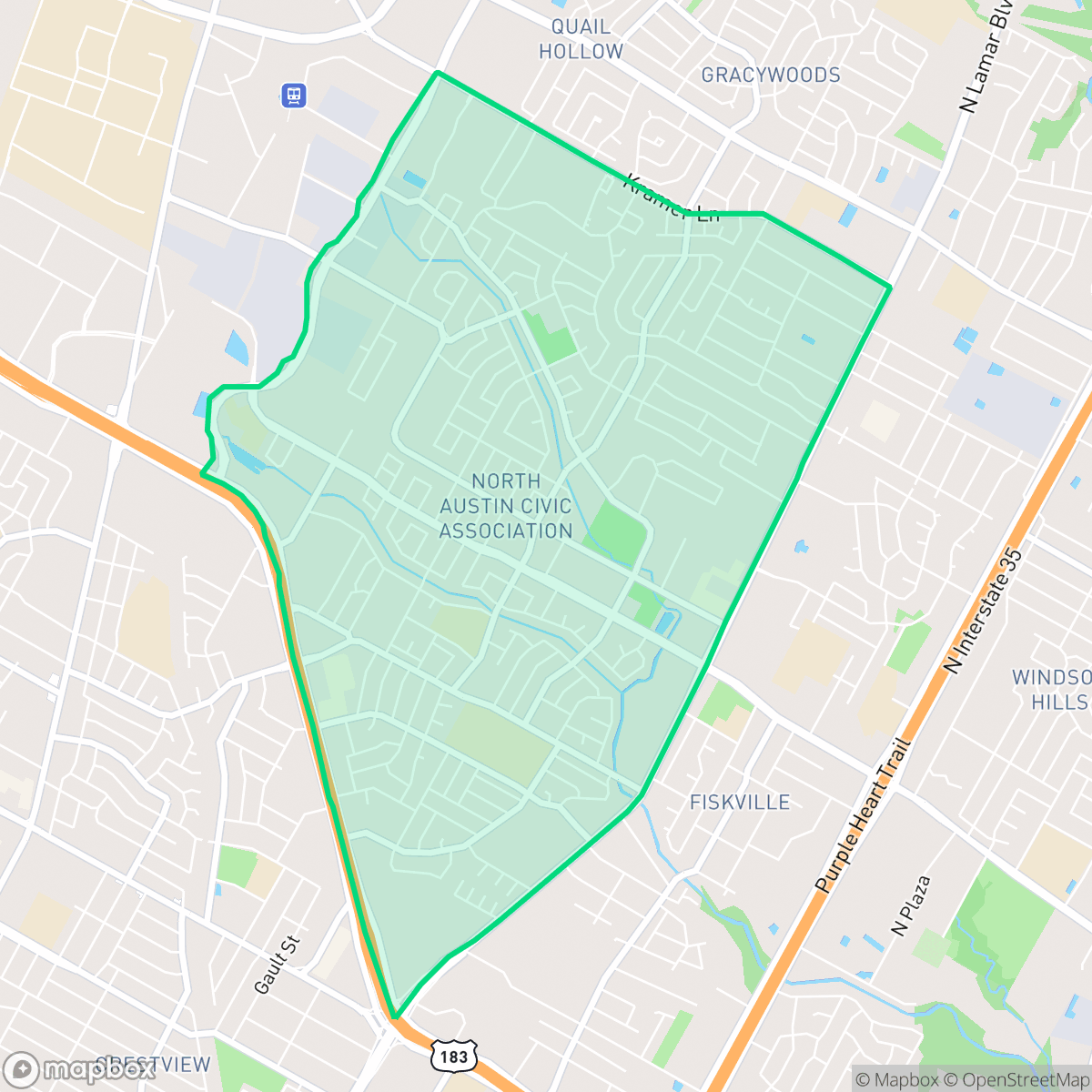
The heart of North Austin, now represented by the North Austin Civic Association (NACA), was originally the independent farming community of Fiskville. Established along Little Walnut Creek in the mid-1800s, the settlement was pioneered by Josiah Fisk in 1846 and Edward Zimmerman in 1854. By 1873, Fiskville had its own post office and grew into a bustling agricultural hub, supporting cotton gins operated by Andrew Payton and George Washington Corzine, a formerly enslaved entrepreneur. Historic remnants of this era still stand, including the Fiskville Cemetery and the 1854 Edward Zimmerman home on Parkfield Drive, a rare fachwerk structure that ranks among Austin’s oldest surviving buildings. Fiskville was annexed by Austin in stages during the 1950s and 1960s, transitioning from a rural outpost into a dense residential neighborhood.
The neighborhood serves as a transit-oriented hub with a dense suburban layout that blends residential streets with commercial retail centers. It is marked by a diverse culinary scene featuring local favorites like Din Ho Chinese BBQ and various taquerias that reflect the area's cultural variety. While the street grid provides some connectivity, the presence of major highway corridors and large-scale commercial warehouses creates a landscape that is frequently car-dependent for daily errands. According to iHuus data, the area maintains a distinct urban-rural balance, positioning it as a functional, high-traffic sector of the city. Prospective residents will find a community in transition with a mix of single-family homes and multi-unit developments. The area faces challenges regarding acoustic comfort and air quality due to its proximity to industrial zones and heavy traffic, and public green space is largely limited to private backyards. It is best suited for those prioritizing proximity to major thoroughfares and diverse local amenities over quiet, expansive parkland.
Neighborhood Scores Across 15 Qualities
Housing arrangements range from closely packed apartment complexes with shared walls to detached suburban homes with moderate spacing. This level of privacy is roughly comparable to the Austin city average.
Residential streets offer safe walking conditions due to low traffic, but significant highway fragmentation and inconsistent sidewalk networks make navigating major arterials difficult. According to iHuus data, pedestrian connectivity in this area is slightly lower than the Austin city average.
Uniform tract housing and apartment complexes define the area, offering a standard residential aesthetic that is slightly less visually diverse than the Austin average. While the landscape lacks luxury estates, many properties feature shared amenities or occasional private pools.
Public access to parks and wide grassy verges is below the Austin average, as most greenery in this area is located within private backyards or fenced complexes. While some large central parks and school fields exist, the neighborhood lacks a consistent network of public trails or wide walking paths for pets.
Frequent open land and scattered woodland are interspersed with dense suburban developments and commercial corridors. This landscape is less urbanized than the Austin city average, featuring a balance of single-family homes and large-scale retail centers.
A mix of lively social hubs and quiet industrial pockets creates an atmosphere more active than the Austin average. While diverse dining and local amenities are available, the area remains largely car-dependent due to the spread of businesses and industrial units.
Frequent noise from nearby-freeway and railroad activity is common in this area. According to iHuus data, acoustic comfort levels are slightly below the Austin city average.
Frequent unhealthy air quality levels pose a significant risk to sensitive groups. This area experiences lower air quality than the Austin city average, according to iHuus data.
Residential areas and light commercial units dominate the landscape, though some warehouse clusters along main transit corridors may introduce moderate traffic and noise. This level of industrial activity is lower than the Austin city average.
Health insurance enrollment among residents is notably lower than the Austin city average, according to iHuus data.
Voting patterns and census indicators show a distinctly liberal leaning that is more pronounced than the Austin city average.
Residents live alongside a balanced mix of young professionals, families, and older adults. This demographic spread is largely consistent with the broader Austin area according to iHuus data.
Frequent flooding concerns exist here because portions of the area fall within identified floodplains. According to iHuus data, this risk is higher than the average for the city of Austin; therefore, flood insurance is typically required for properties in this neighborhood.
Address-Level Insights for North Austin


iHuus Neighborhood Intelligence Insights
Get address-level neighborhood insights for North Austin
- Street-level scores — see how individual blocks compare, not just neighborhood averages
- Micro-zone boundaries — identify quiet pockets, flood boundaries, and walkable clusters before you visit
- 15 dimensions in full — walkability, noise, air quality, school quality, insurance coverage, population age profile, urban/rural index, and more
- Boundary risk alerts — know if your address sits near a block boundary where scores drop, the kind of detail no listing will ever mention
- School insights — individual school ratings and insights, not just district-level data
- Compare before you commit — side-by-side data across neighborhoods, down to block precision
No credit card required
Compare with Any Neighborhood
| Dimension | North Austin | Allandale |
|---|---|---|
| 🚶 Walkabilityavg 6.73 | ||
| 🔊 Acoustic Comfortavg 3.73 | ||
| 🤫 Privacy Indexavg 5.87 | ||
| 🎨 Visual Appealavg 6.95 | ||
| 🐕 Dog Friendlinessavg 6.92 | ||
| 🗺️ Urban-Rural Indexavg 7.09 | ||
| ✨ Neighborhood Vibeavg 4.91 | ||
| 🏥 Health Insurance Coverageavg 7.56 | ||
| 🌿 Air Qualityavg 5.17 | ||
| 🏭 Industrial Proximityavg 8.86 | ||
| 🌊 Flood Safetyavg 4.83 | ||
| 🗳️ Ideological Leanavg 9.13 | ||
| 👥 Population Age Profileavg 4.52 | ||
| 🔥 Fire Safety | ||
| 🏫 School Quality |
North Austin Rankings
School Districts Serving North Austin
School Insights for North Austin
Below average outcomes; significant attendance and academic challenges.
School Insights
See what's really behind every school rating near North Austin
- Individual school ratings — each school's own score with outcome context, not just a district average
- Enrollment & class size data — student-to-teacher ratio and how it compares to the state average
- Full demographics breakdown — ethnicity and gender composition for every school in the enrollment zone
- Every school in the district — all schools within the enrollment boundary ranked by rating, not just the closest one
- Grade levels & benchmarks — elementary through high school, with below/above state-average flags
No credit card required