Montopolis, Austin
Updated · 11,098 residents
Montopolis is a diverse, semi-urban neighborhood in Southeast Austin characterized by a mix of single-family homes and apartment complexes. While the area offers a quiet, suburban atmosphere with access to green spaces, it remains car-dependent and experiences moderate noise levels from nearby road traffic.
Key Highlights
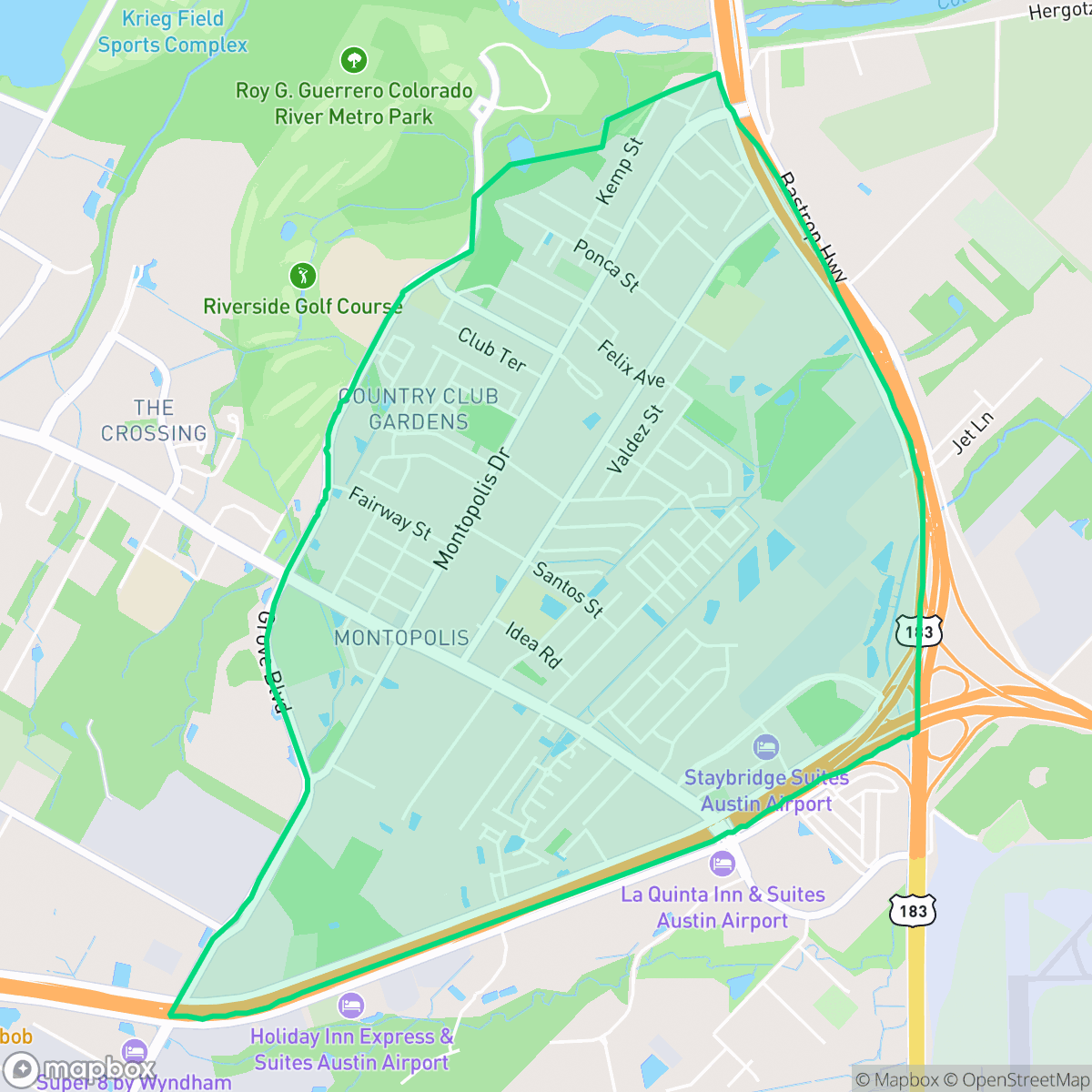
About Montopolis
Initially planned in 1838 by Jesse Cornelius Tannehill as a potential Republic of Texas capital, Montopolis evolved south of the Colorado River near a historic ford along El Camino Real de los Tejas. In the late 19th century, the area became home to Burditt’s Prairie, a freedmen's community. Waves of Mexican immigrants in the 1920s further shaped its multiethnic identity. Annexed by Austin between the 1950s and 1970s, the neighborhood retained a distinct semi-rural character. During the 1960s War on Poverty, local advocate Father Fred Underwood dubbed the underserved area 'Poverty Island' while pioneering community services. Key historic landmarks include the 1930s steel-truss Montopolis Bridge (now a pedestrian path), the Burditt Prairie Cemetery, and the San Jose Cemetery.
The neighborhood functions as a dense suburban enclave that balances residential living with light commercial and industrial proximity. Residents benefit from a consistent sidewalk network on major arterials and frequent access to open green verges, making it a functional choice for pet owners. According to iHuus data, the area maintains a distinct, quiet character despite its location near major transit corridors. While the housing stock consists primarily of standard mid-range suburban structures, the community remains accessible for those seeking a practical, central location within the broader Austin metropolitan area. The area presents a trade-off between its central location and the acoustic impact of regional road traffic. Prospective residents should note that while the neighborhood provides essential amenities and diverse dining options, it lacks the high-density walkability found in more urbanized parts of the city. Educational options are varied, with both district-run schools and specialized preparatory academies available to families. Overall, the community is well-suited for individuals prioritizing a balance of suburban space and proximity to the city center over high-end architectural aesthetics.
Neighborhood Scores Across 15 Qualities
Housing arrangements vary between tightly packed townhomes and detached houses with modest yards. This level of privacy is roughly in line with the Austin average, according to iHuus data.
Sidewalk availability is inconsistent throughout the area, though low traffic on many residential streets allows for quiet walking. According to iHuus data, pedestrian infrastructure in Montopolis is below the Austin average.
Basic tract housing and multi-family complexes define the visual landscape, which is less lush than the Austin average. Residential lots are generally tidy but feature smaller yards and simple architectural styles according to iHuus data.
Nearby golf courses and continuous green verges provide ample space for pet exercise. According to iHuus data, the availability of these walking areas is roughly comparable to the rest of Austin.
Varying landscapes of industrial warehouses, woodland patches, and dense suburban pockets create a more open environment than much of Austin. According to iHuus data, the area features more undeveloped land and scattered greenery compared to the city average.
A tranquil, suburban atmosphere prevails throughout the area, characterized by light industrial zones and pockets of green space. According to iHuus data, the level of activity and social density is lower than the Austin average, with most essential services and dining options requiring a vehicle to access.
Steady sound from nearby thoroughfares is a common feature here, resulting in acoustic levels that are comparable to the Austin average. Residents may experience a continuous hum from local vehicle movement throughout the day.
Air quality in this area fluctuates between acceptable and unhealthy levels, presenting occasional concerns for sensitive groups. According to iHuus data, these conditions are slightly worse than the Austin city average.
Industrial presence is minimal and mostly limited to light commercial use; however, the area sits slightly below the Austin average due to the proximity of a major airport runway and large highway interchanges.
Health insurance coverage among residents is below the Austin average, according to iHuus data. This indicates a higher proportion of uninsured individuals compared to the rest of the city.
Voting patterns and census indicators reflect a highly liberal political leaning that is even more pronounced than the Austin city average.
Residents live alongside a diverse mix of young adults, families, and older individuals. This demographic spread is slightly more varied than the typical Austin profile, according to iHuus data.
Flood risk in this area remains difficult to determine because FEMA has not yet completed a detailed study for this location. According to iHuus data, the level of risk is slightly higher than the Austin average.
Address-Level Insights for Montopolis


iHuus Neighborhood Intelligence Insights
Get address-level neighborhood insights for Montopolis
- Street-level scores — see how individual blocks compare, not just neighborhood averages
- Micro-zone boundaries — identify quiet pockets, flood boundaries, and walkable clusters before you visit
- 15 dimensions in full — walkability, noise, air quality, school quality, insurance coverage, population age profile, urban/rural index, and more
- Boundary risk alerts — know if your address sits near a block boundary where scores drop, the kind of detail no listing will ever mention
- School insights — individual school ratings and insights, not just district-level data
- Compare before you commit — side-by-side data across neighborhoods, down to block precision
No credit card required
Compare with Any Neighborhood
| Dimension | Montopolis | Allandale |
|---|---|---|
| 🚶 Walkabilityavg 6.73 | ||
| 🔊 Acoustic Comfortavg 3.73 | ||
| 🤫 Privacy Indexavg 5.87 | ||
| 🎨 Visual Appealavg 6.95 | ||
| 🐕 Dog Friendlinessavg 6.92 | ||
| 🗺️ Urban-Rural Indexavg 7.09 | ||
| ✨ Neighborhood Vibeavg 4.91 | ||
| 🏥 Health Insurance Coverageavg 7.56 | ||
| 🌿 Air Qualityavg 5.17 | ||
| 🏭 Industrial Proximityavg 8.86 | ||
| 🌊 Flood Safetyavg 4.83 | ||
| 🗳️ Ideological Leanavg 9.13 | ||
| 👥 Population Age Profileavg 4.52 | ||
| 🔥 Fire Safety | ||
| 🏫 School Quality |
Montopolis Rankings
School Districts Serving Montopolis
School Insights for Montopolis
Below average outcomes; significant attendance and academic challenges.
School Insights
See what's really behind every school rating near Montopolis
- Individual school ratings — each school's own score with outcome context, not just a district average
- Enrollment & class size data — student-to-teacher ratio and how it compares to the state average
- Full demographics breakdown — ethnicity and gender composition for every school in the enrollment zone
- Every school in the district — all schools within the enrollment boundary ranked by rating, not just the closest one
- Grade levels & benchmarks — elementary through high school, with below/above state-average flags
No credit card required