MLK, Austin
Updated · 5,969 residents
The MLK neighborhood in East Austin offers a serene, suburban atmosphere characterized by high walkability and proximity to local green spaces. It serves as a quiet residential enclave where residents can easily access community parks and a selection of popular local eateries.
Key Highlights
About MLK
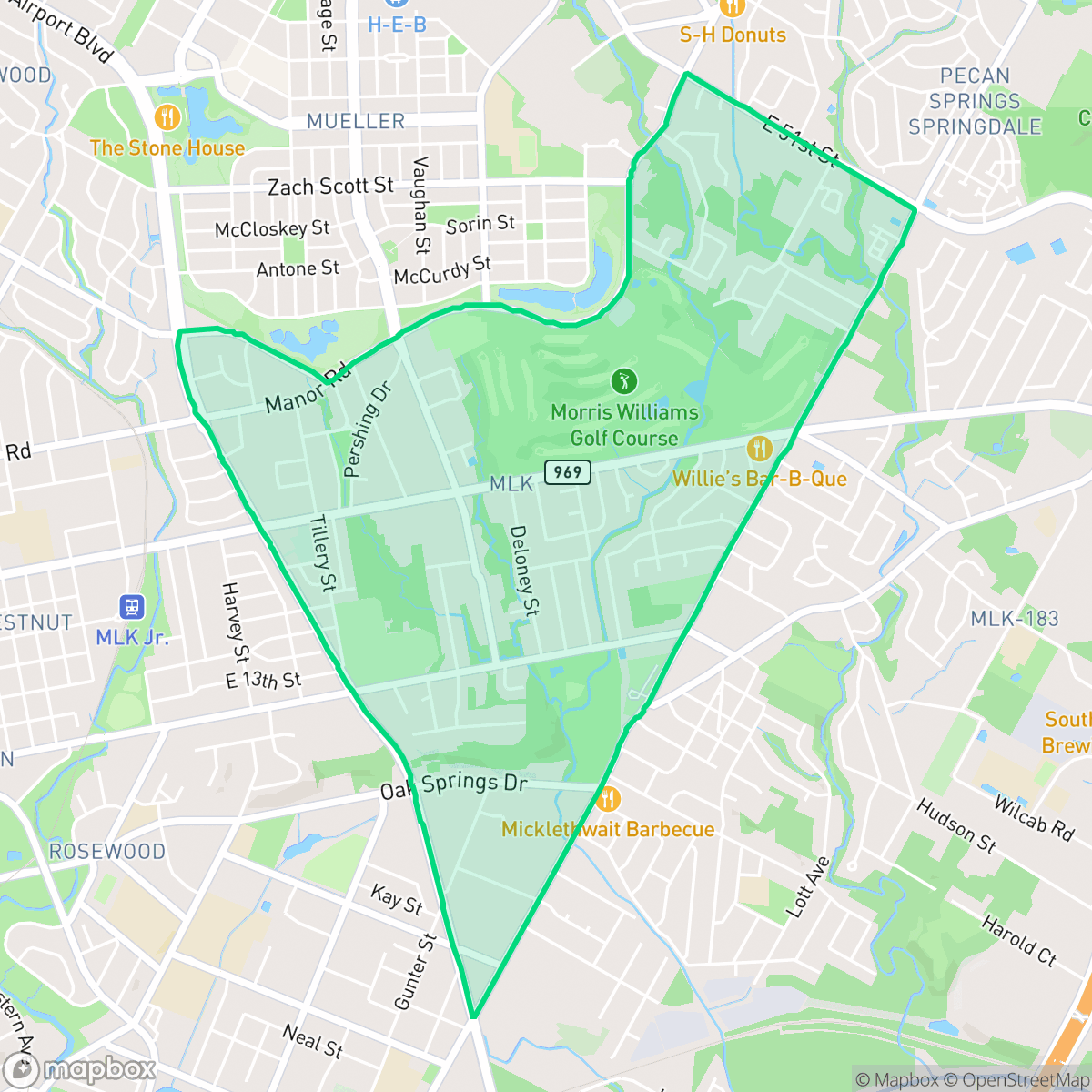
The MLK neighborhood in East Austin—bounded by Martin Luther King Jr. Boulevard, Airport Boulevard, East 12th Street, and Springdale Road—is a historically Black community with deep cultural roots. In 1950, dentist and civil rights advocate Dr. Everett Givens subdivided land here to establish Holy Cross Heights, Austin’s first Federal Housing Authority-approved subdivision for African Americans, which was built alongside the historic Holy Cross Hospital. The neighborhood is home to the historic Bethany Cemetery, a sacred African American burial ground dating back to the 19th century, and the Blair Woods Nature Preserve, which contains the site of the 1830s-era Fort Colorado. Formally organized in 1995 under the Martin Luther King Neighborhood Association, the area has historically been home to prominent local figures, including trailblazing Texas State Representative Wilhelmina Delco.
This area maintains a distinct, quiet rhythm, blending residential streets with significant natural areas like the Blair Woods Nature Preserve and Givens District Park. According to iHuus data, the neighborhood provides a highly walkable environment that supports a relaxed lifestyle, punctuated by local favorites such as Batch Craft Beer and Kolaches and La Fruta Feliz. The presence of community institutions like the Islamic Center and various churches contributes to the stable, neighborhood-focused atmosphere that defines much of the local experience.
While the area offers a peaceful retreat from the urban core, prospective residents should consider specific trade-offs regarding infrastructure and environmental factors. Noise levels are primarily influenced by road traffic, and the neighborhood faces challenges with flood safety compared to other parts of the city. While the local Austin Independent School District campus provides educational access, the broader district is currently navigating financial and operational transitions. Overall, the area is well-suited for those prioritizing a dog-friendly, walkable community with a strong sense of local history and character.
Neighborhood Scores Across 15 Qualities
Residential spacing is typical for the area, featuring a mix of houses with moderate yards and denser apartment clusters. Backyard tree cover provides some natural screening between neighbors, a level of seclusion that is largely in line with the Austin average.
Many residential streets offer continuous sidewalk networks and safe crossings, making the area more walkable than the Austin average. Some interior streets still lack consistent pavement, requiring pedestrians to use low-traffic roads or grass shoulders.
Streetscapes feature a mix of simple apartment complexes and modest tract housing with smaller yards. This visual variety sits slightly below the Austin city average for greenery and architectural scale, according to iHuus data.
Large public parks with wooded trails and baseball diamonds offer ample space for pets. According to iHuus data, these connected green spaces and wide paths make the area more dog friendly than the Austin average.
Open land and scattered homes amid woodland characterize this area, though it feels slightly less rural than much of Austin. According to iHuus data, the landscape features a mix of low-density housing and neighborhood commercial zones.
Residential life here follows a calm, suburban rhythm with a lower level of activity than most of Austin. While some walkable pockets offer local coffee shops and dining, the area lacks the constant energy found in more dense urban centers.
Persistent noise from nearby busy streets is a common feature of this area. According to iHuus data, the level of acoustic activity is slightly higher than the Austin average.
Air quality in this area fluctuates between acceptable and unhealthy levels, occasionally posing risks for sensitive groups. According to iHuus data, the air quality is slightly better than the Austin average.
Industrial presence is minimal throughout most of the area, though some warehouse and storage facilities are located toward the southern edge. This neighborhood remains slightly below the Austin average for the lack of heavy industry.
Health insurance access among residents is notably higher than the Austin average, according to iHuus data.
Voting patterns and census indicators show a significantly more liberal political leaning than the Austin average, according to iHuus data.
Residents live alongside a balanced mix of young adults, families, and older individuals. This demographic spread is very similar to the typical age profile found across Austin.
Flood risk in this area is difficult to assess because FEMA has not completed a detailed study for the neighborhood. According to iHuus data, the level of safety from flooding is lower than the Austin average.
Address-Level Insights for MLK


iHuus Neighborhood Intelligence Insights
Get address-level neighborhood insights for MLK
- Street-level scores — see how individual blocks compare, not just neighborhood averages
- Micro-zone boundaries — identify quiet pockets, flood boundaries, and walkable clusters before you visit
- 15 dimensions in full — walkability, noise, air quality, school quality, insurance coverage, population age profile, urban/rural index, and more
- Boundary risk alerts — know if your address sits near a block boundary where scores drop, the kind of detail no listing will ever mention
- School insights — individual school ratings and insights, not just district-level data
- Compare before you commit — side-by-side data across neighborhoods, down to block precision
No credit card required
Compare with Any Neighborhood
| Dimension | MLK | Allandale |
|---|---|---|
| 🚶 Walkabilityavg 6.73 | ||
| 🔊 Acoustic Comfortavg 3.73 | ||
| 🤫 Privacy Indexavg 5.87 | ||
| 🎨 Visual Appealavg 6.95 | ||
| 🐕 Dog Friendlinessavg 6.92 | ||
| 🗺️ Urban-Rural Indexavg 7.09 | ||
| ✨ Neighborhood Vibeavg 4.91 | ||
| 🏥 Health Insurance Coverageavg 7.56 | ||
| 🌿 Air Qualityavg 5.17 | ||
| 🏭 Industrial Proximityavg 8.86 | ||
| 🌊 Flood Safetyavg 4.83 | ||
| 🗳️ Ideological Leanavg 9.13 | ||
| 👥 Population Age Profileavg 4.52 | ||
| 🔥 Fire Safety | ||
| 🏫 School Quality |
MLK Rankings
School Districts Serving MLK
School Insights for MLK
Below average outcomes; significant attendance and academic challenges.
School Insights
See what's really behind every school rating near MLK
- Individual school ratings — each school's own score with outcome context, not just a district average
- Enrollment & class size data — student-to-teacher ratio and how it compares to the state average
- Full demographics breakdown — ethnicity and gender composition for every school in the enrollment zone
- Every school in the district — all schools within the enrollment boundary ranked by rating, not just the closest one
- Grade levels & benchmarks — elementary through high school, with below/above state-average flags
No credit card required