MLK 183, Austin
Updated · 9,878 residents
MLK 183 is an East Austin community defined by its mix of quiet residential blocks, light industrial zones, and proximity to major transit corridors. While the area offers access to green spaces like the Walnut Creek Trails, residents experience a car-dependent environment with limited sidewalk infrastructure and moderate noise levels from nearby highways.
Key Highlights
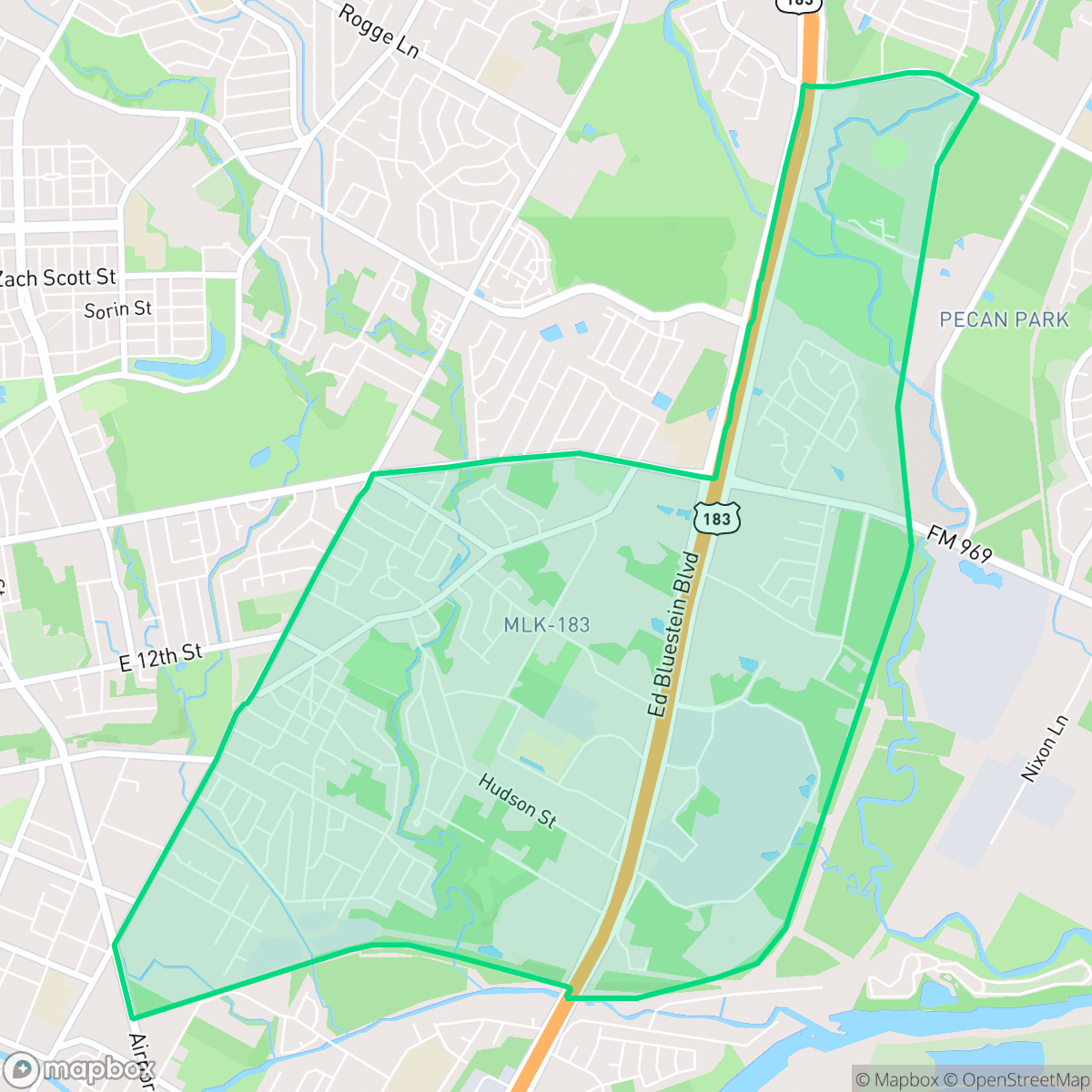
About MLK 183
Located in East Austin, the MLK 183 neighborhood is part of the East MLK Combined Planning Area. Historically known as "Hungry Hill", the area is home to the landmark Bethany Cemetery on Springdale Road. Established in 1893 by early Black leaders—including Charles W. Jones and William M. Tears—Bethany was Austin's first African American cemetery, founded to provide a sacred burial space when segregated city cemeteries filled up. It serves as the final resting place for formerly enslaved individuals, Buffalo Soldiers, and early Black entrepreneurs. The surrounding residential neighborhood developed primarily around 1971, characterized by single-family homes and duplexes. Today, the community works actively to preserve this historical landmark amid ongoing regional development and gentrification.
Located in East Austin, the area functions as a low-density urban environment where single-family homes and duplexes sit alongside warehouses and logistics hubs. The landscape is characterized by a blend of residential streets and industrial corridors, creating a quiet, car-oriented atmosphere. Residents benefit from the presence of local dining options and essential services, alongside significant green spaces that provide opportunities for outdoor recreation.
Living here involves certain trade-offs, particularly regarding pedestrian infrastructure and flood risk. The lack of consistent sidewalks makes the area better suited for those who rely on personal vehicles for daily commuting and errands. While the neighborhood offers a calm, suburban feel with moderate privacy between homes, prospective residents should consider the proximity to major highways and industrial sites when evaluating acoustic comfort and environmental factors.
Neighborhood Scores Across 15 Qualities
Residential spacing is typical for the area, offering a balance of proximity and separation. Backyard tree cover provides some natural screening between neighbors, according to iHuus data.
Low traffic volumes allow for comfortable walking, though the lack of consistent sidewalks means pedestrians often navigate grass shoulders or road edges. This level of walkability is slightly below the Austin average.
Modest tract housing and simple roof geometries define the area, making the visual landscape less diverse than the Austin average. According to iHuus data, yards are typically small and residential architecture remains functional rather than ornamental.
Access to large public parks with wooded trails and wide, traffic-safe paths makes this area more dog friendly than the Austin average, according to iHuus data.
Frequent open land and dense woodlands provide a transition toward a more rural landscape, appearing slightly less developed than the Austin average according to iHuus data.
Primarily a tranquil and low-density area, this neighborhood lacks the energetic commercial activity found in much of Austin. Most pockets are characterized by quiet residential blocks, light industrial zones, or vast open spaces with very few social destinations.
Frequent vehicle movement along nearby busy streets creates a consistent level of ambient noise. This acoustic profile is roughly in line with the average experienced across Austin.
Air quality levels are generally acceptable, though they are slightly better than the Austin average. Sensitive groups may experience occasional periods of concern during certain weather conditions, according to iHuus data.
Residential life remains largely undisturbed by heavy industry, though some utility infrastructure and large warehouse facilities are present. This area maintains a lower level of industrial activity compared to the Austin average.
Health insurance access among residents is slightly lower than the Austin city average, according to iHuus data.
Voting patterns and census indicators show a predominantly liberal leaning that is more pronounced than the Austin average, according to iHuus data.
A varied mix of young adults, families, and older residents characterizes this area. This demographic distribution is largely in line with the broader Austin average, according to iHuus data.
Significant flood risk exists here because parts of the area fall within the 100-year floodplain. According to iHuus data, this risk is notably higher than the Austin average, and residents should anticipate that flood insurance is typically required.
Address-Level Insights for MLK 183


iHuus Neighborhood Intelligence Insights
Get address-level neighborhood insights for MLK 183
- Street-level scores — see how individual blocks compare, not just neighborhood averages
- Micro-zone boundaries — identify quiet pockets, flood boundaries, and walkable clusters before you visit
- 15 dimensions in full — walkability, noise, air quality, school quality, insurance coverage, population age profile, urban/rural index, and more
- Boundary risk alerts — know if your address sits near a block boundary where scores drop, the kind of detail no listing will ever mention
- School insights — individual school ratings and insights, not just district-level data
- Compare before you commit — side-by-side data across neighborhoods, down to block precision
No credit card required
Compare with Any Neighborhood
| Dimension | MLK 183 | Allandale |
|---|---|---|
| 🚶 Walkabilityavg 6.73 | ||
| 🔊 Acoustic Comfortavg 3.73 | ||
| 🤫 Privacy Indexavg 5.87 | ||
| 🎨 Visual Appealavg 6.95 | ||
| 🐕 Dog Friendlinessavg 6.92 | ||
| 🗺️ Urban-Rural Indexavg 7.09 | ||
| ✨ Neighborhood Vibeavg 4.91 | ||
| 🏥 Health Insurance Coverageavg 7.56 | ||
| 🌿 Air Qualityavg 5.17 | ||
| 🏭 Industrial Proximityavg 8.86 | ||
| 🌊 Flood Safetyavg 4.83 | ||
| 🗳️ Ideological Leanavg 9.13 | ||
| 👥 Population Age Profileavg 4.52 | ||
| 🔥 Fire Safety | ||
| 🏫 School Quality |
MLK 183 Rankings
School Districts Serving MLK 183
School Insights for MLK 183
Below average outcomes; significant attendance and academic challenges.
School Insights
See what's really behind every school rating near MLK 183
- Individual school ratings — each school's own score with outcome context, not just a district average
- Enrollment & class size data — student-to-teacher ratio and how it compares to the state average
- Full demographics breakdown — ethnicity and gender composition for every school in the enrollment zone
- Every school in the district — all schools within the enrollment boundary ranked by rating, not just the closest one
- Grade levels & benchmarks — elementary through high school, with below/above state-average flags
No credit card required