Mckinney, Austin
Updated · 6,927 residents
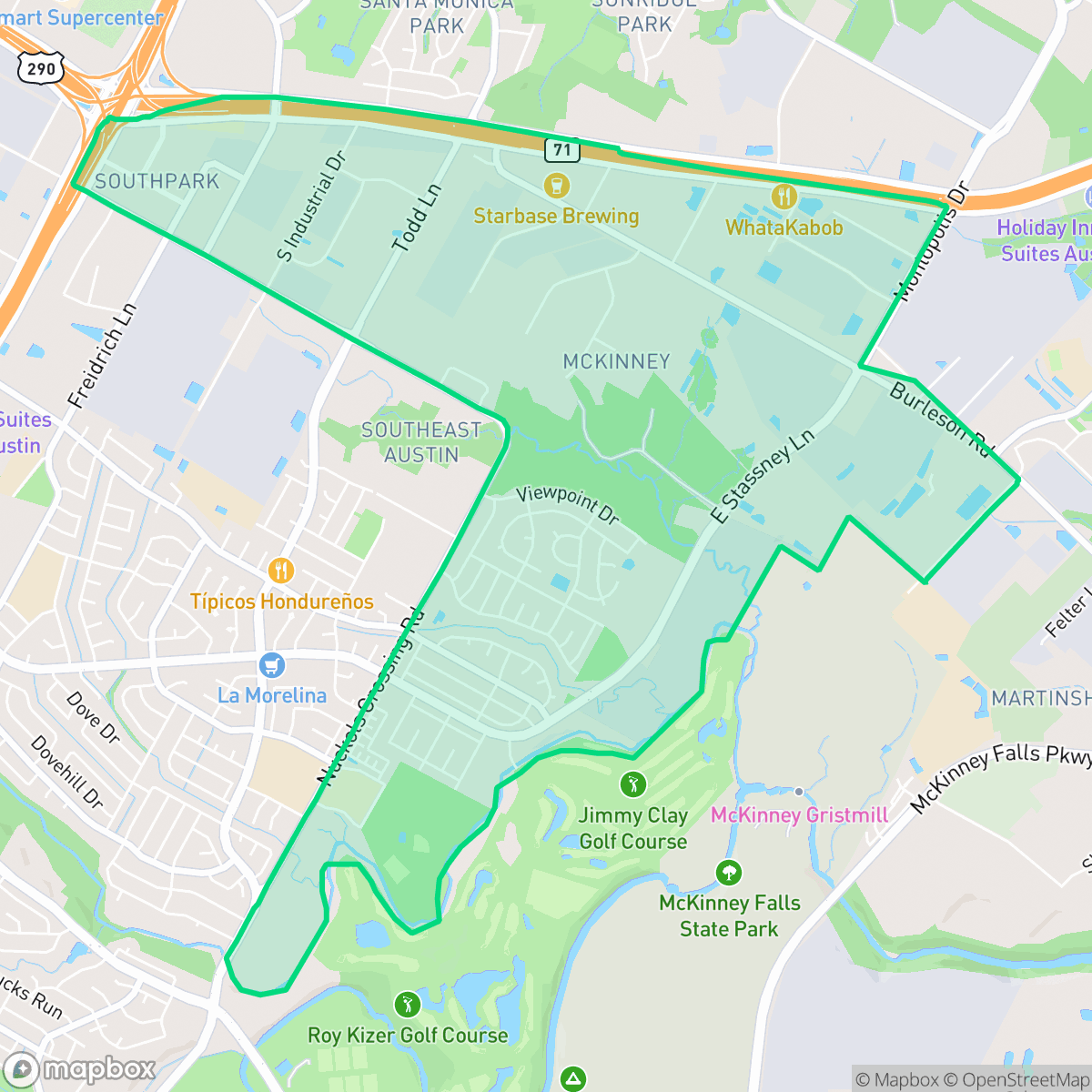
McKinney is a quiet, industrial-adjacent neighborhood in southeast Austin known for its proximity to expansive green spaces and the Roy Kizer Golf Course. While the area offers a suburban residential atmosphere with accessible trails for dog walking, residents experience a mix of heavy industrial activity and limited local walkability.
Key Highlights
About Mckinney
Located in southeast Austin, the McKinney neighborhood is named after Texas pioneer Thomas F. McKinney, who built his historic two-story limestone homestead and gristmill along Onion Creek between 1850 and 1852. While his former ranch lands are now preserved within the adjacent McKinney Falls State Park, the residential neighborhood itself was primarily developed between 1970 and 1999. Today, the community is characterized by a strong cultural identity, with over 75% of residents claiming Mexican ancestry and a majority speaking Spanish at home. The neighborhood offers a suburban feel with large, tree-lined yards, bordered by local recreational landmarks like the Roy Kizer Golf Course and community hubs such as the Radio East music venue and coffee shop.
The area balances suburban residential life with a significant industrial presence, featuring a landscape defined by logistics hubs, warehouses, and nearby natural corridors. The residential grid consists primarily of single-family tract homes with standard lot sizes, offering moderate privacy despite the proximity to heavy commercial traffic. The neighborhood maintains a distinct character shaped by its history and cultural demographics, with local amenities often requiring a vehicle due to the low density of walkable retail options.
Prospective residents should consider the trade-offs between the neighborhood's quiet, suburban environment and the operational noise from nearby freight corridors and logistics facilities. According to iHuus data, the area provides excellent access to outdoor recreation, including trails and golf courses, though it faces challenges regarding air quality and academic performance in local schools. It is best suited for those who prioritize proximity to major transit routes and green space over a high-density, walkable urban lifestyle.
Neighborhood Scores Across 15 Qualities
Housing density is slightly higher than the Austin average, offering a mix of standard suburban setbacks and more secluded lots near wooded areas. According to iHuus data, neighbors are typically separated by moderate distances that provide a balance of community and buffer.
Low-traffic residential streets and cul-de-sacs provide safe routes for walking, though the sidewalk network is less comprehensive than the Austin average. According to iHuus data, heavy tree canopy may occasionally obscure paths, and major arterials lack safe crossings.
Standard tract housing defines the landscape here, characterized by uniform rooflines and small private yards. This level of visual variety is lower than the Austin city average, according to iHuus data.
Abundant wooded trails and large residential yards provide ample space for exercise. This area offers similar levels of dog friendliness to the Austin average, featuring many green spaces that are well-connected to residential streets.
Expansive green belts and scattered woodland patches provide a semi-rural atmosphere that is largely consistent with the Austin city average. Residents will find a mix of open land and low-density residential pockets alongside larger industrial zones.
Primarily composed of industrial and suburban landscapes, this area offers a low-density environment with limited social destinations. According to iHuus data, the level of activity and commercial density is lower than the Austin average.
Steady traffic sounds from nearby busy streets are present, though the acoustic environment remains notably quieter than the Austin city average according to iHuus data.
Frequent unhealthy air quality levels pose significant risks to sensitive groups. According to iHuus data, the air quality in this area is notably worse than the Austin city average.
Primarily residential and light commercial, this area lacks heavy industrial hazards. While some sectors feature large-scale logistics hubs and warehouse activity, the overall presence of heavy industry is slightly below the Austin average according to iHuus data.
Health insurance access among residents is lower than the Austin city average, according to iHuus data.
Voting patterns and census indicators show a notably liberal political leaning that is even more pronounced than the Austin city average, according to iHuus data.
Residents live alongside a balanced mix of young adults, families, and seniors. This demographic distribution is largely consistent with the broader Austin area according to iHuus data.
Flood risk in this area is higher than the Austin average, though the specific level of danger remains undetermined due to incomplete federal studies. Residents should remain aware of potential vulnerabilities as there is no detailed FEMA assessment available for this part of McKinney.
Address-Level Insights for Mckinney


iHuus Neighborhood Intelligence Insights
Get address-level neighborhood insights for Mckinney
- Street-level scores — see how individual blocks compare, not just neighborhood averages
- Micro-zone boundaries — identify quiet pockets, flood boundaries, and walkable clusters before you visit
- 15 dimensions in full — walkability, noise, air quality, school quality, insurance coverage, population age profile, urban/rural index, and more
- Boundary risk alerts — know if your address sits near a block boundary where scores drop, the kind of detail no listing will ever mention
- School insights — individual school ratings and insights, not just district-level data
- Compare before you commit — side-by-side data across neighborhoods, down to block precision
No credit card required
Compare with Any Neighborhood
| Dimension | Mckinney | Allandale |
|---|---|---|
| 🚶 Walkabilityavg 6.73 | ||
| 🔊 Acoustic Comfortavg 3.73 | ||
| 🤫 Privacy Indexavg 5.87 | ||
| 🎨 Visual Appealavg 6.95 | ||
| 🐕 Dog Friendlinessavg 6.92 | ||
| 🗺️ Urban-Rural Indexavg 7.09 | ||
| ✨ Neighborhood Vibeavg 4.91 | ||
| 🏥 Health Insurance Coverageavg 7.56 | ||
| 🌿 Air Qualityavg 5.17 | ||
| 🏭 Industrial Proximityavg 8.86 | ||
| 🌊 Flood Safetyavg 4.83 | ||
| 🗳️ Ideological Leanavg 9.13 | ||
| 👥 Population Age Profileavg 4.52 | ||
| 🔥 Fire Safety | ||
| 🏫 School Quality |
Mckinney Rankings
School Districts Serving Mckinney
School Insights for Mckinney
Below average outcomes; significant attendance and academic challenges.
School Insights
See what's really behind every school rating near Mckinney
- Individual school ratings — each school's own score with outcome context, not just a district average
- Enrollment & class size data — student-to-teacher ratio and how it compares to the state average
- Full demographics breakdown — ethnicity and gender composition for every school in the enrollment zone
- Every school in the district — all schools within the enrollment boundary ranked by rating, not just the closest one
- Grade levels & benchmarks — elementary through high school, with below/above state-average flags
No credit card required