Johnston Terrace, Austin
Updated · 2,077 residents
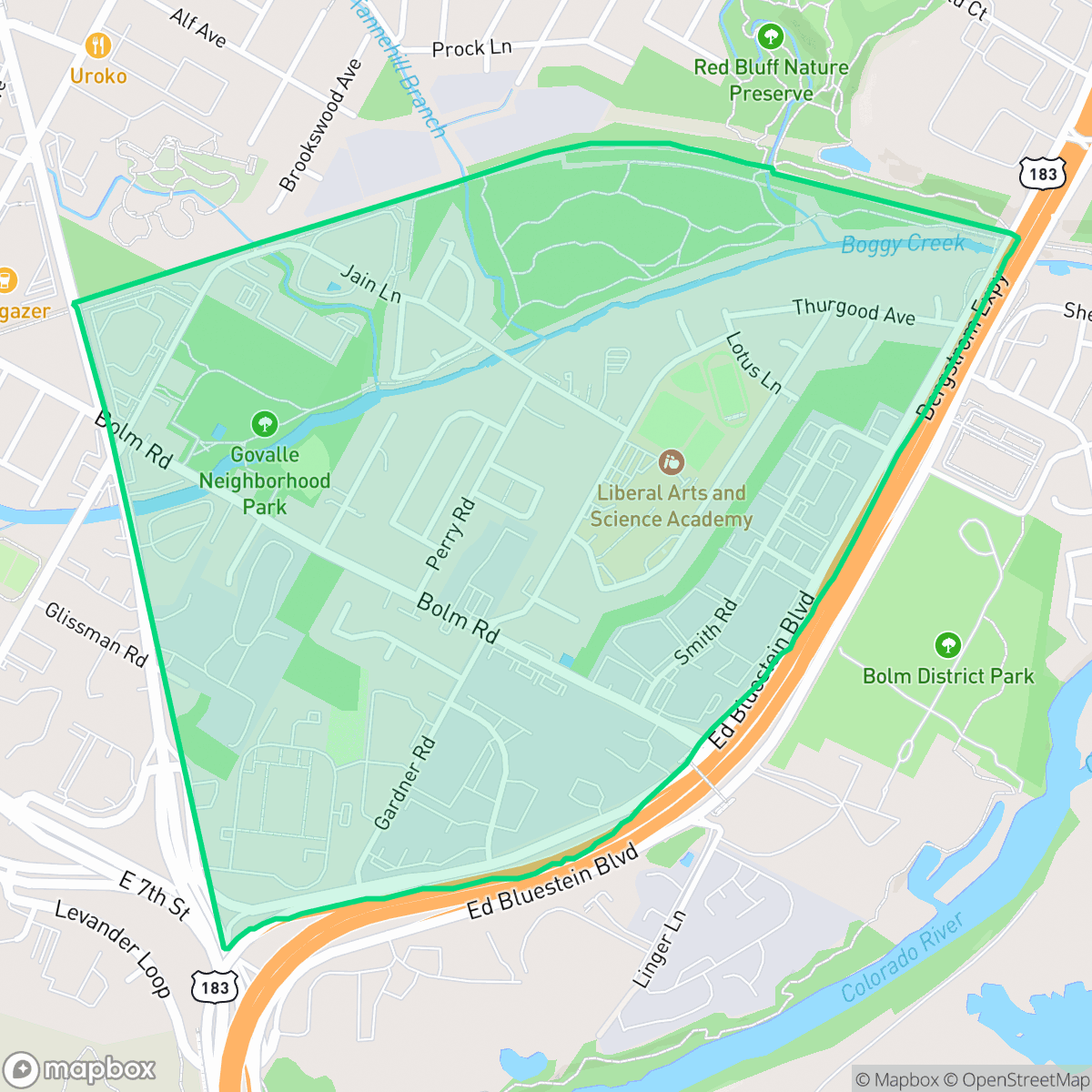
Johnston Terrace is an East Austin neighborhood defined by its industrial roots, proximity to Govalle Park, and ongoing transition toward creative redevelopment. Residents experience a quiet, suburban atmosphere with limited walkability and notable noise levels from nearby logistics corridors.
Key Highlights
About Johnston Terrace
Located in East Austin, Johnston Terrace is a historically working-class, predominantly African American and Latino neighborhood with a rich history of community activism. For forty years, the area was home to a massive gasoline storage 'tank farm' until local grassroots groups, such as PODER, successfully organized in the early 1990s to close and remediate the toxic site. Today, the neighborhood is bordered by Govalle Park—home to a historical marker for Montopolis, an 1839 settlement founded by Jesse Tannehill near the historic El Camino Real de los Tejas crossing. In recent years, Johnston Terrace has transitioned from its industrial past, welcoming creative redevelopments like the thinkEAST arts district on a former 24-acre brownfield site, while simultaneously facing rapid gentrification and demographic shifts.
Johnston Terrace serves as a distinct example of East Austin's evolving urban landscape, where remnants of an industrial past sit alongside emerging creative hubs like the thinkEAST district. The area maintains a suburban feel, characterized by a mix of residential clusters, large logistics warehouses, and expansive green spaces like Govalle Park. While the neighborhood lacks a dense commercial core, it offers significant outdoor access for residents, particularly those with pets, and maintains a strong sense of community rooted in its history of local activism.
According to iHuus data, the area presents a specific set of trade-offs for prospective residents. The neighborhood is notably quiet in terms of social activity, yet it faces acoustic challenges from road traffic and regional logistics operations. Those considering a move here will find a community with high health insurance coverage and a strong progressive ideological lean, though daily errands often require a vehicle due to limited walkability. It is a suitable location for individuals seeking proximity to nature and creative redevelopment projects while remaining mindful of the industrial surroundings and noise levels.
Neighborhood Scores Across 15 Qualities
Residential spacing is mixed, offering some buffer between neighbors. According to iHuus data, the level of separation is roughly in line with the Austin average.
Quiet streets provide a calm environment for walking, though the lack of sidewalks makes navigation less convenient than in many other parts of Austin. According to iHuus data, the overall walkability of this area falls below the city average.
Standard tract housing characterizes the area, featuring boxy rooflines and modest yards. This visual landscape is less varied than the Austin average, according to iHuus data.
Interconnected green spaces and wide paths provide safe, low-traffic areas for walking pets. According to iHuus data, this level of accessibility is slightly higher than the Austin average.
A mix of residential clusters and undeveloped green belts provides a more open landscape than the typical Austin urban core. According to iHuus data, the area features more frequent open land and scattered woodland compared to the city average.
Limited commercial activity and a heavy industrial presence make this area feel more functional than lively, falling below the Austin average. Most blocks are characterized by a quiet, car-oriented landscape featuring warehouses and green spaces near major highway corridors.
Frequent noise from nearby highways and rail lines makes this area louder than the Austin average. Residents should expect persistent ambient sounds from heavy transit traffic according to iHuus data.
Air quality fluctuates between acceptable and unhealthy levels on certain days. According to iHuus data, conditions in this area are slightly better than the Austin average, though sensitive groups should remain cautious during periods of poor air quality.
Logistics hubs, warehouse operations, and utility infrastructure are prominent in this area, resulting in a higher concentration of industrial activity than the Austin average. Residents may encounter heavy truck traffic and large-scale commercial facilities alongside residential pockets.
Health insurance access is notably lower than the Austin average, according to iHuus data. This indicates a higher proportion of uninsured residents compared to most parts of the city.
Voting patterns and census indicators reflect a deeply progressive political leaning that is even more pronounced than the Austin average, according to iHuus data.
Residents live alongside a balanced mix of young adults, families, and older individuals, matching the typical age distribution seen across Austin. According to iHuus data, this creates a demographic profile that is neither skewed toward youth nor older populations.
Flood risk in this area is higher than the Austin average, though official FEMA studies for this specific neighborhood remain incomplete. Residents should remain aware of potential localized flooding during heavy rain events, according to iHuus data.
Address-Level Insights for Johnston Terrace


iHuus Neighborhood Intelligence Insights
Get address-level neighborhood insights for Johnston Terrace
- Street-level scores — see how individual blocks compare, not just neighborhood averages
- Micro-zone boundaries — identify quiet pockets, flood boundaries, and walkable clusters before you visit
- 15 dimensions in full — walkability, noise, air quality, school quality, insurance coverage, population age profile, urban/rural index, and more
- Boundary risk alerts — know if your address sits near a block boundary where scores drop, the kind of detail no listing will ever mention
- School insights — individual school ratings and insights, not just district-level data
- Compare before you commit — side-by-side data across neighborhoods, down to block precision
No credit card required
Compare with Any Neighborhood
| Dimension | Johnston Terrace | Allandale |
|---|---|---|
| 🚶 Walkabilityavg 6.73 | ||
| 🔊 Acoustic Comfortavg 3.73 | ||
| 🤫 Privacy Indexavg 5.87 | ||
| 🎨 Visual Appealavg 6.95 | ||
| 🐕 Dog Friendlinessavg 6.92 | ||
| 🗺️ Urban-Rural Indexavg 7.09 | ||
| ✨ Neighborhood Vibeavg 4.91 | ||
| 🏥 Health Insurance Coverageavg 7.56 | ||
| 🌿 Air Qualityavg 5.17 | ||
| 🏭 Industrial Proximityavg 8.86 | ||
| 🌊 Flood Safetyavg 4.83 | ||
| 🗳️ Ideological Leanavg 9.13 | ||
| 👥 Population Age Profileavg 4.52 | ||
| 🔥 Fire Safety | ||
| 🏫 School Quality |
Johnston Terrace Rankings
School Districts Serving Johnston Terrace
School Insights for Johnston Terrace
Below average outcomes; significant attendance and academic challenges.
School Insights
See what's really behind every school rating near Johnston Terrace
- Individual school ratings — each school's own score with outcome context, not just a district average
- Enrollment & class size data — student-to-teacher ratio and how it compares to the state average
- Full demographics breakdown — ethnicity and gender composition for every school in the enrollment zone
- Every school in the district — all schools within the enrollment boundary ranked by rating, not just the closest one
- Grade levels & benchmarks — elementary through high school, with below/above state-average flags
No credit card required