Hyde Park, Austin
Updated · 7,174 residents
Hyde Park is a historic Austin neighborhood known for its mature tree canopy and a blend of Victorian and Craftsman architecture. It offers high walkability and a vibrant local social scene, though residents should expect moderate noise levels from nearby road traffic.
Key Highlights
About Hyde Park
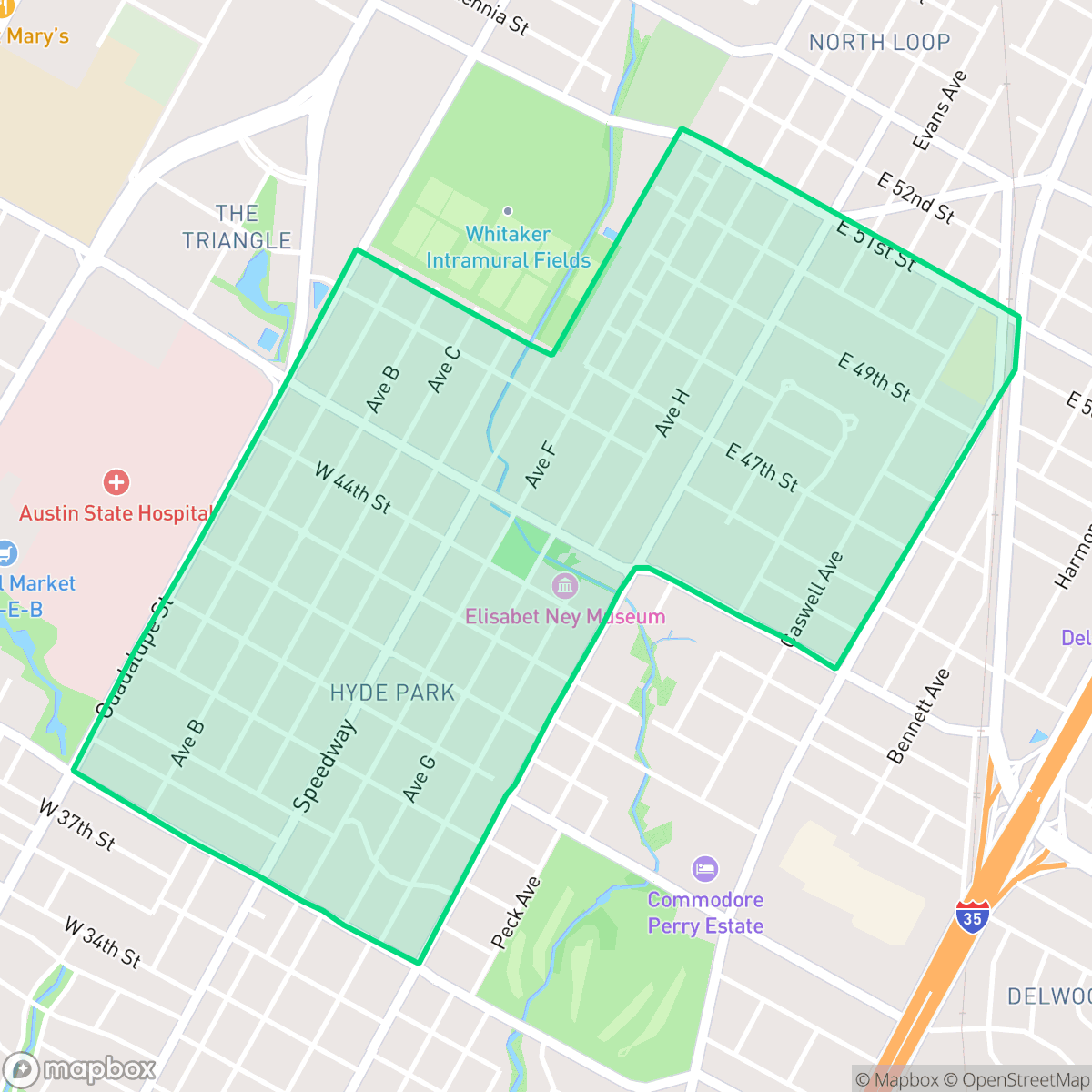
Established in 1891 by developer Monroe M. Shipe, Hyde Park is celebrated as Austin's first streetcar suburb. Before its development, the area hosted the State Fair of Texas from 1875 to 1884; a curved segment of 39th Street still traces the fair's historic horseracing track. Initially marketed to Austin's elite, the neighborhood featured grand Queen Anne-style Victorian homes. Among its earliest residents was acclaimed sculptor Elisabet Ney, who built her castle-like studio, "Formosa," in 1892, which now operates as a museum. By the early 1900s, marketing shifted toward working-class affordability, prompting a major building boom of Craftsman bungalows and Tudor Revival homes. Today, Hyde Park retains its historic charm, anchored by landmarks like Shipe Park and the historic Avenue B Grocery.
The area maintains a distinct character through its grid-based street layout and dense suburban atmosphere. It is defined by a mix of single-family homes and light commercial corridors, providing residents with access to local eateries and social hubs. According to iHuus data, the neighborhood benefits from high health insurance coverage and a strong sense of community, making it a stable environment for long-term residents. The presence of green spaces like Shipe Park and the proximity to diverse dining options contribute to a lively, walkable daily experience. Prospective residents should consider the trade-offs associated with an urban-suburban transition. While the area is highly walkable, the acoustic comfort is impacted by road traffic, resulting in an average noise level of 58 dB. The neighborhood is well-suited for those who value historic aesthetics and a central location but are comfortable with the moderate density and noise typical of an established Austin community. Schooling options are provided by the Austin Independent School District, which offers varying levels of performance across its campuses.
Neighborhood Scores Across 15 Qualities
Residential spacing is consistent with the Austin average, featuring a mix of closely packed homes and larger apartment complexes. Mature trees and yard buffers provide some separation between neighbors, though density increases near medical and commercial borders.
Pedestrian navigation is easier here than the Austin average due to a consistent street grid with sidewalks and mature tree canopy. While interior residential streets are low-traffic, larger commercial arterials can present more difficult crossings.
Mature trees and large residential lots provide a lush atmosphere, though the overall visual variety sits slightly below the Austin average according to iHuus data.
Tree-lined streets and accessible large public parks provide ample space for pets, making this area more dog-friendly than the Austin average. According to iHuus data, the presence of sports fields and residential greenery offers consistent opportunities for exercise and outdoor activity.
A blend of single-family homes and low-rise apartment blocks creates a transitionary feel that is slightly less dense than the Austin average. Large tree canopies and institutional facilities provide more open space than typical urban corridors.
A concentrated collection of local eateries, coffee shops, and cultural landmarks provides a vibrant atmosphere that is notably more active than the Austin average. While some residential blocks remain quiet, the area features a steady presence of social anchors according to iHuus data.
Steady traffic hum from nearby busy streets characterizes the area, though acoustic conditions remain more tranquil than the Austin average according to iHuus data.
Air quality in this area fluctuates between acceptable and unhealthy levels on certain days. According to iHuus data, conditions are slightly better than the Austin city average, though sensitive groups should remain aware of occasional periods of concern.
Residential and light commercial land use dominates the area, with no detectable warehouses or heavy industrial hazards. This lack of industrial proximity is even more pronounced than the Austin average, according to iHuus data.
Health insurance access is widespread among residents, appearing significantly higher than the Austin average according to iHuus data.
Voting patterns and census indicators show a predominantly liberal political leaning that is more pronounced than the Austin city average.
Residents live alongside a balanced mix of young adults, families, and older individuals. This demographic spread is very similar to the broader Austin area, according to iHuus data.
Flood risk levels in this area are difficult to determine because FEMA has not completed a detailed study for this specific location. According to iHuus data, the level of safety from flooding is roughly comparable to the Austin city average.
Address-Level Insights for Hyde Park


iHuus Neighborhood Intelligence Insights
Get address-level neighborhood insights for Hyde Park
- Street-level scores — see how individual blocks compare, not just neighborhood averages
- Micro-zone boundaries — identify quiet pockets, flood boundaries, and walkable clusters before you visit
- 15 dimensions in full — walkability, noise, air quality, school quality, insurance coverage, population age profile, urban/rural index, and more
- Boundary risk alerts — know if your address sits near a block boundary where scores drop, the kind of detail no listing will ever mention
- School insights — individual school ratings and insights, not just district-level data
- Compare before you commit — side-by-side data across neighborhoods, down to block precision
No credit card required
Compare with Any Neighborhood
| Dimension | Hyde Park | Allandale |
|---|---|---|
| 🚶 Walkabilityavg 6.73 | ||
| 🔊 Acoustic Comfortavg 3.73 | ||
| 🤫 Privacy Indexavg 5.87 | ||
| 🎨 Visual Appealavg 6.95 | ||
| 🐕 Dog Friendlinessavg 6.92 | ||
| 🗺️ Urban-Rural Indexavg 7.09 | ||
| ✨ Neighborhood Vibeavg 4.91 | ||
| 🏥 Health Insurance Coverageavg 7.56 | ||
| 🌿 Air Qualityavg 5.17 | ||
| 🏭 Industrial Proximityavg 8.86 | ||
| 🌊 Flood Safetyavg 4.83 | ||
| 🗳️ Ideological Leanavg 9.13 | ||
| 👥 Population Age Profileavg 4.52 | ||
| 🔥 Fire Safety | ||
| 🏫 School Quality |
Hyde Park Rankings
School Districts Serving Hyde Park
School Insights for Hyde Park
Below average outcomes; significant attendance and academic challenges.
School Insights
See what's really behind every school rating near Hyde Park
- Individual school ratings — each school's own score with outcome context, not just a district average
- Enrollment & class size data — student-to-teacher ratio and how it compares to the state average
- Full demographics breakdown — ethnicity and gender composition for every school in the enrollment zone
- Every school in the district — all schools within the enrollment boundary ranked by rating, not just the closest one
- Grade levels & benchmarks — elementary through high school, with below/above state-average flags
No credit card required