Holly, Austin
Updated · 4,794 residents
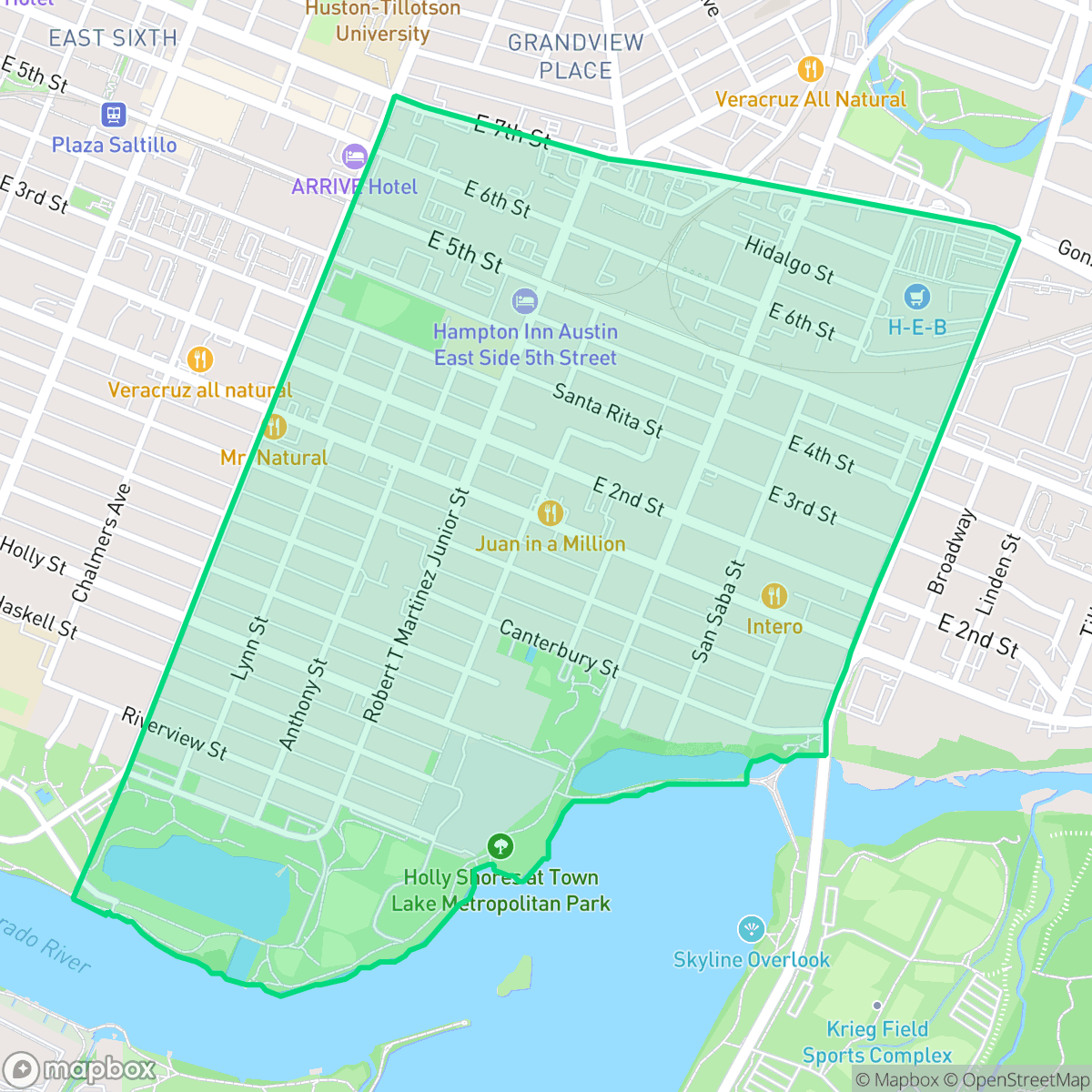
Holly is a vibrant East Austin neighborhood defined by its proximity to Lady Bird Lake and a strong cultural identity rooted in its Chicano heritage. Residents enjoy a highly walkable environment with easy access to local parks, though the area experiences moderate noise levels from nearby road traffic.
Key Highlights
About Holly
The Holly neighborhood in East Austin, bounded by Lady Bird Lake and East 7th Street, traces its roots to the city's 1839 plan. Following a railroad expansion in 1871, it grew into a working-class area and, by the 1920s, a vibrant Mexican-American enclave. Holly is home to Santa Rita Courts, the nation’s first public housing project completed under the U.S. Housing Act of 1937, which initially housed Mexican-American families during the segregation era. The neighborhood’s history is also defined by decades of environmental activism against the Holly Street Power Plant, which opened in 1958 and was decommissioned in 2007. Today, Holly’s rich Chicano heritage is celebrated through the Tejano Trail and the iconic Holly Street Murals, even as the area experiences rapid gentrification.
Located along the northern banks of Lady Bird Lake, this area serves as a hub for both long-term residents and newcomers attracted to its eclectic mix of historic bungalows and modern residential developments. The neighborhood features a dense grid of streets that support a high level of walkability, connecting residents to popular local social spots like Launderette and various coffee shops. Proximity to the lakefront trails provides significant outdoor recreation opportunities, making it a popular choice for dog owners and active commuters.
While the neighborhood offers a lively urban atmosphere, prospective residents should note that it faces typical city trade-offs, including moderate noise levels from road traffic and air quality metrics that reflect its central urban location. According to iHuus data, the area maintains a high rate of health insurance coverage and strong flood safety ratings compared to the city average. It is well-suited for individuals who prioritize a walkable lifestyle and access to city amenities over the quiet seclusion of a suburban environment.
Neighborhood Scores Across 15 Qualities
Residential spacing varies between single-family homes and dense apartment complexes, offering a level of privacy that is roughly consistent with the Austin average. According to iHuus data, neighbors are typically separated by moderate buffers, though shared walls are common in more concentrated areas.
Pedestrian infrastructure is well-developed here, featuring a gridded street pattern with sidewalks and accessible crossings. This neighborhood offers much greater walkability than the Austin average, particularly near the river and campus areas.
Housing features a mix of older bungalows and newer high-density complexes with small lots. This landscape offers less visual variety than the Austin average due to the prevalence of standard urban architecture and modest yards.
Access to Lady Bird Lake trails and several local green pockets provides superior opportunities for pet walking compared to the Austin average. Wide paths and proximity to the riverbank ensure many areas are well connected to safe, open spaces for exercise.
Residential streets and green spaces are distributed fairly evenly, though the area is less dense than the Austin average. According to iHuus data, the neighborhood features a mix of single-family homes and low-rise apartment blocks.
Social activity and local dining options are significantly more concentrated here than the Austin average. Residents have access to a diverse array of coffee shops, bars, and restaurants situated near green spaces and waterfront areas.
Steady traffic sounds from nearby busy streets are a frequent presence here. This level of acoustic activity is higher than the typical noise profile found across Austin.
Air quality fluctuates between acceptable and unhealthy levels, appearing lower than the Austin average. Sensitive groups should monitor local conditions according to iHuus data.
Industrial presence is minimal, though a rail corridor and electrical substation contribute to some localized activity. While this area remains largely residential, the level of industrial proximity is slightly higher than the Austin average according to iHuus data.
Health insurance accessibility is higher than the Austin average, indicating a well-covered resident population according to iHuus data.
Voting patterns and census indicators show a deeply liberal political leaning that is even more pronounced than the Austin average, according to iHuus data.
Residents experience a varied demographic mix of young professionals, families, and seniors. This age distribution is slightly more balanced than the typical Austin profile, according to iHuus data.
Residual flood risks exist within this area due to its location inside the 500-year floodplain. According to iHuus data, safety from flooding is notably higher here than the Austin average.
Address-Level Insights for Holly


iHuus Neighborhood Intelligence Insights
Get address-level neighborhood insights for Holly
- Street-level scores — see how individual blocks compare, not just neighborhood averages
- Micro-zone boundaries — identify quiet pockets, flood boundaries, and walkable clusters before you visit
- 15 dimensions in full — walkability, noise, air quality, school quality, insurance coverage, population age profile, urban/rural index, and more
- Boundary risk alerts — know if your address sits near a block boundary where scores drop, the kind of detail no listing will ever mention
- School insights — individual school ratings and insights, not just district-level data
- Compare before you commit — side-by-side data across neighborhoods, down to block precision
No credit card required
Compare with Any Neighborhood
| Dimension | Holly | Allandale |
|---|---|---|
| 🚶 Walkabilityavg 6.73 | ||
| 🔊 Acoustic Comfortavg 3.73 | ||
| 🤫 Privacy Indexavg 5.87 | ||
| 🎨 Visual Appealavg 6.95 | ||
| 🐕 Dog Friendlinessavg 6.92 | ||
| 🗺️ Urban-Rural Indexavg 7.09 | ||
| ✨ Neighborhood Vibeavg 4.91 | ||
| 🏥 Health Insurance Coverageavg 7.56 | ||
| 🌿 Air Qualityavg 5.17 | ||
| 🏭 Industrial Proximityavg 8.86 | ||
| 🌊 Flood Safetyavg 4.83 | ||
| 🗳️ Ideological Leanavg 9.13 | ||
| 👥 Population Age Profileavg 4.52 | ||
| 🔥 Fire Safety | ||
| 🏫 School Quality |
Holly Rankings
School Districts Serving Holly
School Insights for Holly
Below average outcomes; significant attendance and academic challenges.
School Insights
See what's really behind every school rating near Holly
- Individual school ratings — each school's own score with outcome context, not just a district average
- Enrollment & class size data — student-to-teacher ratio and how it compares to the state average
- Full demographics breakdown — ethnicity and gender composition for every school in the enrollment zone
- Every school in the district — all schools within the enrollment boundary ranked by rating, not just the closest one
- Grade levels & benchmarks — elementary through high school, with below/above state-average flags
No credit card required