Highland, Austin
Updated · 6,403 residents
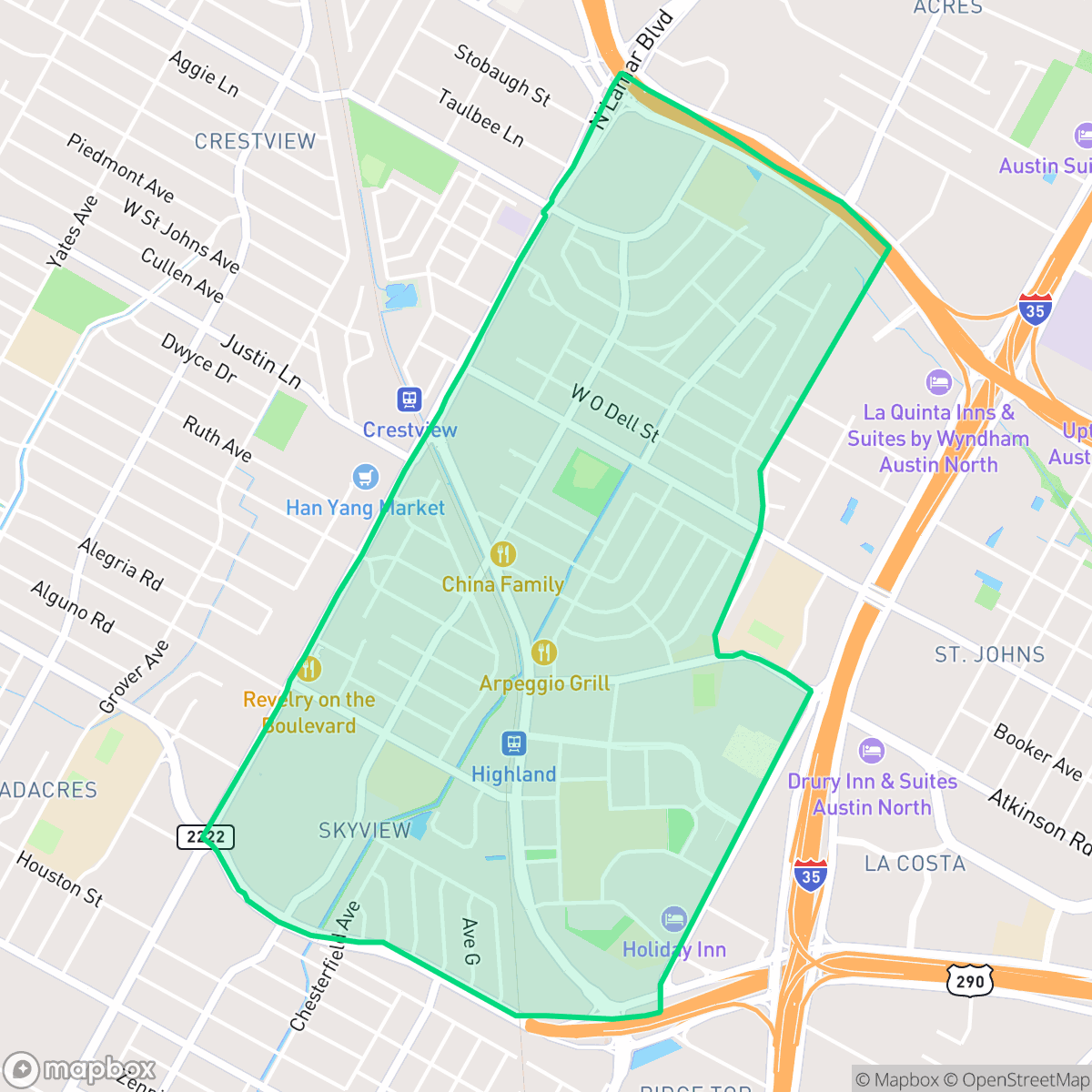
Highland is a north-central Austin neighborhood defined by a blend of mid-century residential tracts and modern educational hubs. It offers above-average walkability with a consistent sidewalk network, making it a functional choice for those seeking a balanced suburban lifestyle.
Key Highlights
About Highland
Located in north-central Austin, the Highland neighborhood is defined by a unique history of education, commerce, and community transformation. In the early 1900s, the area was home to the St. John’s Orphan Home, a school for African American children supported by the St. John Regular Baptist Association. After the orphanage closed, the surrounding farmland was developed into mid-century residential tracts during the 1950s and 1960s. In 1971, the site of the former orphanage became Highland Mall, Central Texas’s first enclosed shopping center. Following the mall’s closure in 2015, the property was revitalized through a public-private partnership into the Austin Community College (ACC) Highland Campus and the headquarters for Austin PBS. Today, the neighborhood’s history is preserved at the St. John’s Encampment Commons park, celebrating its deep educational and community roots.
The neighborhood functions as a blend of residential stability and institutional growth. Beyond the Austin Community College Highland Campus and Austin PBS, the area features a variety of housing options ranging from single-family homes to denser apartment complexes. Residents benefit from a reliable sidewalk grid that supports pedestrian activity, which is notably higher here than in many surrounding areas. Local dining options like Brazas Taco House and China Palace provide accessible social hubs, while the proximity to major highway corridors ensures connectivity to the wider Austin metropolitan region.
Living here involves certain trade-offs, particularly regarding acoustic comfort due to road traffic noise. While the area provides a calm atmosphere with access to green spaces like the St. John’s Encampment Commons, the proximity to commercial zones and highways influences the overall environment. According to iHuus data, the neighborhood is well-suited for those prioritizing educational access and a central location over complete seclusion. With a diverse range of public school options, including high-performing campuses like Cedars Academy, it remains a practical consideration for families and students alike.
Neighborhood Scores Across 15 Qualities
Residential spacing provides a moderate buffer between neighbors, though density is slightly higher than the Austin average. While many homes maintain consistent distance, the presence of high-density apartments can reduce privacy in certain sections of the area.
Pedestrian navigation is complicated by highway severance and inconsistent sidewalk coverage, making the area less walkable than much of Austin. While some residential grids offer quieter routes, connectivity remains below the city average according to iHuus data.
Standard tract housing and mid-range apartment complexes define the area's landscape. This visual variety provides a functional environment, though it is less lush than the Austin average.
Tree-lined streets and private yards offer adequate walking areas, but public park access and wide green verges are below the Austin average. According to iHuus data, most greenery in the area is contained within private residential lots.
Open land and wooded areas are frequently interspersed with residential blocks and commercial zones. This area feels less densely urbanized than the Austin average, according to iHuus data.
A mix of light industrial zones and residential streets creates a calm atmosphere that is slightly below the Austin average for urban energy. While diverse dining options are available throughout the area, many locations require car travel as walking access to services is limited in several blocks.
Frequent noise from nearby highways and railroad tracks characterizes this area. According to iHuus data, acoustic comfort in Highland is notably lower than the Austin average.
Air quality in this area fluctuates between acceptable and unhealthy levels, presenting occasional concerns for sensitive groups. According to iHuus data, these conditions are slightly below the Austin city average.
Residential life remains primarily uninterrupted by heavy industry, though some warehouse clusters and commercial yards introduce moderate levels of daytime traffic. This area contains more industrial activity than the Austin average, particularly near major highway corridors and commercial loading zones.
Health insurance enrollment among residents is notably higher than the Austin city average, according to iHuus data.
Voting patterns and census indicators reflect a predominantly liberal political leaning that is even more pronounced than the Austin average, according to iHuus data.
Residents live alongside a balanced mix of young professionals, families, and older adults, matching the typical age distribution found across Austin.
Flood safety levels in Highland are lower than the Austin average due to the lack of a detailed federal flood study for this area. Residents should exercise caution as the risk level remains undetermined by current FEMA assessments.
Address-Level Insights for Highland


iHuus Neighborhood Intelligence Insights
Get address-level neighborhood insights for Highland
- Street-level scores — see how individual blocks compare, not just neighborhood averages
- Micro-zone boundaries — identify quiet pockets, flood boundaries, and walkable clusters before you visit
- 15 dimensions in full — walkability, noise, air quality, school quality, insurance coverage, population age profile, urban/rural index, and more
- Boundary risk alerts — know if your address sits near a block boundary where scores drop, the kind of detail no listing will ever mention
- School insights — individual school ratings and insights, not just district-level data
- Compare before you commit — side-by-side data across neighborhoods, down to block precision
No credit card required
Compare with Any Neighborhood
| Dimension | Highland | Allandale |
|---|---|---|
| 🚶 Walkabilityavg 6.73 | ||
| 🔊 Acoustic Comfortavg 3.73 | ||
| 🤫 Privacy Indexavg 5.87 | ||
| 🎨 Visual Appealavg 6.95 | ||
| 🐕 Dog Friendlinessavg 6.92 | ||
| 🗺️ Urban-Rural Indexavg 7.09 | ||
| ✨ Neighborhood Vibeavg 4.91 | ||
| 🏥 Health Insurance Coverageavg 7.56 | ||
| 🌿 Air Qualityavg 5.17 | ||
| 🏭 Industrial Proximityavg 8.86 | ||
| 🌊 Flood Safetyavg 4.83 | ||
| 🗳️ Ideological Leanavg 9.13 | ||
| 👥 Population Age Profileavg 4.52 | ||
| 🔥 Fire Safety | ||
| 🏫 School Quality |
Highland Rankings
School Districts Serving Highland
School Insights for Highland
Below average outcomes; significant attendance and academic challenges.
School Insights
See what's really behind every school rating near Highland
- Individual school ratings — each school's own score with outcome context, not just a district average
- Enrollment & class size data — student-to-teacher ratio and how it compares to the state average
- Full demographics breakdown — ethnicity and gender composition for every school in the enrollment zone
- Every school in the district — all schools within the enrollment boundary ranked by rating, not just the closest one
- Grade levels & benchmarks — elementary through high school, with below/above state-average flags
No credit card required