Heritage Hills, Austin
Updated · 8,961 residents
Heritage Hills is a dense, suburban neighborhood in Northeast Austin characterized by a mix of mobile home parks, apartment complexes, and light industrial warehouses. While the area offers residents access to the expansive Gus Garcia District Park, it faces challenges with high traffic noise and limited privacy due to its high-density layout.
Key Highlights
About Heritage Hills
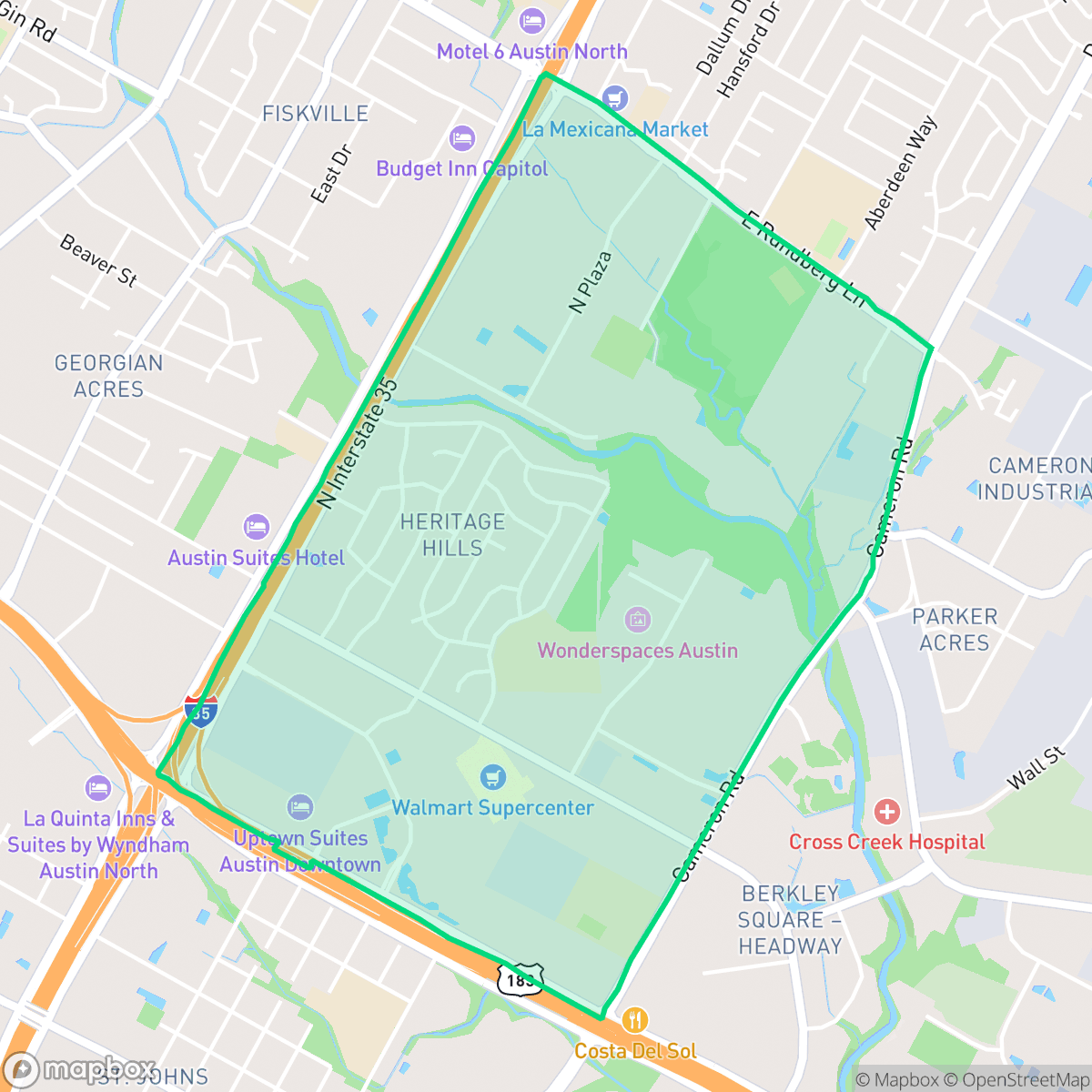
Located in Northeast Austin and bordered by Interstate 35 and U.S. Highway 183, the Heritage Hills neighborhood—also known as Woodbridge—was originally part of the 1870s settlement of Fiskville. Prior to the 1950s, the land was used primarily for farming and cattle grazing before transitioning into a residential community of single-story homes. The area remained largely unplanned and was not fully annexed by the City of Austin until December 2008. Today, a central hub of the neighborhood is the Gustavo “Gus” L. Garcia District Park and Recreation Center, which offers walking trails, sports facilities, and a community garden.
The area sits at the intersection of major transit corridors, including Interstate 35 and U.S. Highway 183. This location facilitates regional mobility but contributes to significant acoustic impacts from heavy road traffic. The built environment consists of a high-density mix of residential units, including mobile home parks and multi-family complexes, interspersed with active commercial and industrial zones. According to iHuus data, the community maintains a distinct urban-suburban blend that prioritizes proximity to major thoroughfares over quiet, low-density residential seclusion.
Prospective residents should note that the neighborhood presents a unique set of trade-offs regarding environmental quality and infrastructure. While the presence of the Gus Garcia District Park provides a valuable green space for outdoor recreation and pet owners, the area experiences lower air quality and higher noise levels compared to the Austin average. The housing stock is primarily geared toward those seeking high-density, accessible living options, though the lack of private yard space and the industrial nature of the surrounding landscape are important factors for potential residents to consider.
Neighborhood Scores Across 15 Qualities
Residential spacing is mixed, featuring both closely packed multi-family units and single-family homes with mature tree screening. This level of separation is slightly lower than the Austin average, according to iHuus data.
Fragmented sidewalk networks and major highway barriers make navigating the area on foot difficult. While some residential streets are quiet and accessible, the overall walkability falls below the Austin average due to disconnected paths and significant infrastructure gaps.
Uniform tract housing and apartment complexes define the landscape, which lacks the greenery and estate-style properties found more frequently across Austin. Most lots feature modest yards and standardized rooflines according to iHuus data.
Wooded greenbelts and tree-lined residential zones provide ample space for pet exercise, though the area lacks large public parks when compared to the Austin average. According to iHuus data, the presence of trails and yard space offers decent walking options away from traffic.
Open land and scattered homes amidst woodland characterize this area, providing a more semi-rural atmosphere than the more urbanized Austin average according to iHuus data.
Balanced pockets of suburban life and light industrial zones offer a moderate level of activity, sitting slightly above the Austin average. Residents can find diverse dining options and local landmarks, though the area remains largely car-dependent.
Frequent noise from nearby heavy transit infrastructure, such as major freeways or rail lines, makes this area significantly louder than the Austin average. According to iHuus data, residents may experience consistent acoustic disturbances throughout the day.
Frequent periods of unhealthy air quality pose a significant risk to sensitive groups. According to iHuus data, these levels are notably worse than the average seen across Austin.
Light commercial activity and warehouses are integrated into the residential landscape, resulting in notably lower industrial density than the Austin average. According to iHuus data, residents may experience moderate daytime traffic from nearby commercial hubs along the western corridors.
Health insurance coverage among residents is notably lower than the Austin average, according to iHuus data. This indicates a higher proportion of uninsured individuals living in the area compared to the rest of the city.
Voting patterns and census indicators reflect a deeply liberal political leaning that is even more pronounced than the Austin city average.
A balanced mix of young adults, families, and older residents characterizes this area. This demographic spread is slightly lower than the Austin average, according to iHuus data.
Flood risk is elevated in this area due to its location within a designated floodplain. According to iHuus data, this level of risk is higher than the average found throughout Austin.
Address-Level Insights for Heritage Hills


iHuus Neighborhood Intelligence Insights
Get address-level neighborhood insights for Heritage Hills
- Street-level scores — see how individual blocks compare, not just neighborhood averages
- Micro-zone boundaries — identify quiet pockets, flood boundaries, and walkable clusters before you visit
- 15 dimensions in full — walkability, noise, air quality, school quality, insurance coverage, population age profile, urban/rural index, and more
- Boundary risk alerts — know if your address sits near a block boundary where scores drop, the kind of detail no listing will ever mention
- School insights — individual school ratings and insights, not just district-level data
- Compare before you commit — side-by-side data across neighborhoods, down to block precision
No credit card required
Compare with Any Neighborhood
| Dimension | Heritage Hills | Allandale |
|---|---|---|
| 🚶 Walkabilityavg 6.73 | ||
| 🔊 Acoustic Comfortavg 3.73 | ||
| 🤫 Privacy Indexavg 5.87 | ||
| 🎨 Visual Appealavg 6.95 | ||
| 🐕 Dog Friendlinessavg 6.92 | ||
| 🗺️ Urban-Rural Indexavg 7.09 | ||
| ✨ Neighborhood Vibeavg 4.91 | ||
| 🏥 Health Insurance Coverageavg 7.56 | ||
| 🌿 Air Qualityavg 5.17 | ||
| 🏭 Industrial Proximityavg 8.86 | ||
| 🌊 Flood Safetyavg 4.83 | ||
| 🗳️ Ideological Leanavg 9.13 | ||
| 👥 Population Age Profileavg 4.52 | ||
| 🔥 Fire Safety | ||
| 🏫 School Quality |
Heritage Hills Rankings
School Districts Serving Heritage Hills
School Insights for Heritage Hills
Below average outcomes; significant attendance and academic challenges.
School Insights
See what's really behind every school rating near Heritage Hills
- Individual school ratings — each school's own score with outcome context, not just a district average
- Enrollment & class size data — student-to-teacher ratio and how it compares to the state average
- Full demographics breakdown — ethnicity and gender composition for every school in the enrollment zone
- Every school in the district — all schools within the enrollment boundary ranked by rating, not just the closest one
- Grade levels & benchmarks — elementary through high school, with below/above state-average flags
No credit card required