Hancock, Austin
Updated · 6,089 residents
Hancock is a north-central Austin neighborhood characterized by its historic architecture and high walkability. Residents benefit from excellent access to green spaces and local amenities, making it a notably dog-friendly area with a calm, suburban atmosphere.
Key Highlights
About Hancock
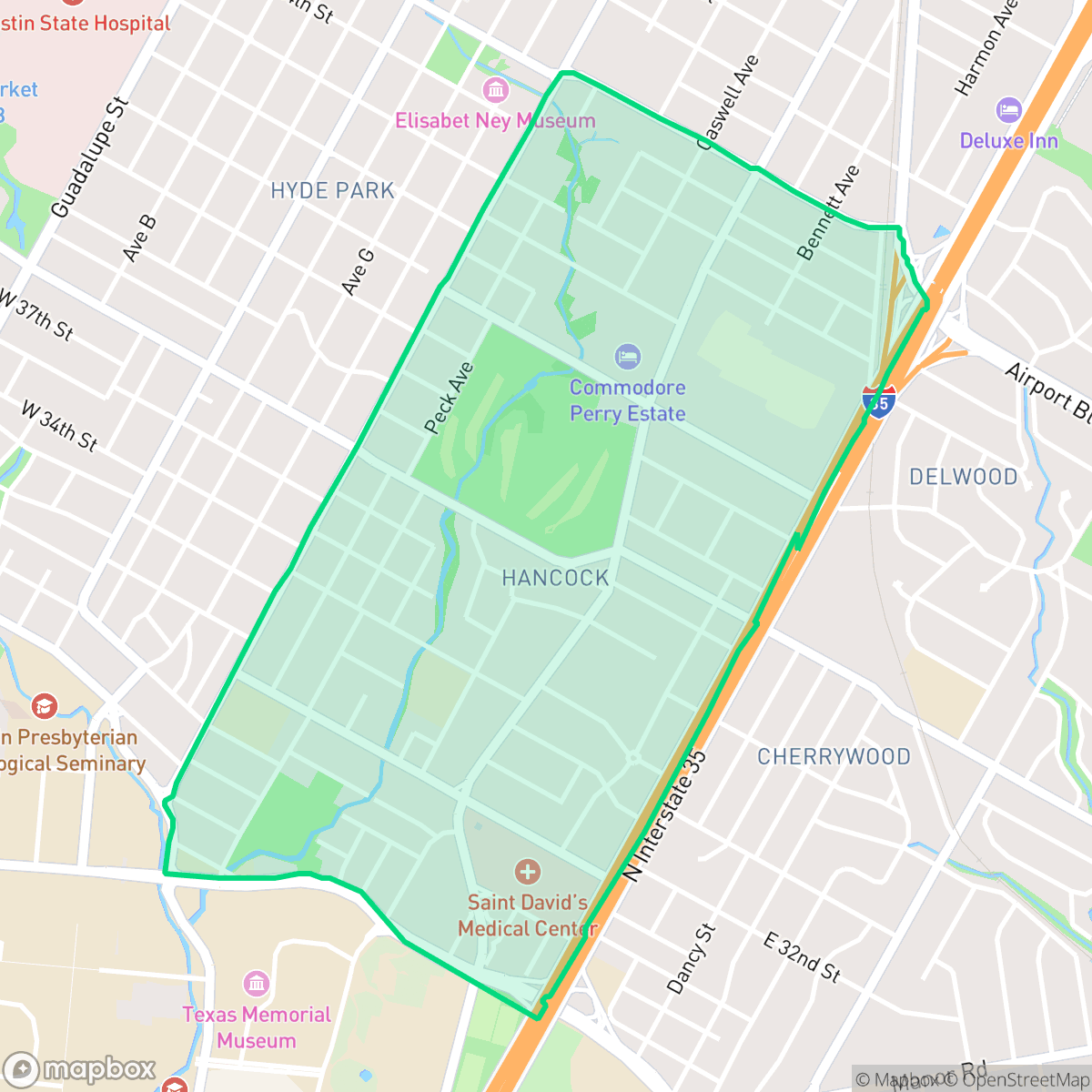
Located in north-central Austin, the historic Hancock neighborhood developed from 19th-century agricultural tracts into an upscale suburb. It is named after Lewis Hancock, a former Austin mayor who founded the Austin Country Club here in 1899. The club's original grounds now serve as the public Hancock Golf Course, one of the oldest in Texas. In 1963, the course's former 'back nine' holes were developed into Hancock Center, Austin's first shopping mall. Early notable residents included Alamo survivor Susanna Dickinson, writer J. Frank Dobie, and mayor Tom Miller. Architecturally, Hancock features a rich mix of early 20th-century Craftsman bungalows, Tudor Revivals, and historic estates. The neighborhood is also home to historic institutions like St. David’s Hospital, established in 1924.
The area features a grid-based street layout that supports high walkability, allowing residents to easily navigate between residential blocks and nearby retail hubs. According to iHuus data, the neighborhood provides a strong sense of community with mature tree canopies and accessible parks that contribute to its high dog-friendliness rating. The presence of major medical facilities and a variety of housing styles, ranging from early 20th-century bungalows to modern multi-family complexes, creates a diverse urban environment that maintains a quiet, residential feel.
While the neighborhood offers significant benefits, prospective residents should consider that it faces challenges related to flood safety and noise levels from surrounding road traffic. The area is served by the Austin Independent School District, which includes the highly rated Lee Elementary. With a population profile that trends older and high rates of health insurance coverage, the community is well-suited for those seeking a stable, established environment that balances suburban tranquility with urban convenience.
Neighborhood Scores Across 15 Qualities
Residential spacing varies between dense apartment complexes and detached homes with mature tree buffers. According to iHuus data, the level of separation between neighbors is roughly consistent with the Austin average.
Pedestrian accessibility is strong due to a well-defined street grid and a dense network of sidewalks that connect residential streets to nearby university facilities. Most trips can be completed on foot with ease, offering a level of walkability that is notably higher than the Austin average.
Expansive homes, significant tree canopy, and high-value institutional architecture provide a visual experience that is consistent with the Austin average. According to iHuus data, the area features a mix of upscale private amenities and well-maintained university infrastructure.
Abundant green spaces and a dense tree canopy provide ample walking areas for pets. This level of access to parks and shaded paths is higher than the Austin average, according to iHuus data.
Residential streets and green spaces are balanced with institutional blocks, offering a more suburban feel than the denser Austin average. According to iHuus data, the area transitions between single-family homes and larger apartment or campus structures.
A dense concentration of local dining, cafes, and cultural landmarks provides a much more active social atmosphere than the Austin average. Many residential blocks feature a balanced mix of green space and accessible leisure spots, according to iHuus data.
Continuous noise from nearby busy thoroughfares is a common feature here; however, acoustic comfort remains higher than the Austin average according to iHuus data.
Air quality levels in Hancock fluctuate between acceptable and unhealthy, which may cause occasional concern for sensitive groups. According to iHuus data, the air quality in this area is slightly better than the Austin city average.
Residential and institutional land use dominates the area with no detected warehouses or heavy industrial hazards. This lack of industrial proximity is even more pronounced than the Austin average according to iHuus data.
Health insurance coverage among residents is notably higher than the Austin average, according to iHuus data. This indicates a high level of-access to medical coverage within the community.
Voting patterns and census indicators show a deeply liberal political leaning that is even more pronounced than the Austin city average, according to iHuus data.
A varied demographic of young professionals, families, and seniors resides here, representing a slightly more skewed age distribution than the Austin average according to iHuus data.
Frequent flooding is a significant concern here because parts of the area sit within a designated floodplain. According to iHuus data, the risk of inundation in Hancock is notably higher than the Austin average, which often necessitates flood insurance for properties.
Address-Level Insights for Hancock


iHuus Neighborhood Intelligence Insights
Get address-level neighborhood insights for Hancock
- Street-level scores — see how individual blocks compare, not just neighborhood averages
- Micro-zone boundaries — identify quiet pockets, flood boundaries, and walkable clusters before you visit
- 15 dimensions in full — walkability, noise, air quality, school quality, insurance coverage, population age profile, urban/rural index, and more
- Boundary risk alerts — know if your address sits near a block boundary where scores drop, the kind of detail no listing will ever mention
- School insights — individual school ratings and insights, not just district-level data
- Compare before you commit — side-by-side data across neighborhoods, down to block precision
No credit card required
Compare with Any Neighborhood
| Dimension | Hancock | Allandale |
|---|---|---|
| 🚶 Walkabilityavg 6.73 | ||
| 🔊 Acoustic Comfortavg 3.73 | ||
| 🤫 Privacy Indexavg 5.87 | ||
| 🎨 Visual Appealavg 6.95 | ||
| 🐕 Dog Friendlinessavg 6.92 | ||
| 🗺️ Urban-Rural Indexavg 7.09 | ||
| ✨ Neighborhood Vibeavg 4.91 | ||
| 🏥 Health Insurance Coverageavg 7.56 | ||
| 🌿 Air Qualityavg 5.17 | ||
| 🏭 Industrial Proximityavg 8.86 | ||
| 🌊 Flood Safetyavg 4.83 | ||
| 🗳️ Ideological Leanavg 9.13 | ||
| 👥 Population Age Profileavg 4.52 | ||
| 🔥 Fire Safety | ||
| 🏫 School Quality |
Hancock Rankings
School Districts Serving Hancock
School Insights for Hancock
Below average outcomes; significant attendance and academic challenges.
School Insights
See what's really behind every school rating near Hancock
- Individual school ratings — each school's own score with outcome context, not just a district average
- Enrollment & class size data — student-to-teacher ratio and how it compares to the state average
- Full demographics breakdown — ethnicity and gender composition for every school in the enrollment zone
- Every school in the district — all schools within the enrollment boundary ranked by rating, not just the closest one
- Grade levels & benchmarks — elementary through high school, with below/above state-average flags
No credit card required